Why Aluminum Wiring Became a Residential Standard (And Why It Stopped)
Copper prices tripled between 1965 and 1973 due to global supply constraints and increased industrial demand. Builders and electricians turned to aluminum as a cost-effective alternative — it was lighter, cheaper, and approved by the National Electrical Code for residential use. Over two million homes were wired with aluminum branch circuits during this period, most of them in subdivisions built between 1965 and 1972.
The problem emerged slowly.
By the mid-1970s, fire investigators noticed a pattern: homes with aluminum wiring experienced more electrical fires originating at outlets, switches, and junction boxes. The Franklin Research Institute conducted a national survey for the CPSC and found that aluminum-wired homes were 55 times more likely to have connections reach "fire hazard conditions" than copper-wired homes.[1] That data prompted the CPSC to issue repair guidelines and recommend phasing out aluminum for branch circuits.
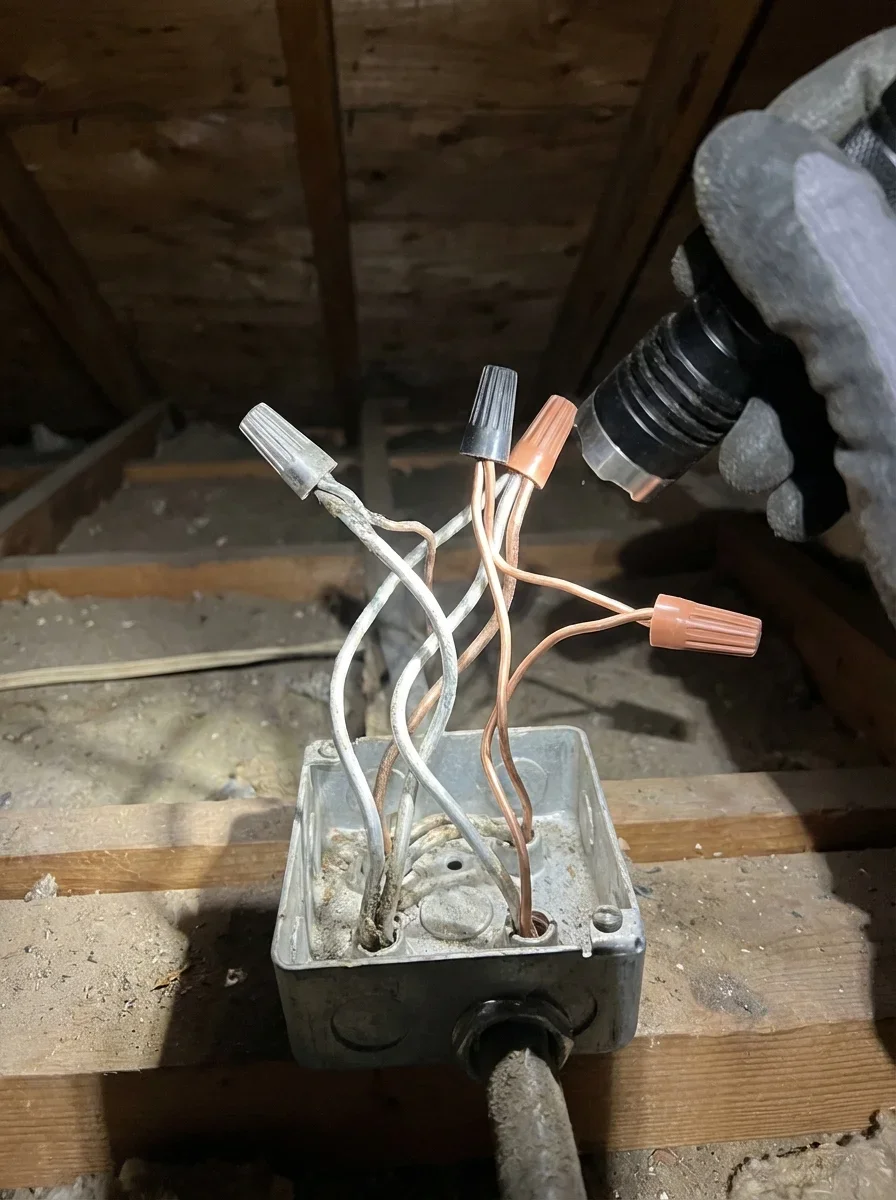
Here's what actually goes wrong. Aluminum has a higher coefficient of thermal expansion than copper, about 40% more, meaning it expands and contracts significantly with temperature changes.[5] In Phoenix's climate, where attic temps exceed 150°F in summer and outdoor-rated wire bakes under direct sun, that expansion is pronounced. Over thousands of heating and cooling cycles, connections can loosen. Loose connections create resistance, which generates heat, which loosens the connection further. A feedback loop that can eventually cause arcing or melting at the terminal.
Aluminum also forms a non-conductive oxide layer when exposed to air. Copper oxidizes too, but copper oxide still conducts electricity. Aluminum oxide doesn't. If that layer forms at a connection point and isn't properly disrupted with anti-oxidant compound or mechanical abrasion, you get increased resistance and heat buildup.
Devices rated "CO/ALR" (copper-aluminum revised) were developed to address these issues, but the CPSC later clarified that CO/ALR devices are only suitable for temporary emergency repairs, not permanent solutions.[2]
By 1972, most builders had switched back to copper for branch circuits as manufacturing processes improved and copper prices stabilized. Aluminum wiring is still legal and widely used for service entrance cables (the large conductors that run from the utility meter to your main panel), where the wire gauge is thick enough and connections are fewer and professionally torqued. But for the wiring that runs through your walls to outlets and fixtures, copper became the standard.
It still is.
Electrical Properties: Conductivity, Ampacity, and Wire Size Differences
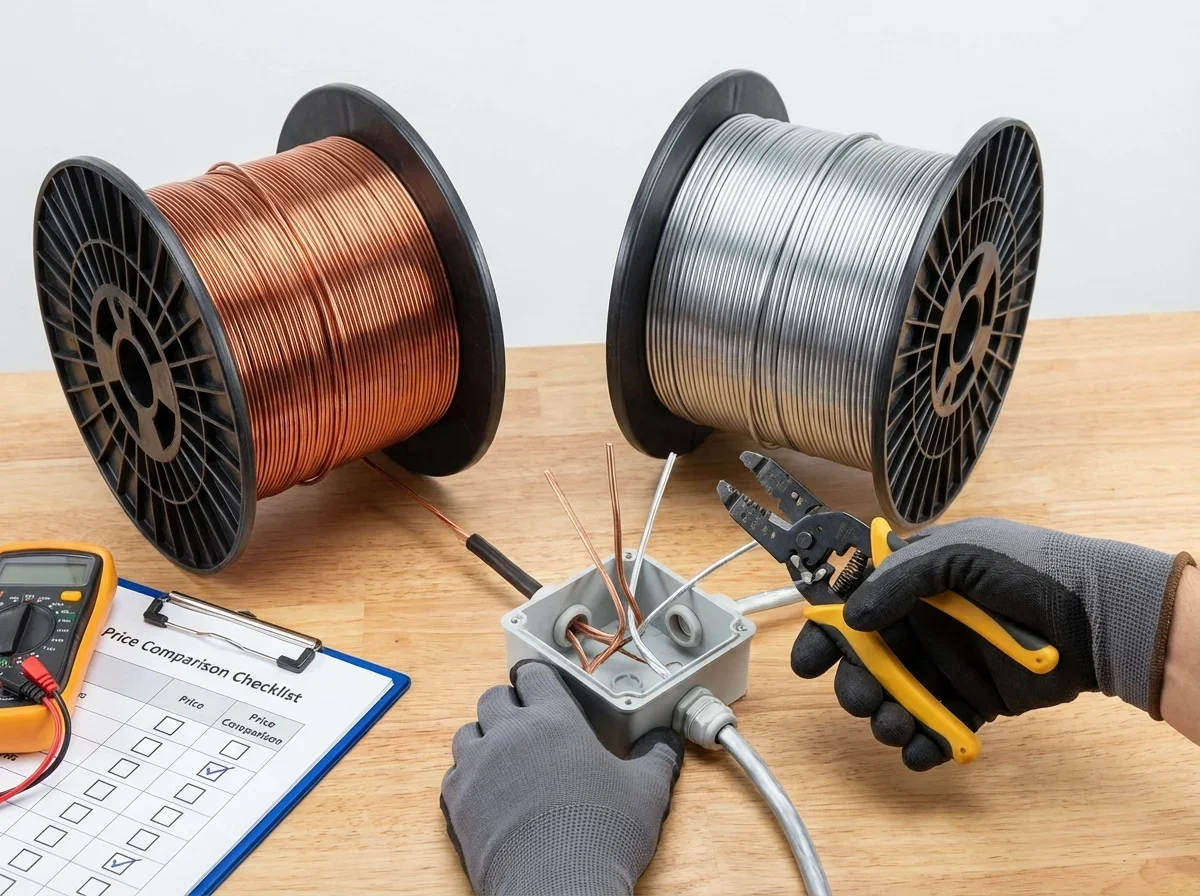
Copper has 100% IACS (International Annealed Copper Standard) conductivity. Aluminum sits at 61%.[4] To carry the same current with comparable resistance, aluminum conductors must be approximately 60% larger in cross-sectional area. That translates directly to wire gauge.
For a 20-amp circuit, copper uses 12 AWG wire. Aluminum requires 10 AWG. For a 15-amp circuit, copper uses 14 AWG; aluminum needs 12 AWG. The National Electrical Code (NEC) specifies these ampacity ratings in Article 310, which governs conductor sizing for both materials.[3] The larger aluminum wire takes up more space in conduit and junction boxes, which can complicate retrofits in homes with existing conduit runs.
Aluminum is significantly lighter than copper, roughly one-third the weight for equivalent current-carrying capacity. That's why utilities use aluminum for overhead transmission lines and service drops. When you're stringing wire across spans of 50+ feet, weight matters.
For residential branch circuits inside walls, that weight advantage is irrelevant.
The larger wire size also affects termination. Many standard residential devices (outlets, switches, breakers) are designed with terminal screws and wire holes sized for copper gauges. Using aluminum requires devices specifically rated for aluminum (marked "CO/ALR" or "AL9CU" for aluminum-copper compatibility) and proper torque specs to prevent loosening over time. If you connect aluminum wire to a device only rated for copper, you're creating exactly the scenario that led to the fire hazard statistics: dissimilar metals, improper clamping force, and oxidation at the interface.
| Property | Copper | Aluminum |
|---|---|---|
| Conductivity (IACS) | 100% | 61% |
| Wire Size (20-amp circuit) | 12 AWG | 10 AWG |
| Wire Size (15-amp circuit) | 14 AWG | 12 AWG |
| Thermal Expansion | Standard | 40-50% higher |
| Oxide Layer | Conductive | Non-conductive |
| Weight (equivalent capacity) | 3x heavier | 1x (baseline) |
| Typical Application | Branch circuits, outlets, fixtures | Service entrance, utility feeders |
Thermal Expansion and Connection Integrity
Aluminum's thermal expansion coefficient is roughly 50% higher than copper's. In practical terms: when a conductor heats up under load (which all conductors do), aluminum expands more. When it cools, it contracts more.
That mechanical cycling, repeated thousands of times over years, works terminal screws loose if they're not installed with the correct torque and anti-oxidant compound.
This effect is more pronounced in Arizona than in cooler climates. A circuit powering a window AC unit in a Phoenix bedroom cycles aggressively during summer: high current draw when the compressor kicks on, lower draw during fan-only mode, complete rest overnight. Attic-run wiring experiences ambient temps that swing 80°F between night and day during monsoon season. Aluminum wiring in those conditions is under constant mechanical stress.
Copper expands and contracts too, but the magnitude is smaller and the oxide layer remains conductive, so loose connections are less likely to escalate into fire hazards.
Pennsylvania State University's extension service notes that proper installation of aluminum wiring requires special connectors and anti-oxidant compounds specifically because of this expansion issue and the formation of non-conductive oxide layers.[5] NEMA guidelines emphasize the same point: aluminum can be installed safely, but it demands adherence to manufacturer torque specs and use of rated compounds and devices.[6]
The problem isn't the material. It's the installation quality and ongoing maintenance.
Cost Comparison: Material, Installation, and Long-Term Maintenance
Aluminum wire costs about 40-60% less per linear foot than copper wire of equivalent ampacity. For a 2,000-square-foot rewire in Phoenix, copper wire might run $2,500-$3,500 in material costs; aluminum would be $1,500-$2,200.
That's a meaningful difference, especially on large commercial projects where hundreds or thousands of feet of conductor are involved.
But material cost is only part of the equation. Labor is the same, or often higher for aluminum. Electricians must:
- Use larger conduit to accommodate the larger wire gauge, increasing conduit material costs
- Apply anti-oxidant compound to every termination
- Torque every connection to manufacturer spec (not field-judged "tight enough")
- Use CO/ALR-rated devices, which cost 20-30% more than standard copper-rated devices
- Spend additional time stripping and preparing wire (aluminum is softer and nicks more easily, requiring care to avoid weakening the conductor)
A licensed electrician working on an aluminum installation typically charges the same hourly rate but takes longer per connection. For residential work, that labor premium often offsets most of the material savings. ROC-licensed contractors in Phoenix report that aluminum branch circuit installations cost 10-20% less than copper overall, not the 40-60% material cost difference you'd expect.
For a standard rewire, that's maybe $800-$1,200 in savings on a $10,000-$15,000 project.
The long-term cost difference tilts further toward copper. Homes with aluminum wiring face higher homeowner's insurance premiums (often 20-40% more) or difficulty obtaining coverage at all, depending on the carrier. Some insurers require a professional inspection and certification before issuing a policy. Buyers are wary of aluminum wiring, which can reduce resale value or complicate financing. FHA and VA loan appraisals sometimes flag it as a deficiency requiring repair before closing.
Retrofit and Repair Costs
If you're buying a home with aluminum wiring, you have three options. The CPSC identifies three permanent repair methods:[2]
Complete replacement with copper cable. Full rewire. Costs $8,000-$20,000+ depending on home size and access. This is the gold standard and eliminates the issue permanently. In Phoenix, expect costs toward the higher end if the home is slab-on-grade with limited attic access or if you're dealing with block walls that require surface-mount conduit.
COPALUM crimp connector method. A specialized tool crimps a copper pigtail to the existing aluminum wire using a precisely engineered sleeve. The connection is permanent, rated, and eliminates the aluminum-to-device interface. Costs $30-$60 per connection. For a home with 50 outlets and switches, that's $1,500-$3,000. Only a few contractors in Arizona have the COPALUM tool (it's expensive and requires certification). This is the preferred retrofit if you're keeping the aluminum wire in place.
AlumiConn connector. A twist-on connector that bonds aluminum and copper wires in junction boxes. Costs $10-$20 per connection plus labor. Less expensive than COPALUM but requires accessible junction boxes. You can't use AlumiConn inside walls; every connection must be in an accessible box.
CO/ALR devices (outlets and switches) are not on the CPSC's list of permanent repairs. They're only for temporary emergency use. If your home inspector or electrician suggests "just swap out the outlets with CO/ALR-rated ones," they're not following CPSC guidance.
That's a band-aid, not a fix.
Aluminum Wiring Retrofit: Cost Breakdown
- Full copper replacement: $8,000-$20,000+ (permanent solution)
- COPALUM crimp method: $30-$60 per connection ($1,500-$3,000 for typical home)
- AlumiConn connector: $10-$20 per connection (requires accessible junction boxes)
- Professional inspection: $300-$600 (required by many insurers)
- Insurance premium increase: 20-40% higher for aluminum-wired homes
- Timeline: Full rewire takes 3-7 days; COPALUM retrofit typically 1-2 days
Safety: Fire Risk, Insurance, and Inspection Realities
The CPSC's 55-times statistic is based on connections reaching "fire hazard conditions," defined as temperatures sufficient to ignite surrounding materials or create visible arcing. That doesn't mean 55 times more actual fires. Many hazard conditions are caught during inspections or manifest as flickering lights, warm outlets, or tripped breakers before ignition occurs.
But the elevated risk is real and documented.
Fire risk concentrates at termination points: outlets, switches, breakers, and junction boxes. The wire itself, running through walls or conduit, is generally fine. It's where aluminum connects to something else that problems develop.
In Phoenix homes, the highest-risk areas are:
- Kitchen circuits (high load from appliances, frequent use)
- Garage outlets (power tools, shop equipment)
- AC disconnect and compressor circuits (heavy inductive loads, thermal cycling)
- Attic junction boxes (extreme heat, limited access for inspection)
Insurance companies know the statistics. Many carriers either decline coverage for homes with aluminum branch circuit wiring or require a licensed electrician's certification that the wiring has been inspected and properly retrofitted. That inspection typically costs $300-$600 and involves:
- Visual inspection of all accessible outlets, switches, and junction boxes
- Infrared thermal imaging to detect hot spots at connections
- Verification that devices are CO/ALR-rated or that COPALUM/AlumiConn retrofits have been completed
- Written report for the insurance underwriter
Some homeowners discover the aluminum wiring issue during a pre-sale inspection. Buyers often request a credit or require repairs as a condition of closing. Listing agents in Arizona report that aluminum wiring can reduce buyer interest and extend time-on-market, even if the system is functioning fine.
Perception matters.
If you're living in a home with aluminum wiring and choose not to retrofit immediately, the CPSC recommends regular inspections by a licensed electrician. At minimum every 3-5 years, more frequently if you notice any warning signs like warm outlets, flickering lights, or a burning smell near switches. Verify your electrician's ROC license at roc.az.gov before scheduling work.
Warning Signs of Aluminum Wiring Problems: Schedule immediate inspection if you notice warm or discolored outlet covers, flickering lights without obvious cause, a burning smell near switches or outlets, or breakers that trip repeatedly. These symptoms indicate connection deterioration that can escalate to fire hazard conditions. Don't wait for your scheduled inspection cycle — call a licensed electrician immediately.
When Aluminum Still Makes Sense: Service Entrance and Commercial Applications
Aluminum hasn't disappeared from electrical installations. It's still the dominant material for service entrance cables (the conductors from your meter to your main panel) and utility service drops.
Here's why:
Larger wire gauges. Service entrance cables are typically 2/0 AWG or larger. At those sizes, the aluminum-to-copper size ratio is less of an issue, and weight reduction becomes significant.
Fewer connections. There are only a handful of termination points: the meter, the main breaker, and possibly a sub-panel. Fewer connections mean fewer failure points.
Professional installation. Service entrance work is always performed by licensed electricians (not DIY), and the connections are torqued to spec, lugged properly, and inspected by the city or county.
For a 200-amp service in a Phoenix home, using aluminum service entrance cable saves $150-$300 in material costs with negligible added risk if installed correctly. The NEC allows it, utilities use it, and ROC-licensed electricians install it routinely.
In commercial settings, aluminum is common for feeder cables (large conductors running from the main panel to sub-panels or heavy equipment). A commercial kitchen, data center, or manufacturing facility might use aluminum feeders to save costs on long conduit runs where the wire gauge is large and the installation is performed by certified electricians with proper tooling.
For branch circuits feeding individual outlets or light fixtures, copper remains standard.
Service Entrance Cable in Arizona's Climate
Phoenix's intense UV exposure and thermal cycling affect all exposed wiring, but service entrance cable is typically protected. Most installations run through conduit (either PVC or rigid metal) from the meter to the panel, shielding the conductor from direct sun. Where cable is exposed (such as along the exterior wall from the weather head to the meter) it's usually jacketed SER (Service Entrance Round) or SEU (Service Entrance with Uninsulated neutral) cable with UV-resistant insulation.
Aluminum service entrance cable performs reliably in Arizona if installed per code.
The main panel connection is lubricated with anti-oxidant compound, torqued per manufacturer spec (typically 200-300 inch-pounds for large lugs), and re-inspected during any panel upgrade or service work. If you're upgrading from a 100-amp to a 200-amp service (common in older Phoenix homes adding pool equipment or EV chargers) your electrician will likely replace the service entrance cable regardless of material to meet the new ampacity requirement.
What Phoenix Electricians Actually Recommend for Residential Rewires
ROC-licensed electricians in the Phoenix metro are unanimous on one point: for branch circuit wiring in residential new construction or rewires, use copper.
The material cost premium is modest, the installation is faster, and the long-term reliability is proven. Homeowners don't worry about insurance issues, buyers don't balk at inspections, and you're not scheduling thermal imaging checkups every few years.
The decision tree shifts slightly if you're working with an existing aluminum-wired home. Full copper replacement is the permanent solution, but it's not always necessary if the existing wiring is in good condition and properly retrofitted. Top-rated contractors in Phoenix typically recommend:
If you're already opening walls for a remodel (kitchen, bathroom, room addition), replace the aluminum with copper in those areas. The walls are open anyway, so the labor delta is minimal. Run new dedicated circuits for high-load appliances while you're at it.
If the home inspection flags aluminum wiring but it's functioning fine, have a licensed electrician perform a detailed inspection, including thermal imaging. If connections are cool and devices are properly rated, consider the COPALUM retrofit rather than a full rewire. That addresses the fire risk at a fraction of the cost.
If you're experiencing symptoms (flickering lights, warm outlets, tripping breakers, burning smell), don't wait. Call for an electrical troubleshooting service immediately. These are exactly the warning signs that precede connection failure.
If you're planning to sell in the next 1-3 years, get ahead of the inspection issue. Either retrofit with COPALUM or replace the wiring. Disclosing the issue and providing documentation of professional repairs adds value; waiting for a buyer's inspector to flag it costs you leverage.
For homes built between 1965 and 1973 in Phoenix neighborhoods like Maryvale, Arcadia, or parts of Scottsdale, aluminum wiring is common. These homes are now 50+ years old, and many have already been partially rewired during kitchen or bathroom remodels.
If you're buying one of these properties, budget $1,500-$3,000 for a COPALUM retrofit or $10,000-$18,000 for a full whole house rewire, depending on square footage and access.
New Construction and Modern Installations
For new construction in Arizona, copper is non-negotiable for branch circuits. Builders use copper for all 120V and 240V circuits feeding outlets, lights, appliances, and HVAC equipment. Aluminum service entrance cable is common for the meter-to-panel run, but everything downstream is copper.
If you're adding circuits as part of a home improvement project (say, EV charger installation in the garage, pool electrical for a new spa, or a sub-panel for a detached casita) your electrician will run copper unless you're pulling heavy feeder cable over a long distance (100+ feet) to a sub-panel, in which case aluminum feeder with proper terminations might be cost-effective.
Some homeowners ask about mixing materials: using aluminum for some circuits and copper for others. Electricians advise against it for residential applications. The complexity of tracking which circuits are which, ensuring the right devices and termination methods are used, and avoiding mistakes during future work (by you or another contractor) outweighs any cost savings.
Consistency simplifies maintenance and reduces error risk.
Code, Licensing, and Professional Installation Requirements
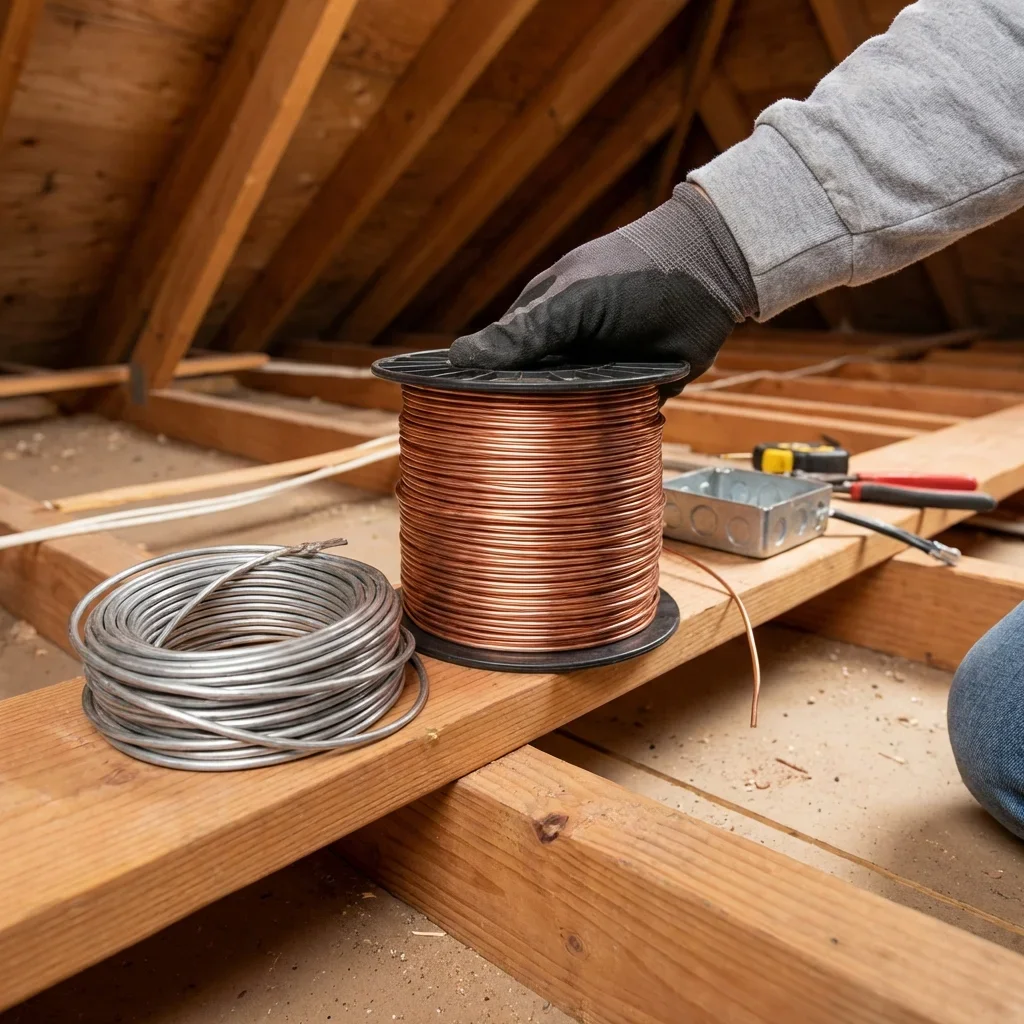
The National Electrical Code (NEC), published by the National Fire Protection Association (NFPA) and adopted by Arizona with state-specific amendments, governs conductor sizing, installation methods, and termination requirements for both copper and aluminum.[3]
The NEC doesn't ban aluminum wiring. It simply requires that installations follow specific rules:
- Wire must be sized per ampacity tables in Article 310, adjusted for conductor material
- Terminations must use devices and connectors rated for the conductor material
- Anti-oxidant compound must be applied to aluminum terminations
- Connections must be torqued per manufacturer specifications
- Aluminum wire in wet or corrosive locations requires additional protection
In Arizona, all electrical work over $1,000 in labor and materials requires a licensed contractor with an active ROC C-11 (residential electrical) or A-11 (commercial electrical) license. The electrician performing the work must be a licensed journeyman or master electrician. Verify licenses at roc.az.gov before hiring.
Permits are required for most electrical work, including rewires, panel upgrades, new circuits, and service entrance replacements. The permitting authority (city or county) inspects the work to verify code compliance.
Unpermitted electrical work can void your homeowner's insurance, complicate home sales, and create liability if something goes wrong. If a contractor suggests skipping the permit to save money, walk away.
NEMA Guidelines and Manufacturer Specifications
The National Electrical Manufacturers Association (NEMA) publishes guidelines for proper installation of copper and aluminum wiring. These guidelines emphasize termination techniques, use of rated devices, and application of anti-oxidant compounds to prevent connection failures.[6]
For aluminum, NEMA specifies:
- Use of devices marked "CO/ALR" or "AL9CU" for aluminum wire
- Application of anti-oxidant compound (typically zinc-based) to exposed aluminum conductor before termination
- Proper torque values for terminal screws and lugs (under-torquing allows loosening; over-torquing can damage the softer aluminum conductor)
- Avoidance of mixed-metal terminations unless using rated connectors designed for that purpose
Manufacturers like Ideal (makers of the AlumiConn connector) and AMP (makers of the COPALUM system) provide detailed installation instructions that become part of the code compliance requirement. A licensed electrician performing a COPALUM retrofit must follow the AMP installation manual exactly: the crimp tool pressure, conductor preparation, and inspection criteria are all specified.
Deviation from those instructions voids the listing and creates liability.
Making the Decision: What Matters for Your Home
If you're building new or doing a whole-house rewire, the choice is simple: use copper. The cost difference is small relative to the total project, and copper eliminates the insurance, resale, and long-term maintenance issues associated with aluminum.
If you're buying a home with aluminum wiring, don't panic. But don't ignore it. Have a licensed electrician inspect the system and provide a written report on its condition. Use that information to negotiate with the seller or budget for repairs.
A properly retrofitted aluminum-wired home is safe. An uninspected one is a gamble.
If you're living in a home with aluminum wiring, schedule an inspection if you haven't had one in the past 3-5 years. Look for warning signs: warm outlets, discolored switch plates, flickering lights, or a burning smell near electrical devices. Any of these symptoms warrants an immediate call to a licensed electrician for electrical troubleshooting.
Don't assume the problem will resolve itself. Connection failures escalate over time.
For service entrance cable and large feeder runs, aluminum is a legitimate cost-saving option if installed by a licensed professional following NEC and manufacturer guidelines. There's no reason to insist on copper for a 200-amp service drop or a feeder cable to a detached workshop. The application is appropriate, and the installation practices are well-established.
The bottom line: aluminum wiring isn't inherently bad, but it requires expertise, proper materials, and ongoing attention. Copper is the safer, simpler choice for most residential applications.
In a climate as demanding as Phoenix's (with extreme heat, UV exposure, and thermal cycling) the reliability advantage of copper justifies the cost for wiring that's meant to last 50+ years.
- U.S. Consumer Product Safety Commission (CPSC). "REPAIRING ALUMINUM WIRING." https://www.cpsc.gov/s3fs-public/516.pdf. Accessed April 07, 2026.
- U.S. Consumer Product Safety Commission (CPSC). "Aluminum Wiring." https://www.cpsc.gov/safety-education/safety-guides/home/aluminum-wiring. Accessed April 07, 2026.
- National Fire Protection Association (NFPA). "Article 310 Conductors for General Wiring." https://www.nfpa.org/codes-and-standards/all-codes-and-standards/list-of-codes-and-standards/detail?code=70. Accessed April 07, 2026.
- U.S. Department of Energy (DOE). "Electrical Conductor Material Comparison: Copper vs. Aluminum." https://www.energy.gov/oe/articles/electrical-conductor-material-comparison-copper-vs-aluminum. Accessed April 07, 2026.
- Pennsylvania State University Extension. "Copper vs. Aluminum Wiring in Residential Applications." https://extension.psu.edu/copper-vs-aluminum-wiring-in-residential-applications. Accessed April 07, 2026.
- National Electrical Manufacturers Association (NEMA). "Guidelines for Copper and Aluminum Electrical Wiring." https://www.nema.org/standards/view/guidelines-for-copper-and-aluminum-electrical-wiring. Accessed April 07, 2026.