What Level 1 and Level 2 Actually Mean
Level 1 charging uses your home's standard 120-volt outlet — the same outlet that powers your phone charger and coffee maker. The cable that came with your EV plugs directly into any grounded three-prong outlet in your garage, carport, or driveway. No electrician required.
Level 2 charging operates at 240 volts, the same voltage that powers your clothes dryer, electric water heater, or pool pump. It requires a dedicated circuit and a hardwired charging station (EVSE — Electric Vehicle Supply Equipment) installed by a licensed electrician.
The automotive engineering organization SAE International outlines three levels of EV charging, with Level 2 operating at 240 volts and typically at three to four times the amperage of Level 1, making it roughly six to eight times faster.[3]
Voltage and Amperage Differences
Level 1 chargers draw 12-16 amps at 120 volts, delivering 1.4-1.9 kW of power. Level 2 chargers typically draw 16-80 amps at 240 volts, delivering 3.8-19.2 kW. Most residential Level 2 installations in Phoenix use 40-50 amp circuits, providing 9.6-12 kW — enough to fully charge most EVs overnight.
Higher amperage means faster charging, but it also means your electrical panel needs the capacity to support it.
Many Phoenix homes built before 2000 have 100-150 amp panels that are already near capacity during summer when air conditioning runs continuously. Adding a 50-amp EV charger to a maxed-out panel requires a panel upgrade or strategic load management.
| Feature | Level 1 Charger | Level 2 Charger |
|---|---|---|
| Voltage | 120V (standard outlet) | 240V (dedicated circuit) |
| Amperage | 12-16 amps | 16-80 amps (typically 40-50) |
| Power Output | 1.4-1.9 kW | 3.8-19.2 kW (typically 9.6-12 kW) |
| Range Added/Hour | 2-5 miles | 20-30 miles |
| Installation Cost | $0 (uses existing outlet) | $1,000-$3,000 |
| Electrician Required | No | Yes |
Charging Speed: The Real-World Difference
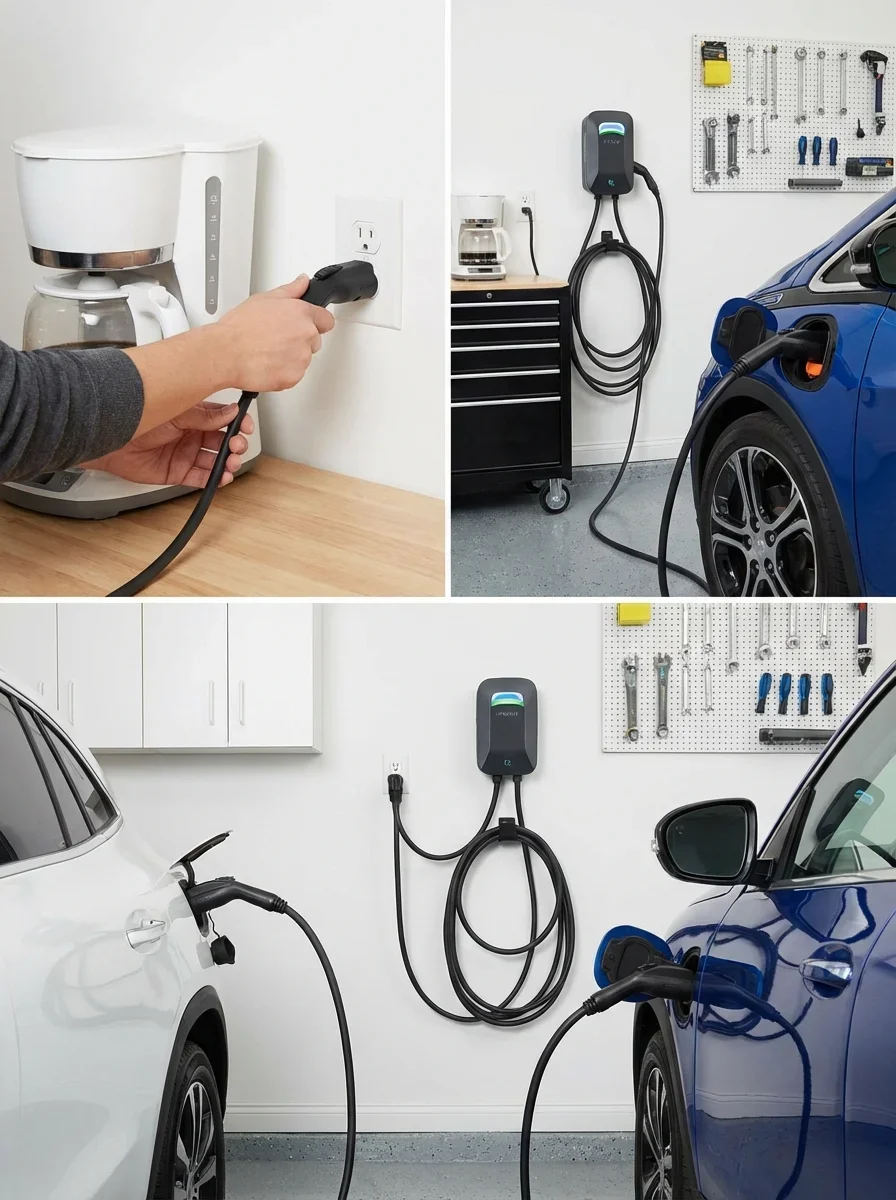
Level 1 chargers add 2-5 miles of range per hour of charging.[2] If you drive 40 miles to work and back, you'll need 8-20 hours plugged in just to recover that range. Level 1 chargers can take 40-50+ hours to charge a battery electric vehicle to 80 percent from empty, while Level 2 chargers can accomplish the same in 4-10 hours.[1]
Level 2 chargers add 20-30 miles of range per hour with standard residential installations.[2] That same 40-mile commute recovers in 2-3 hours. A completely depleted 60 kWh battery (typical for a Chevy Bolt or Nissan Leaf) recharges overnight on a 40-amp Level 2 circuit.
You plug in at 10 PM, and by 6 AM you're back to 100%.
How Phoenix Heat Affects Charging
Arizona's summer temperatures create two charging complications. First, EVs parked in direct sun can reach cabin temperatures of 150°F+, and battery thermal management systems draw power to cool the battery before accepting a charge. That pre-cooling can consume 1-2 kWh before charging even begins, effectively reducing your overnight range recovery by 4-8 miles on Level 1.
Second, charging generates heat. Level 1 charging at low amperage produces minimal heat, but Level 2 charging at 40+ amps can stress electrical connections and wiring if not properly installed.
Phoenix electricians who regularly install EV chargers — including ROC-licensed contractors like those in our directory — use oversized conductors and commercial-grade breakers specifically rated for continuous duty cycles to prevent voltage drop and connection overheating during summer.
Cold Weather Impact (Yes, Even in Arizona)
Phoenix winter lows drop to 40-45°F in December and January. EV batteries lose 20-40% of their range in cold weather because the battery management system heats the battery pack to maintain optimal temperature.
Level 1 charging often can't keep up with this phantom drain. You might plug in with 50% charge, and wake up with 55% after eight hours because most of the incoming power went to battery heating, not range recovery.
Level 2's higher power delivery overcomes this. Even with battery heating active, a 9.6 kW Level 2 charger delivers enough power to both maintain temperature and add meaningful range.
Installation Requirements and Costs
Level 1 installation cost is zero. You're using existing infrastructure — a standard outlet that's already code-compliant and grounded. The charging cable came with your vehicle.
Plug it in.
Level 2 installation in Phoenix typically costs $1,000-$3,000 depending on three factors: distance from your electrical panel to the charging location, whether your panel has available capacity, and whether you need a dedicated circuit installation or full panel upgrade.
What Level 2 Installation Actually Involves
A licensed Arizona electrician (verify at roc.az.gov) will first assess your electrical panel's available capacity. If you have a 200-amp panel with 40-50 amps of headroom, installation is straightforward: run 6-gauge or 4-gauge copper wire from the panel to the charging location, install a 40-50 amp double-pole breaker, mount the EVSE, and pull a permit for inspection.
If your panel is at capacity — common in Phoenix homes built in the 1980s and 1990s with 100-150 amp service — you have two options. Install a load management system that sheds power from lower-priority circuits (like your pool pump or water heater) when the EV charger is active, or upgrade to a 200-amp panel.
Panel upgrades run $2,500-$5,000 in Phoenix, depending on whether your utility service lateral (the line from the street transformer to your meter) can support 200 amps or also needs upgrading.
Permit and Code Compliance
All Level 2 EV charger installations in Phoenix, Scottsdale, Tempe, and surrounding cities require an electrical permit. The permit process ensures the installation meets National Electrical Code (NEC) Article 625 (EV charging equipment) and Arizona amendments. Unpermitted electrical work can void your homeowner's insurance, complicate future home sales, and create liability if a fire or electrocution occurs.
Reputable electricians pull permits as part of their service. If a contractor offers to skip the permit to save money, find someone else.
The ROC bond for electrical contractors in Arizona is only $4,000-$15,000 — not enough to cover a house fire caused by faulty wiring.
When Level 1 Is Enough
Level 1 works if you drive less than 30-40 miles per day and have consistent overnight parking. Plug-in hybrids (PHEVs) with 25-50 mile electric ranges — like the Toyota RAV4 Prime or Jeep Wrangler 4xe — can fully recharge on Level 1 in 5-10 hours. If you're commuting 15 miles to work, running errands, and parking in your garage every night, Level 1 keeps the battery topped off without any installation cost.
It's also ideal for second vehicles or low-mileage drivers. If your household has two EVs and one only drives 20 miles per week for grocery runs, Level 1 is plenty.
You're not racing to recover range. The car sits plugged in 6 days a week.
The Limitations Emerge Quickly
Level 1's weakness shows up the moment your routine changes. A weekend trip to Flagstaff or Sedona (120-160 miles round trip) can take three full days to recover on Level 1. If you return Sunday night and need the car Tuesday morning for a work trip, you're either not fully charged or scrambling to find a public fast charger.
Cold weather, hot weather, and increased daily mileage all erode Level 1's viability.
EV owners in Phoenix who start with daily commutes of 25 miles often find themselves driving 40-50 miles as they take advantage of the car's range — detours, side trips, avoiding freeways for surface streets. That mileage creep turns Level 1 from "adequate" to "constantly playing catch-up."
Level 1 Charging Is Right For You If:
- You drive less than 30-40 miles per day consistently
- You own a plug-in hybrid (PHEV) with 25-50 mile electric range
- You have guaranteed overnight parking for 8+ hours
- Your weekly driving patterns are highly predictable
- You're using it as a backup for a second vehicle
- You want zero installation costs
When Level 2 Becomes Necessary
You need Level 2 if you drive more than 40 miles per day, own a pure battery-electric vehicle (BEV) with 200+ mile range, or live in a multi-EV household. A Tesla Model 3, Ford Mustang Mach-E, or Hyundai Ioniq 5 has a 60-75 kWh battery. Draining that battery from a road trip or heavy driving week requires 40-50 hours on Level 1.
Level 2 brings it back to full in one night.
Homeowners who work from home but drive extensively on weekends — exploring Arizona's national parks, visiting family in Tucson or Flagstaff — benefit from Level 2's ability to recover range quickly. You leave Friday with 100%, return Sunday with 20%, plug in, and wake up Monday at 100% again.
Future-Proofing Your Home
Installing Level 2 now prepares your home for EV adoption trends. As of 2026, 15-20% of new car sales in Arizona are electric or plug-in hybrid. If you sell your home in five years, buyers increasingly expect EV charging infrastructure.
A professionally installed Level 2 charger adds value the same way smart home wiring or a whole house generator does. It's infrastructure the next owner doesn't have to retrofit.
Multi-EV households need Level 2. Two EVs sharing one Level 1 charger means one vehicle is always waiting. Two Level 2 chargers — or one Level 2 with load-sharing capability for sequential charging — keeps both vehicles ready.
Electrical Panel Capacity and Load Management
Phoenix homes built in the 1960s-1980s typically have 100-150 amp electrical panels. Summer peak loads in these homes — two central AC units, pool pump, electric water heater, dryer, and kitchen appliances — can hit 90-120 amps.
Adding a 50-amp EV charger on top of that exceeds panel capacity.
Load management systems solve this without a full panel upgrade. Devices like the Wallbox Pulsar Plus or Emporia smart chargers monitor your home's real-time electrical load and throttle EV charging when other high-draw appliances are active. If your dryer kicks on while your EV is charging, the charger temporarily reduces from 50 amps to 30 amps, then ramps back up when the dryer cycle ends.
When Panel Upgrades Are Worth It
If your home also needs other electrical work — adding a sub panel for a home addition, upgrading to support a heat pump water heater, or replacing an outdated Federal Pacific or Zinsco panel (common fire hazards in 1970s-era Phoenix homes) — combining those projects with an EV charger installation spreads the panel upgrade cost across multiple improvements.
A 200-amp panel provides headroom for future loads: a second EV, battery backup systems, or expanded air conditioning.
It's a 30-40 year investment in your home's electrical infrastructure.
Portability and Installation Flexibility
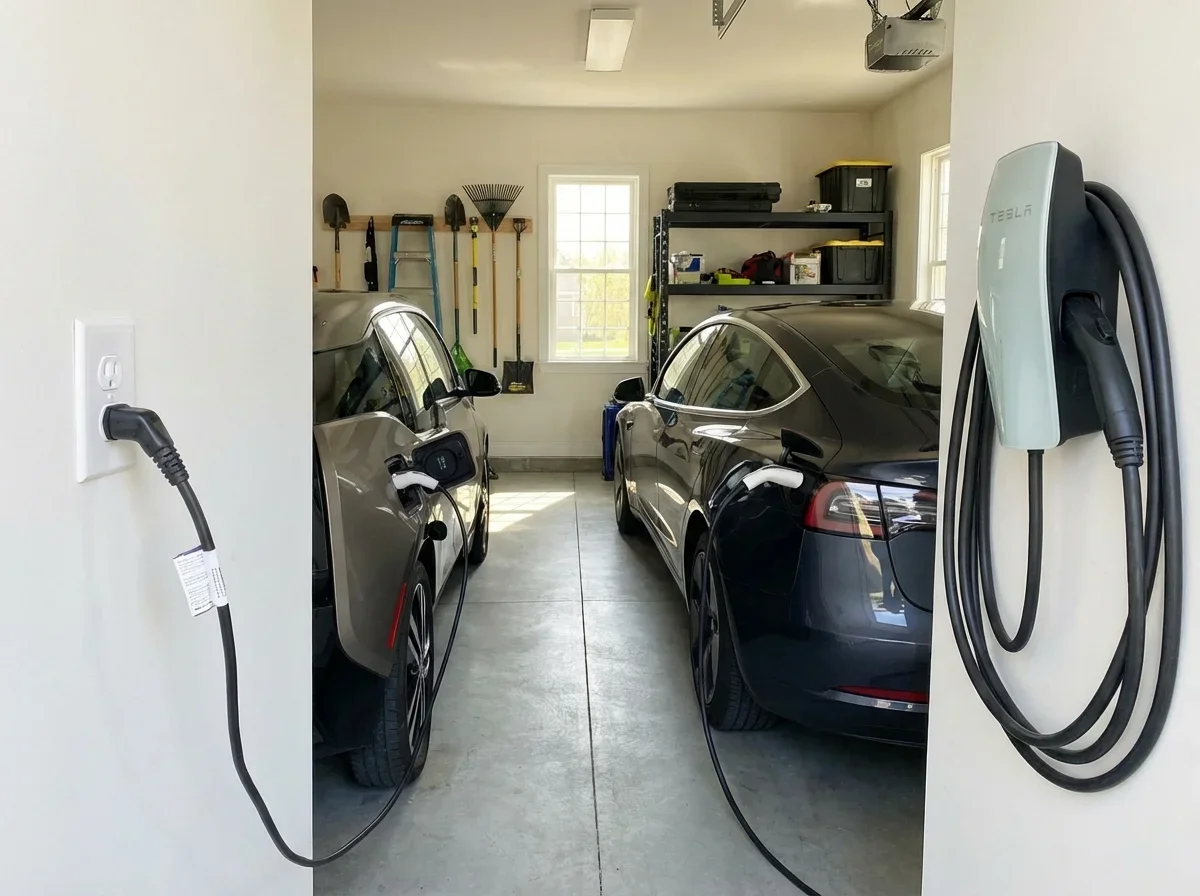
Level 1 chargers are portable. Unplug the cable, toss it in your trunk, and you can charge anywhere with a standard outlet — at a friend's house, an Airbnb, a campsite with RV hookups. That flexibility matters if you rent, travel frequently, or split time between multiple properties.
Level 2 chargers are hardwired and location-specific. Once installed in your garage, moving it requires an electrician to disconnect, relocate, and re-permit.
Some Level 2 units (like Tesla's Mobile Connector with a NEMA 14-50 adapter) use plug-in connections instead of hardwiring, offering a middle ground — faster than Level 1, more portable than hardwired Level 2, but still requiring a 240-volt outlet installation.
Cost Comparison: 5-Year Ownership
Level 1's zero installation cost is its only financial advantage. Over five years, the opportunity cost compounds. If you need 8 hours to recover 40 miles of range, but you drove 60 miles, your battery depletes 20 miles per day. Over weeks, that forces you to use public fast charging ($0.40-$0.60/kWh in Phoenix) to stay topped off, erasing the savings from avoiding Level 2 installation.
Level 2's upfront cost ($1,500-$3,000 installed) pays for itself through convenience and efficiency. Charging overnight during off-peak hours on Arizona Public Service's (APS) EV rate plan costs $0.06-$0.10/kWh — significantly cheaper than daytime rates or public charging.
A Phoenix homeowner driving 12,000 miles per year (1,000 miles/month) at 3.5 miles/kWh uses roughly 285 kWh monthly. At $0.08/kWh off-peak, that's $23/month. Public fast charging for the same miles would cost $115-$170.
Incentives and Rebates
Arizona does not currently offer statewide EV charger rebates, but the federal Alternative Fuel Vehicle Refueling Property Credit (IRS Form 8911) provides up to 30% of installation costs (capped at $1,000 for residential) through 2032. Some Phoenix-area utilities offer time-of-use rate plans specifically for EV owners, reducing overnight charging costs by 40-60% compared to standard rates.
Verify current incentives at Transportation.gov before installation.
Pro Tip: Phoenix homeowners can save $15-$30 monthly by combining Level 2 charging with APS or SRP time-of-use EV rate plans. Schedule charging between midnight and 6 AM when rates drop to $0.06-$0.08/kWh — a 60% discount compared to peak hours. Most smart chargers automate this scheduling, so you never pay premium rates.
What the Data Says About Charging Habits
In February 2023, the Federal Highway Administration (FHWA) unveiled new national standards for federally funded EV chargers, establishing minimum technical standards including required charging ports, connector types, power levels, and interoperability requirements.[4] While those standards target public infrastructure, they reflect broader trends: faster charging is becoming baseline, and Level 1 is increasingly relegated to backup or trickle charging for low-mileage scenarios.
Real-world usage shows most EV owners who start with Level 1 upgrade to Level 2 within the first year once they experience the limitations firsthand.
The tipping point comes during the first road trip or the first week of unexpectedly high mileage — when Level 1 can't recover range fast enough to maintain driving flexibility.
Choosing Based on Your Driving Profile
If you drive under 30 miles per day, park overnight consistently, and own a PHEV: Level 1 works. You'll recover your daily usage every night without installation costs.
If you drive 40-80 miles per day, own a BEV, or experience variable weekly mileage: Level 2 is necessary. The installation cost is offset by convenience, faster range recovery, and the ability to handle atypical driving weeks without range anxiety.
If you drive over 80 miles per day or run a rideshare/delivery business: Level 2 at maximum residential power (60-80 amps, 14-19 kW) becomes critical, or you'll rely heavily on public fast charging.
Installation Process and Timeline
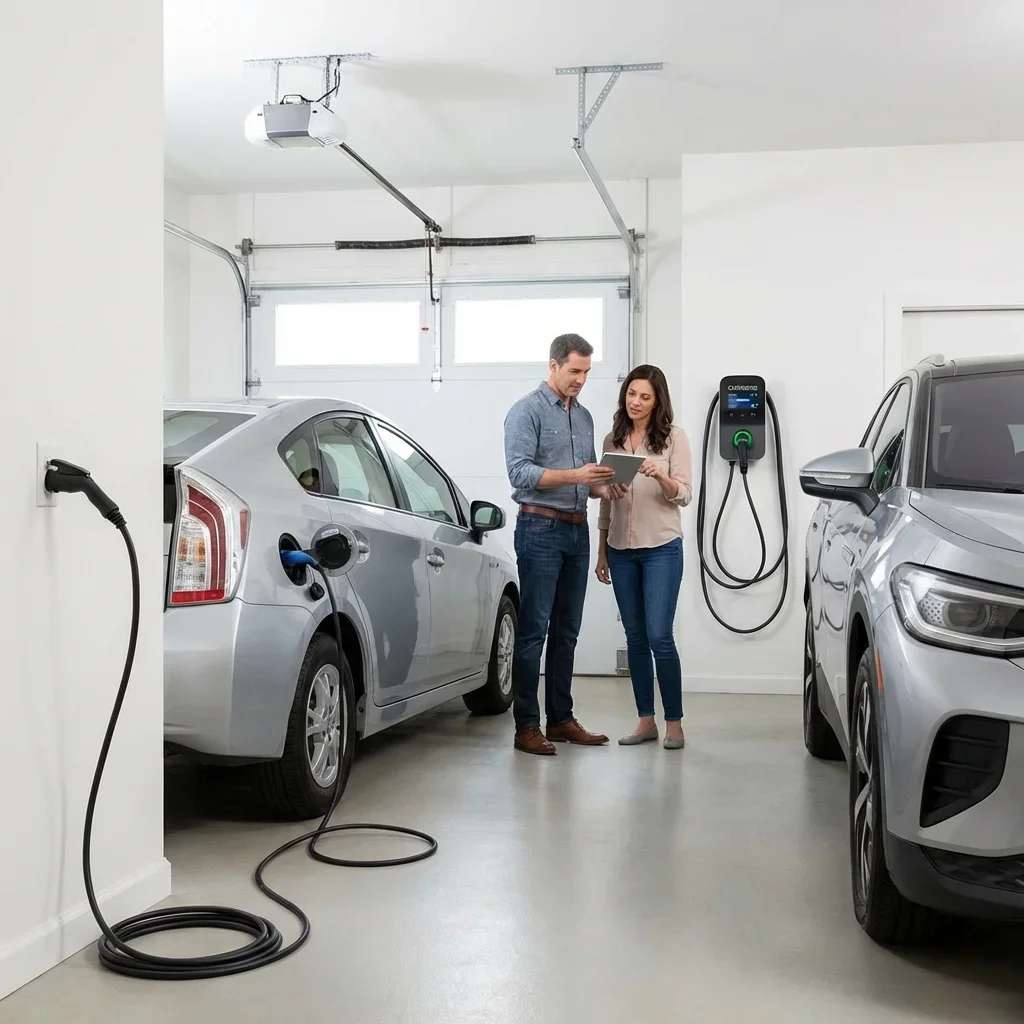
Level 1: Plug in the cable. Done.
Level 2 requires planning. Schedule a site assessment with a licensed Phoenix electrician who specializes in EV charger installation. They'll verify panel capacity, measure conduit runs, confirm grounding, and provide a detailed estimate.
Typical timeline from estimate to completed installation: 1-3 weeks, depending on permit processing and electrician availability.
If a panel upgrade is needed, add 2-4 weeks for utility coordination. APS and SRP (the two major Phoenix-area utilities) need to approve service upgrades and sometimes replace the meter or service lateral. The electrician coordinates this, but it's not instant.
Choosing the Right EVSE
Level 2 chargers range from basic 32-amp units ($400-$600) to smart chargers with Wi-Fi connectivity, load management, and scheduling ($800-$1,500). For Phoenix homeowners, key features to consider:
- Continuous duty rating: Arizona heat stresses electrical components. Choose chargers rated for 50°C ambient temperatures.
- Cable length: Phoenix garages often have driveways or carports where you'll park. A 25-foot cable provides flexibility.
- Smart features: Scheduling midnight-6AM charging on off-peak rates saves $15-$30/month. Wi-Fi-connected chargers like ChargePoint Home Flex or Emporia make this automatic.
- Compatibility: J1772 connectors work with all non-Tesla EVs. Tesla vehicles need an adapter for J1772, or you can install a Tesla Wall Connector.
Your electrician can recommend models based on your vehicle, panel capacity, and budget.
Avoid buying a charger before consulting the electrician. You might purchase a 60-amp unit only to discover your panel can only support 40 amps.
Common Installation Challenges in Phoenix Homes
Slab-on-grade construction means all wiring runs through the attic or exterior conduit. If your electrical panel is on one side of the house and your garage is on the opposite side, conduit runs can exceed 100 feet, increasing material and labor costs. Surface-mounted conduit along exterior stucco walls is code-compliant but visually prominent — discuss routing options with your electrician.
Caliche soil doesn't affect EV charger installation directly, but if you need a panel upgrade that requires trenching for a new service lateral, expect excavation costs 2-3x higher than homes in non-caliche regions.
Older panels (Federal Pacific, Zinsco, Challenger) are fire hazards and shouldn't support new high-amperage loads. If your home has one of these panels, factor in a full panel replacement ($2,000-$4,000) before adding an EV charger.
This isn't optional. It's a safety requirement.
Maintenance and Longevity
Level 1 chargers have no moving parts, no hardwired connections, and minimal heat generation. Maintenance is zero. The cable lasts 10-15 years unless physically damaged.
Level 2 chargers installed by licensed electricians with proper continuous-duty components require minimal maintenance. Inspect the charging cable quarterly for cracks or exposed wiring (UV exposure from desert sun accelerates insulation degradation if the cable is stored outdoors). If your charger has an LCD screen or connectivity features, firmware updates keep it compatible with newer EV models.
Annual inspections by the same electrician who installed the unit — combined with broader electrical wiring inspections every 3-5 years — catch issues before they become hazards.
Loose connections, corrosion from monsoon humidity, or breaker wear show up early during inspection.
The Real Homeowner Experience
Phoenix EV owners who've lived on Level 1 for years describe it as "fine until it's not." A retired couple in Chandler with a Nissan Leaf and 15-mile daily grocery runs used Level 1 happily for three years. Their needs aligned perfectly with Level 1's capabilities — low mileage, predictable schedule, overnight parking.
Contrast that with a Tempe family who bought a Ford Mustang Mach-E, started with Level 1, and upgraded to Level 2 within six weeks. Two working parents, kids in East Valley sports leagues, weekend hiking trips to Sedona — they were driving 60-80 miles some days and couldn't recover range fast enough.
Level 1 turned their EV into a source of stress rather than convenience.
The pattern is consistent: Level 1 works until your driving exceeds its recovery rate, then it becomes a constraint you think about daily.
- US Department of Transportation. "Charger Types and Speeds." https://www.transportation.gov/rural/ev/toolkit/ev-basics/charging-speeds. Accessed April 07, 2026.
- San Francisco Public Utilities Commission. "Electric Vehicle Charging Level Options and Considerations." https://www.sfpuc.gov/sites/default/files/EV%20Charging%20Level%20Options%20and%20Considerations.pdf. Accessed April 07, 2026.
- SAE International (referenced). "EV Charging Levels Explained for the New or Future EV Owner." https://www.caranddriver.com/features/a70141873/ev-charging-levels-explained/. Accessed April 07, 2026.
- Federal Highway Administration (FHWA). "EV Charging Minimum Standards Rule." https://www.transportation.gov/rural/ev/toolkit/ev-basics/charging-speeds. Accessed April 07, 2026.