When Panel Repair Makes Sense
Panel repairs work when you're fixing a specific component failure, not addressing a systemic problem. A single worn breaker costs $150-$400 to replace. A corroded neutral bus bar can sometimes be cleaned and re-terminated for $300-$600 if the corrosion hasn't spread throughout the enclosure.
You're a good candidate for repair if your panel is less than 20 years old, manufactured by a current reputable brand (Square D, Eaton, Siemens), and the problem is isolated. A tripping breaker that serves one circuit, a loose wire connection causing flickering in a single room, or physical damage from a surge that affected just one breaker — these point to repair, not replacement.
Phoenix contractors see plenty of repairable panel issues that homeowners mistake for replacement scenarios. A GFCI breaker that won't reset after a monsoon storm usually just needs replacement, not a new panel. Same for a main breaker that's chattering under load but hasn't failed yet. ROC-licensed electricians can swap these components in 1-2 hours, and the existing panel continues serving the home safely.
The calculation changes when multiple breakers are failing, when you find heat damage on the bus bars, or when the panel enclosure itself shows rust penetration.
These signal deeper problems that component swaps won't solve.
What Gets Repaired vs What Requires Replacement
Individual breakers wear out from normal use. Breakers are mechanical devices with spring-loaded contacts that arc slightly every time they interrupt a circuit. After 20-30 years of cycles, they lose their trip calibration.
Replacing a 20-amp breaker costs $80-$150 in parts and labor. Replacing three or four breakers in a single visit starts looking expensive relative to panel replacement, but it's still repair territory if the panel itself is sound.
Wire terminations loosen over time, especially in Arizona where temperature cycling expands and contracts metal. A loose wire at a breaker terminal creates resistance, which generates heat, which oxidizes the connection, which increases resistance further. Electricians can re-terminate these connections, apply anti-oxidant compound, and torque them to spec for $200-$400 per affected circuit.
This works if the damage is limited to a few connections and the bus bars aren't compromised.
But here's what can't be repaired: cracked or corroded bus bars, heat-damaged panel interiors, panels with recalled or obsolete breaker types that are no longer manufactured. Federal Pacific, Zinsco, and Challenger panels fall into this category. If a breaker fails, replacement breakers either don't exist or are pulled from salvaged panels. Every Arizona ROC-licensed electrician will tell you the same thing: these get replaced, not repaired.
| Repair Scenario | Cost | Timeline | When It Makes Sense |
|---|---|---|---|
| Single breaker replacement | $150-$250 | 1-2 hours | Isolated circuit failure, panel <20 years old |
| Wire re-termination (3-4 circuits) | $300-$500 | 2-3 hours | Loose connections, no bus bar damage |
| Corroded neutral bus bar | $400-$800 | 3-4 hours | Early-stage corrosion, enclosure still intact |
| Full panel replacement | $2,800-$4,200 | 6-10 hours | Multiple failures, obsolete panels, undersized capacity |
Signs Your Panel Needs Full Replacement
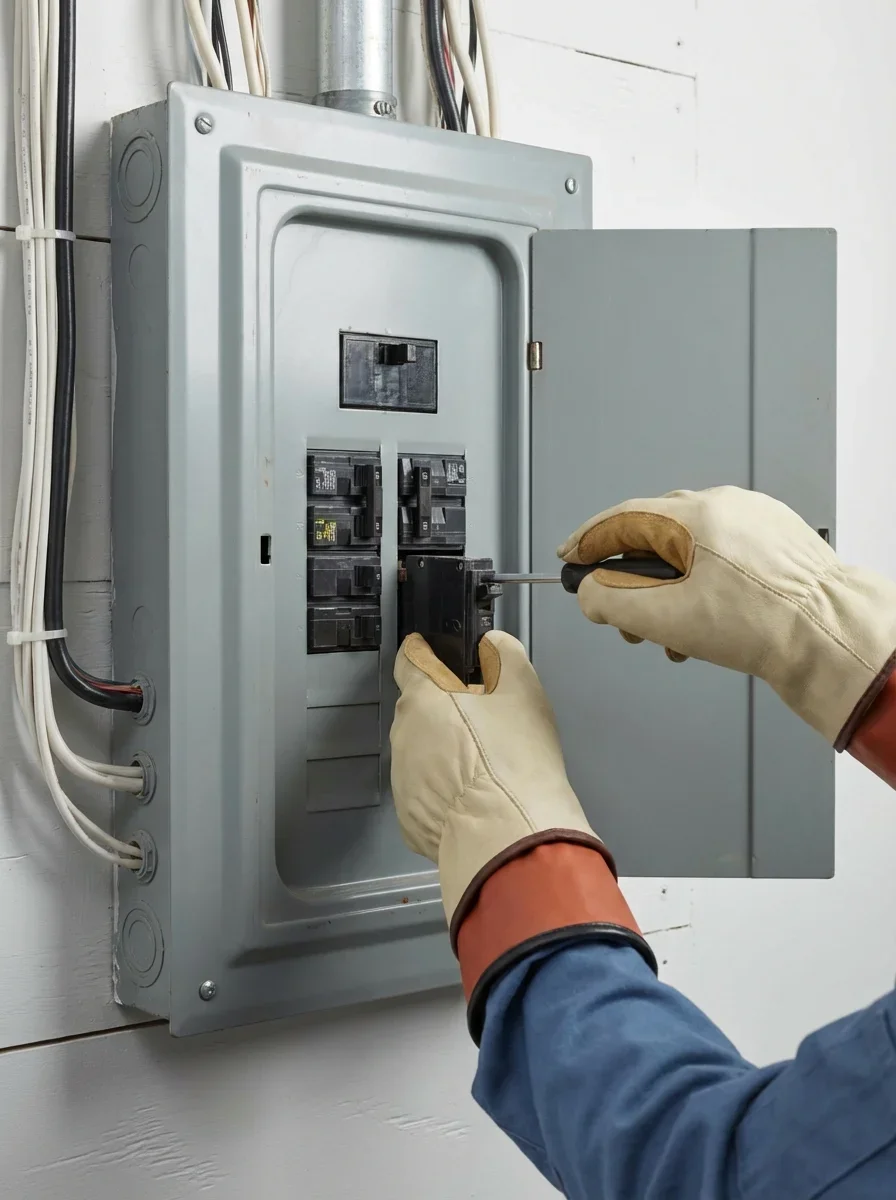
You need a replacement, not a repair, when the panel itself is the problem — not just the components inside it. Age is the first clue. Panels installed before 1990 in Phoenix homes were sized for 100-150 amps, which barely covers modern baseline loads once you add AC, pool equipment, and EV charger installation.
Physical signs tell the story your panel can't. Rust staining around the enclosure means moisture has penetrated the box, and moisture plus electricity equals corrosion on bus bars and breaker contacts. Phoenix doesn't get much rain, but monsoon storms plus poorly sealed conduit penetrations allow water intrusion.
Once corrosion reaches the main bus, repair isn't viable. The oxidation spreads, creating hot spots that accelerate failure of every component downstream.
Heat damage shows as discoloration: yellowed or browned plastic on breaker housings, scorch marks on the panel interior, or a persistent burning smell when the panel is under load. Arizona's 110°F+ summer days mean panels in non-conditioned spaces (garages, exterior installations) run hotter than code calculations assume. A panel that's been overheating for years has compromised insulation, weakened bus bar connections, and breakers that no longer trip at their rated amperage.
Breaker availability is a replacement trigger most homeowners don't see coming. If your panel takes breakers that are no longer manufactured, you're done. Federal Pacific Stab-Lok panels haven't had code-compliant breakers available for decades. Electricians pull breakers from salvage panels to keep these systems limping along, but every ROC contractor will tell you it's a temporary fix before replacement.
How to Tell if Your Panel is Undersized
Count your circuits and compare them to available spaces. If you have no room to add circuits for that kitchen remodel or sub panel installation for a workshop, the panel is functionally obsolete even if it's mechanically sound.
Most 100-amp panels in Phoenix homes have 16-24 circuit spaces. That covered a 1980s home with minimal plug loads, but it doesn't cover a 2026 household with AC, electric dryers, pool pumps, multiple refrigerators, and car chargers.
Calculate your total load if you want hard numbers. Add up the amperage of every major appliance: central AC (25-30A), electric range (40-50A), electric dryer (30A), water heater (20-30A), pool pump (15-20A), EV charger (40-50A for Level 2). If that total approaches 80% of your panel's rating, you're undersized. Electrical code allows panels to run at 80% continuous load, but Phoenix summer conditions mean you hit that number for 10-12 hours a day in July.
Homes built before 2000 in the Phoenix metro typically have 100-150 amp service. That was adequate when air conditioning was the largest load. Add a Level 2 EV charger and a pool, and you're either tripping the main breaker or forcing the panel to carry loads beyond its thermal design.
Electricians see this constantly in Tempe, Gilbert, and Chandler neighborhoods where original panels from the 1980s are still in service.
Visual Warning Signs That Demand Immediate Panel Replacement:
- Rust stains or water damage around the panel enclosure
- Scorch marks or discolored plastic on breakers
- Persistent burning smell when circuits are under load
- Multiple breakers failing within 6-12 months
- No available spaces for new circuits
- Panel brands: Federal Pacific, Zinsco, or Challenger
- Breakers that feel hot to the touch during normal operation
Cost Comparison: Repair vs Replacement in Phoenix
Panel repairs in the Phoenix metro run $150-$800 depending on scope. Replacing a single breaker costs $150-$250. Re-terminating loose connections on 3-4 circuits runs $300-$500. Replacing a corroded neutral bus bar (if the panel is otherwise intact) costs $400-$800.
These jobs take 1-3 hours, and you're back in service the same day.
Full panel replacement in Phoenix averages $2,800-$4,200 for a 200-amp upgrade in a standard garage installation. That includes the panel, breakers, labor, permit fees, and ROC-required inspection. Prices climb to $5,000-$7,000 if the utility requires a meter base upgrade or if the main service entrance cable needs replacement. Exterior panel relocations or installations requiring trenching through caliche soil can hit $8,000+ due to excavation costs.
The math gets interesting when you compare multiple repairs to a single replacement. If you're looking at $600 to fix a current issue and your electrician tells you the panel will need another $500-$800 in repairs within 2-3 years, replacement makes financial sense.
You're also comparing the cost of downtime. A failed panel means no power until it's fixed, and emergency repair rates run 1.5-2x normal pricing.
What Drives Replacement Costs Higher
Service entrance upgrades add $1,200-$2,500 to panel replacement costs. If your existing service is 100 amps and you're upgrading to 200 amps, the utility (APS, SRP) may require a new meter base and service entrance conductors sized for the higher capacity.
Arizona's hard desert soil and caliche layers make trenching expensive if the service entrance runs underground.
Permit and inspection fees in Phoenix-area jurisdictions run $150-$300. Every ROC-licensed contractor pulling a panel replacement permit knows this cost is non-negotiable. Arizona's electrical code compliance and permit services requirements mandate inspections for service equipment changes. Unpermitted panel work voids homeowner insurance and creates liability issues during home sales.
Panel location affects pricing. A garage panel on an exterior wall with accessible breaker space is the lowest-cost scenario. Panels buried in interior closets, panels requiring drywall removal and patching, and panels in outdoor enclosures that need weatherproof upgrades all add labor hours. Phoenix contractors charge $95-$140 per hour for licensed electrician labor, and complicated access adds 2-4 hours to a job.
Panel size and breaker count matter. A basic 200-amp, 40-space panel costs $400-$600. A 200-amp, 60-space panel with combination AFCI/GFCI breakers runs $800-$1,200 in materials alone.
AFCI protection is required by current National Electrical Code for most residential circuits, and AFCI breakers cost $45-$65 each versus $8-$15 for standard breakers. A full panel with 30 circuits of AFCI protection costs $1,500+ in breakers before you add labor.
Lifespan and Long-Term Value Considerations
Electrical panels in Arizona last 25-35 years under normal conditions, but Phoenix heat exposure shortens that range. Panels installed in non-conditioned garages where summer temperatures hit 120°F+ age faster due to insulation breakdown and thermal stress on breaker internals.
Contractors pulling panels from 1980s homes routinely find cracked breaker housings and oxidized bus bars that wouldn't show up in milder climates until year 40.
Repaired panels don't reset the clock. If you replace three breakers in a 28-year-old panel, you've extended those three circuits, but the rest of the panel continues aging on its original timeline. The bus bars, neutral connections, and remaining breakers are still 28 years old and accumulating wear. Most electricians quote a repair with the caveat that the panel itself may need replacement within 3-5 years.
Replacement panels come with manufacturer warranties (10-25 years depending on brand) and full compliance with current National Electrical Code. That includes AFCI protection, proper grounding, and sizing for modern loads. A 2026 panel replacement in Phoenix gives you 25-30 years of service before you're looking at another upgrade, assuming normal load growth.
It also positions the home for future additions (solar, battery backup, additional EV chargers) without immediate re-work.
The home value proposition differs between repair and replacement. A repaired 1985 Federal Pacific panel is a disclosure item when you sell. Savvy buyers in Phoenix know these panels are red flags, and home inspectors call them out. Buyers either request replacement before closing or negotiate price reductions that exceed the replacement cost.
A documented panel upgrade with permits and ROC contractor records is a selling point that removes a major inspection objection.
Pro Tip: When considering repair vs replacement, calculate the 5-year total cost. A $600 repair today plus likely $3,500 replacement in 2-3 years totals $4,100—more than immediate replacement at $3,500. Factor in the avoided hassle of a second utility disconnect, permit process, and power outage when making your decision.
Safety Concerns That Force Replacement
Some safety issues can't be repaired. They require full panel replacement regardless of cost.
Federal Pacific Stab-Lok panels top the list. These panels, installed in thousands of Arizona homes between 1950 and 1980, have documented failure rates where breakers don't trip under fault conditions.[1] Every major replacement or repair of electrical equipment after 1972 must comply with current OSHA electrical safety standards, and Federal Pacific panels don't meet those thresholds. No ROC electrician will repair these, only replace.
Zinsco and Challenger panels have similar documented histories of breaker failures and bus bar overheating. The breakers in these panels often corrode directly to the bus bars, meaning they can't trip even if they wanted to. Homeowners discover this during electrical troubleshooting when a short circuit doesn't trip the breaker but instead starts burning wire insulation.
Replacement is the only code-compliant solution.
Aluminum bus bars in older panels create fire risk in Arizona's heat. Aluminum expands and contracts at different rates than copper, which loosens connections over thermal cycles. Phoenix summer temps mean your panel goes through extreme thermal cycling every day: hot during the afternoon load peak, cooler overnight. After 30 years of this, aluminum-bused panels develop loose connections that arc and overheat. You'll see evidence as scorch marks inside the panel or discolored breaker terminals.
Double-tapped breakers (two wires connected to a single breaker terminal) are code violations that some homeowners try to live with. Arizona building code prohibits double-tapping except on breakers specifically rated for it. The problem is overcurrent: a single 20-amp breaker can't safely protect two circuits, and the loose mechanical connection creates arcing.
Electricians sometimes find panels with 6-8 double-tapped circuits from years of DIY additions. When more than half your circuits are double-tapped, the panel is undersized and needs replacement, not repair.
Code Violations That Trigger Replacement
Missing main disconnect breakers in older panels violate current code. Arizona's 2023 IRC amendments require a main breaker to shut off all power to the panel in one action. Split-bus panels (common in 1960s-1970s homes) meet old code but don't meet new code for service equipment.
These can't be cost-effectively retrofitted. Replacement is required.
Improper grounding shows up as floating neutral bars or ground wires terminated directly to panel enclosures. Modern code requires separate ground and neutral buses with bonding only at the main service panel. Sub panels must have isolated neutral bars. Correcting improper grounding in an old panel sometimes costs as much as replacement once you factor in re-wiring every circuit and installing code-compliant bus bars.
Inadequate clearance is a code violation that home inspectors catch. Current code requires 36 inches of clearance in front of panels and 30 inches of width. Panels installed in tight closets or blocked by water heaters don't meet code. If you're already replacing the panel, relocating it to a code-compliant location adds $800-$1,500 depending on the distance and wire runs involved.
But if the existing panel is obsolete or dangerous, the relocation cost is unavoidable.
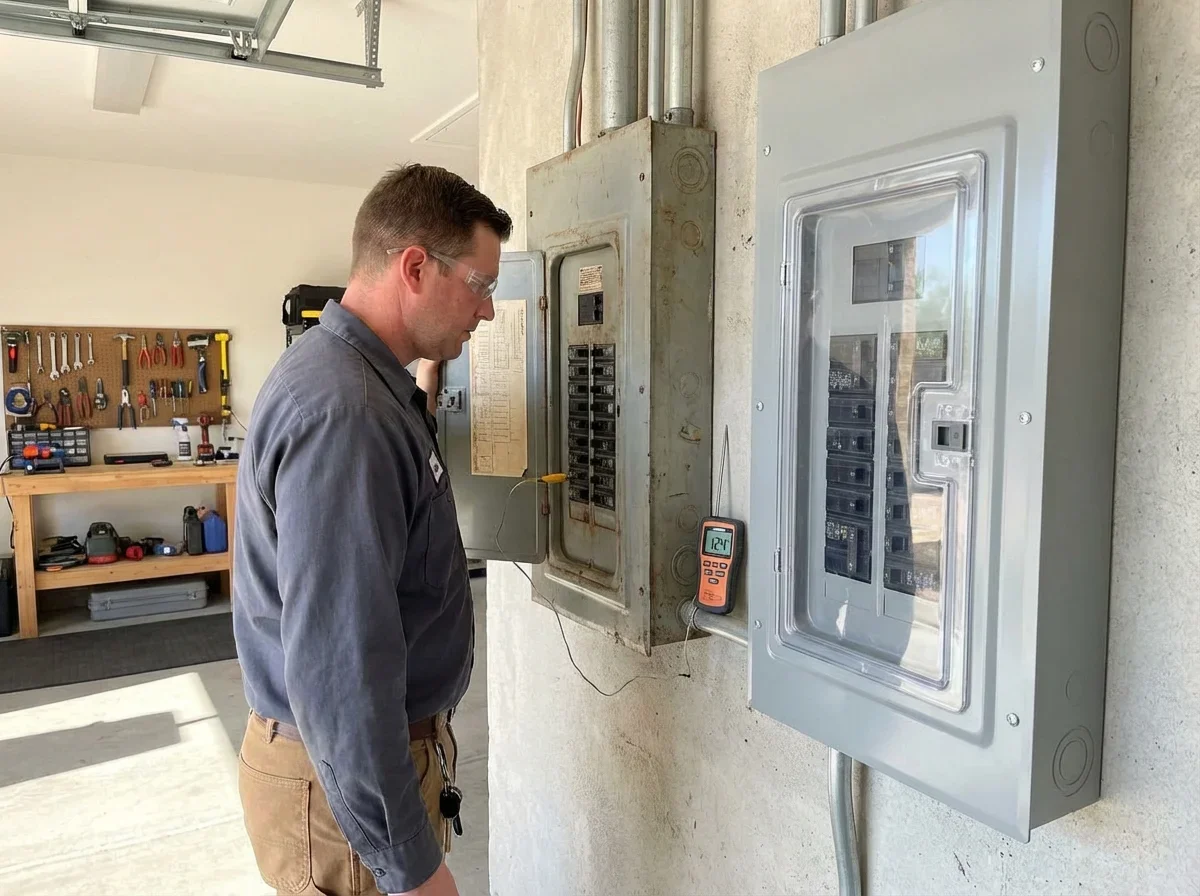
How Arizona Climate and Building Codes Affect the Decision
Phoenix's extreme heat accelerates electrical component aging in ways that building codes don't fully account for. The National Electrical Code assumes ambient temperatures of 86°F for derating calculations, but Arizona garages hit 120°F+ in summer.
That 34-degree difference cuts the effective ampacity of breakers and wiring, meaning panels run closer to their thermal limits than code calculations predict.
Hard water and monsoon moisture create corrosion paths that don't exist in drier or softer-water climates. Arizona's water averages 300+ ppm calcium carbonate, and when that water penetrates conduit runs or panel enclosures, it leaves mineral deposits that hold moisture against metal surfaces. Bus bars and neutral connections corrode faster, and standard repair methods (cleaning and re-terminating) only work if you catch the corrosion early.
ROC Licensing Requirements for Panel Work
Arizona law requires ROC licensing for any electrical work exceeding $1,000, which includes virtually all panel repairs and every panel replacement. Verify your contractor at https://roc.az.gov/ before signing a contract.
The ROC C-11 residential electrical license is the minimum qualification for panel work in your home. Contractors without active licenses face civil penalties, and homeowners lose legal recourse if unlicensed work fails or causes damage.
Permits are non-negotiable for panel replacements. Arizona jurisdictions (Phoenix, Tempe, Scottsdale, Gilbert, Chandler, Mesa) require permits for service equipment changes, and inspections must occur before the utility re-energizes the panel. Some homeowners try to skip permits to save $200-$300 in fees, but you'll pay that cost back during home sales when the unpermitted work shows up on title searches or home inspections.
Insurance companies deny fire claims when they discover unpermitted electrical modifications.
The ROC bond (typically $7,000-$10,000 for C-11 contractors) doesn't provide much consumer protection compared to contractor liability insurance. Ask for proof of general liability insurance ($1M minimum) and verify it with the insurance carrier. Arizona doesn't mandate contractors carry workers compensation insurance, so also verify that.
You're liable if an uninsured worker gets hurt on your property.
Questions to Ask Your Electrician
Start with diagnosis: "Can you show me what's failing and explain why repair isn't viable?" A good electrician walks you to the panel, opens it with power off, and points out heat damage, corrosion, obsolete components, or capacity issues.
If they quote replacement without showing you the problem, get a second opinion.
Ask about load calculation: "Did you perform a load calculation to determine the right panel size?" Arizona ROC electricians should calculate your existing load, account for future additions (EV chargers, pool equipment, solar), and size the new panel with 20-30% spare capacity. A contractor who automatically quotes 200-amp service without asking about your appliances and plans is guessing.
Verify permit inclusion: "Does your quote include permit fees and inspections?" Some contractors quote low then add permits as a separate charge. The total cost should include permit fees ($150-$300), utility coordination fees if applicable, and inspection scheduling.
Ask who pulls the permit. It should be the licensed contractor, not you.
Request references: "Can you provide contacts for 3-4 recent panel replacement customers in my area?" Call those references and ask specific questions: Did the job take longer than quoted? Did the final cost match the estimate? Did the electrician show up on time? How was the city inspection process handled?
Phoenix-area contractors with solid reputations don't hesitate to provide local references.
Understanding What's Included in Replacement Quotes
Material specs matter. Ask whether the quote includes AFCI breakers for circuits requiring them (bedrooms, living areas, kitchens) or if those are add-ons. AFCI protection adds $1,000-$1,500 to a full panel but is required by current code.
Clarify whether the quote includes weatherproof enclosures if your panel is exterior-mounted, and whether surge protection is included or optional.
Labor scope should be detailed. Does the quote cover removing the old panel and hauling it away? Patching and painting drywall if the new panel is a different size? Re-terminating every circuit with new wire if code requires it? Some contractors quote panel swap only, and you discover additional costs when existing wiring is too short to reach new breaker positions or when corroded wires need replacement.
Utility coordination is a hidden cost item. Panel replacement requires the utility to disconnect and reconnect the meter, and some utilities charge $150-$300 for scheduled disconnects. APS and SRP have different processes and timelines.
Verify whether your contractor has accounted for this and scheduled it, or if you'll face delays waiting for utility availability.
Cleanup and disposal should be explicit. Removing a 35-year-old panel means disposing of a 60-pound steel box, 30+ breakers, and possibly asbestos-wrapped wire insulation in older homes.
Ask if disposal fees are included or if they'll be added to the final invoice.
Making the Decision: Repair vs Replace
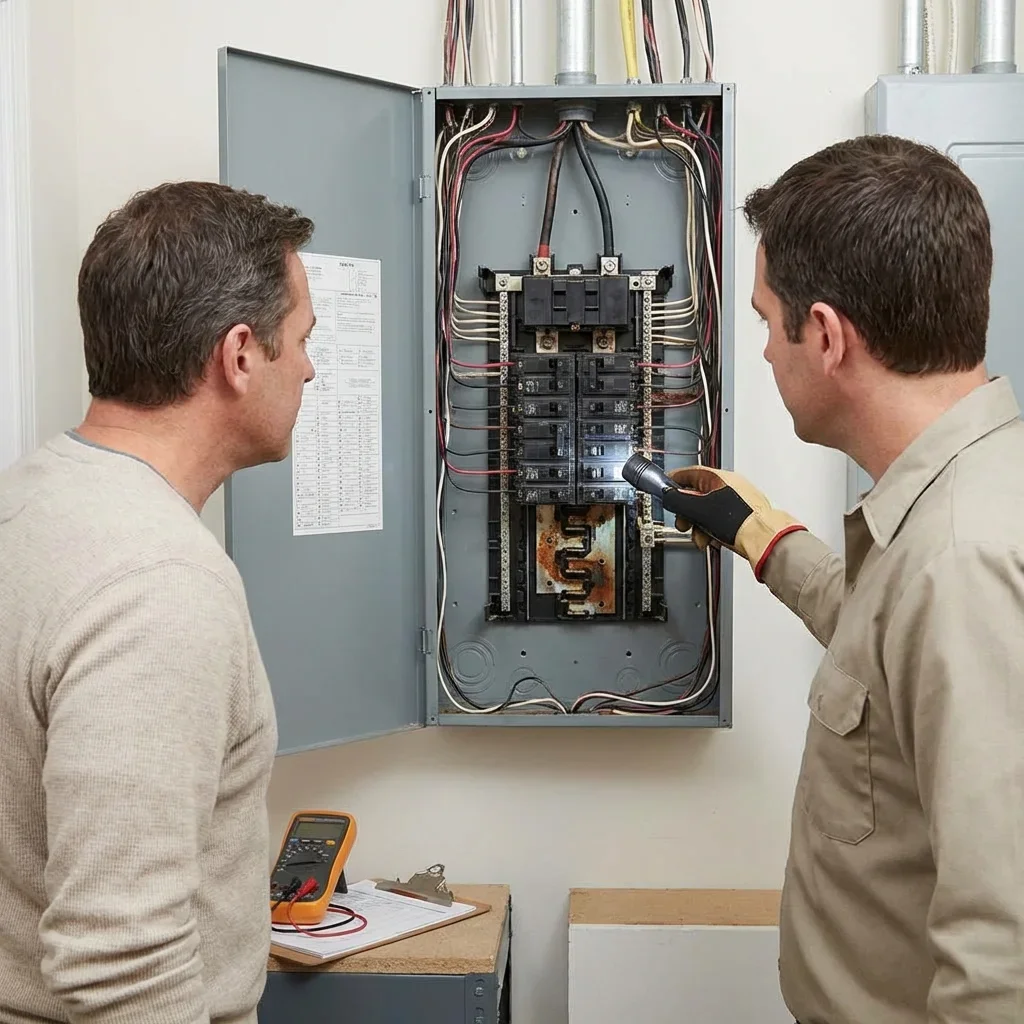
Run the numbers on a 5-year timeline, not just immediate cost. If repair costs $600 today but the panel will likely need replacement in 2-3 years at $3,500, you're looking at a total spend of $4,100 versus $3,500 for immediate replacement.
Factor in the value of not dealing with a second round of electrical disruption, permit pulls, and utility coordination.
Consider your home plans. If you're selling within two years, a repair might make sense if it gets you through inspection and disclosure requirements. But if you're adding load (EV chargers, kitchen remodel electrical, pool), replacement now prevents paying for inadequate repairs followed by forced replacement when the load exceeds panel capacity.
Age is a decision factor that overrides cost sometimes. A 15-year-old Square D panel with a failed breaker? Repair makes sense. You have 15-20 years of remaining panel life.
A 32-year-old Federal Pacific panel with a failed breaker? Replacement is the only responsible choice regardless of immediate cost difference.
Safety concerns trump financial calculations. If your electrician identifies heat damage, corrosion on bus bars, recalled panel brands, or code violations that create fire risk, the repair-vs-replace debate is over. You replace dangerous panels, period. The cost of a house fire or electrical injury isn't comparable to the $3,000-$5,000 you'll spend on a replacement panel.
What to Expect During Panel Replacement
Panel replacement in Phoenix takes 6-10 hours for a straightforward 200-amp upgrade with no service entrance changes. The electrician coordinates a utility disconnect (typically morning of the job), pulls the meter, removes the old panel, mounts and wires the new panel, calls for inspection, and coordinates utility reconnection.
You're without power for most of the workday. Plan accordingly.
Inspection timing varies by jurisdiction. Phoenix and Tempe typically schedule inspections within 1-2 business days. Smaller cities (Surprise, Buckeye) may have same-day or next-day availability. The electrician can't reconnect power until inspection passes, so timeline delays mean extended power outages.
Good contractors schedule inspections proactively and build contingency time into their quotes.
Utility reconnection after inspection can happen same-day or next-day depending on the utility's schedule and workload. APS and SRP prioritize reconnects for panel upgrades, but summer peak season (June-August) may mean waits of 24-48 hours.
Ask your contractor about their typical utility response times. Experienced Phoenix electricians know which utilities respond faster and plan accordingly.
Physical disruption is minimal for garage panels but significant for interior panels. Garage installs rarely require drywall work beyond patching a few screw holes. Interior panels mean drywall removal around the panel box, possible patching in adjacent rooms if wire runs need access, and repainting.
Electricians aren't drywall contractors. Verify whether finish work is included or if you'll need to hire separately.
After Replacement: What You Gain
Circuit capacity is the immediate benefit. A new 200-amp panel with 40-60 spaces gives you room for future circuits without crowding or double-tapping. That kitchen remodel that needs dedicated circuits for the range, microwave, and disposal? You have space.
The workshop in the garage that needs a sub panel? You have capacity.
Modern safety features include AFCI and GFCI protection that didn't exist when your 1985 panel was installed. AFCI breakers detect arc faults (damaged wire insulation, loose connections) and shut off power before fires start. GFCI protection prevents electrocution from ground faults.
These features are code-required for new installations and genuinely reduce fire and shock risk.
Surge protection becomes viable. Whole-house surge protectors install at the main panel and cost $300-$600 including installation. They protect every circuit from voltage spikes caused by lightning strikes, utility switching, and motor startups. Phoenix's monsoon season brings lightning-induced surges that damage electronics, and whole-house protection is more effective than individual plug strips.
Resale value improves measurably. A permitted, inspected panel replacement with current code compliance removes a major inspection objection. Home buyers in Phoenix see 30-year-old panels as negotiation leverage, and you'll either replace it before listing or accept a price reduction that exceeds replacement cost.
Replacing proactively means you control the contractor choice and timing rather than scrambling to close a sale.
- Occupational Safety and Health Administration (OSHA). "Approval requirements for replacement, modification, repair ... - OSHA." http://www.osha.gov/laws-regs/standardinterpretations/2005-08-10. Accessed April 07, 2026.
- Specialty Equipment Market Association (SEMA). "Right to Repair: The Federal Repair Act." https://www.sema.org/advocacy/right-to-repair. Accessed April 07, 2026.
- Society of Collision Repair Specialists (SCRS). "State Collision Repair Laws and Regulations." https://scrs.com/wp-content/uploads/2017/09/statecollisionrepairlaws-crash-parts-steering.pdf. Accessed April 07, 2026.