What Is Whole House Surge Protection?
Whole house surge protection is a hardwired device installed at your electrical panel by a licensed electrician. Unlike power strips you plug into the wall, these panel-mounted surge protective devices (SPDs) intercept voltage spikes before they enter your home's wiring system. They're designed to handle large surges from utility events, transformer malfunctions, and nearby lightning strikes — not the small daily fluctuations that point-of-use devices address.
In Arizona, all ROC-licensed electricians installing panel-level surge protection must follow NEC Article 285 requirements[1]. This isn't optional for new construction or service upgrades.
If your home was built after 2020 or you've had your panel replaced since then, you likely already have one installed. Check your panel cover for a small box labeled "surge protector" or "SPD."
Panel-Mounted Surge Devices Explained
Panel-mounted SPDs connect directly to your electrical service, either inside the panel enclosure or in an adjacent junction box. Most Arizona electricians install them as a two-pole device that connects to dedicated breaker spaces, drawing no power under normal conditions but activating instantly when voltage exceeds safe limits (typically 330-600V clamping voltage)[4].
These devices use metal oxide varistors (MOVs) to divert excess voltage to ground. When your home's voltage spikes — say from a transformer failure on a 110°F Phoenix day when the grid is stressed — the MOV conducts the surge away from your wiring in nanoseconds. The device itself absorbs the energy, measured in joules, until it eventually wears out.
One thing homeowners don't always realize: panel-mounted surge protectors don't last forever.
They degrade with each surge event they handle. Quality units include LED indicators showing when they're still active, and they should be replaced after a major surge event or every 5-10 years depending on how many hits they've taken.
Type 1 vs Type 2 Surge Protectors
The NEC defines SPDs by where they're installed in your electrical system[2]. Type 1 devices install on the line side of your service disconnect — before the main breaker — while Type 2 devices install on the load side, inside the panel after the main breaker. Both are considered "whole house" protection, but Type 1 units offer slightly better protection for the service equipment itself.
For most Arizona homes, electricians install Type 2 devices because they're easier to wire and don't require de-energizing the utility connection. You'll see Type 1 installations more often on homes with separately mounted meter disconnects (common in newer subdivisions) or properties with critical equipment like whole house generators.
| Feature | Type 1 SPD | Type 2 SPD |
|---|---|---|
| Installation Location | Line side (before main breaker) | Load side (inside panel after main breaker) |
| Typical Cost Installed | $500-$800 | $300-$600 |
| Installation Complexity | Higher (requires utility coordination) | Lower (standard panel work) |
| Common Applications | Homes with separate meter disconnects, generators | Most residential installations |
Type 2 units cost $300-$600 installed, while Type 1 installations run $500-$800 due to the additional labor and coordination required.
The 2023 NEC expanded surge protection requirements beyond single-family homes to include dormitories, hotel rooms, and nursing facilities[3]. If you're managing rental properties or multi-family units in Arizona, this is now code. Your electrician will need to install compliant devices on service upgrades or new construction regardless of your preference.
How Does Whole House Surge Protection Work?
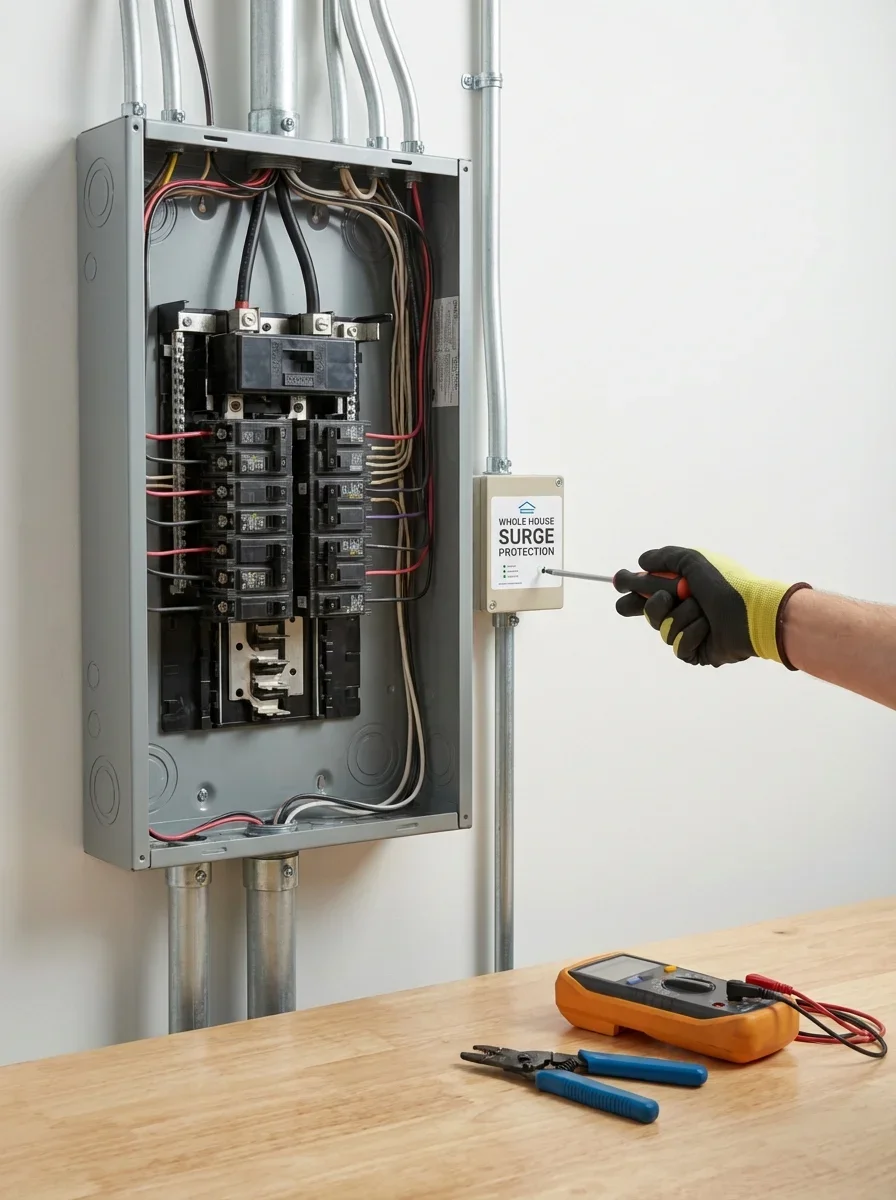
Panel-mounted surge protectors act as a pressure relief valve for voltage. Normal household voltage in Arizona runs 120V per phase (240V across both phases for large appliances). When external events cause voltage to spike — transformer failures, utility switching, or lightning-induced surges on power lines — the SPD clamps that voltage at a safe threshold and diverts the excess energy to ground before it reaches your outlets, appliances, and wiring.
Response time matters. Quality SPDs react in less than one nanosecond, which sounds like marketing hype until you realize modern electronics operate at speeds where even microsecond delays allow damaging voltage through.
The clamping voltage (the point where the device activates) is typically set at 330V, 400V, or 600V depending on the model. Lower clamping voltages offer tighter protection but cost more.
What Surge Protectors Defend Against
Whole house SPDs protect against utility surges, which account for roughly 60-80% of damaging voltage events in residential settings[5]. This includes transformer failures, downed power lines re-energizing, capacitor bank switching at substations, and voltage spikes from large industrial loads cycling on and off nearby. During Phoenix's summer peak load periods when temperatures exceed 110°F and AC systems across the valley are maxing out the grid, utility voltage fluctuations become more common.
They also defend against indirect lightning strikes. Not a bolt hitting your house directly, but lightning hitting power lines or the ground near your home, inducing voltage surges through your electrical service. Arizona's monsoon season (July-September) brings frequent lightning activity, and while direct strikes require separate lightning protection systems, panel-mounted SPDs handle the induced surges that travel through utility lines.
What Whole House Surge Protectors DON'T Protect Against:
- Direct lightning strikes to your home or roof
- Surges originating inside your home (arc faults from damaged wiring)
- Voltage sags and brownouts
- Internal electrical problems from deteriorating wiring
Here's what they don't protect against: direct lightning strikes to your home, surges originating inside your home (like arc faults from damaged wiring), or voltage sags and brownouts.
If lightning hits your roof or a tree touching your house, no panel device will stop that energy. You need a full lightning rod system for that scenario. And if your home's wiring is deteriorating (common in pre-1980 Arizona homes with original copper), the surges generated internally bypass the panel protection entirely.
Clamping Voltage and Joule Ratings
Clamping voltage tells you how much overvoltage the device allows before it activates. A unit with 330V clamping lets voltage rise to 330V before clamping; a 600V unit waits until 600V. Lower is better for sensitive electronics, which is why electricians recommend 330V or 400V units for homes with extensive smart home systems, home offices, or high-end entertainment setups.
Joule rating indicates the total energy the device can absorb over its lifetime. Entry-level units start around 20,000 joules per phase; mid-grade protection runs 40,000-60,000 joules; heavy-duty models exceed 80,000 joules.
In practice, this means a 20kJ unit might handle 15-20 moderate surge events before it's depleted, while an 80kJ unit can handle significantly more or absorb several large hits without failing.
Arizona electricians often recommend higher joule ratings for specific scenarios: homes with pool equipment (pump motors create internal surges when cycling), properties near high-voltage transmission lines, older neighborhoods with aging utility transformers, or homes in areas with frequent monsoon lightning. The cost difference between a 40kJ and 80kJ unit is usually $100-$200 installed, which is negligible if you're protecting $30,000+ worth of electronics and appliances.
What Does Whole House Surge Protection Cost?
Professional installation of panel-mounted surge protection in Arizona ranges from $300 to $800 depending on the device's protection level, your panel type, and installation complexity. This includes the SPD unit itself ($150-$400 retail), labor for a licensed electrician (1-2 hours at $100-$150/hour), and any additional materials like junction boxes or dedicated breaker spaces.
That price assumes straightforward installation on a standard 200-amp residential panel with available breaker spaces.
If your panel is full, the electrician needs to install a junction box alongside the panel to house the SPD, adding $75-$150 in materials and labor. Older panels with outdated bussing or limited neutral bar capacity sometimes require additional prep work, pushing costs toward the higher end of the range.
Installation Cost by Protection Level
Entry-level protection (20,000-30,000 joules, 600V clamping) typically costs $300-$450 installed. These units meet NEC code requirements and provide basic defense against utility surges, which is fine for homes without extensive electronics or those in areas with stable utility infrastructure. You'll see these on new construction specs where builders are checking the code box but not upselling protection levels.
Mid-grade protection (40,000-60,000 joules, 400V clamping) runs $450-$650 installed.
This is the sweet spot for most Arizona homeowners. Enough capacity to handle multiple surge events and tighter voltage clamping for modern smart home equipment. Electricians working in Scottsdale, Gilbert, and newer Chandler neighborhoods install these most frequently because the homes have $15,000+ in smart devices, high-efficiency HVAC, and networked pool controls worth protecting.
Premium protection (80,000+ joules, 330V clamping, diagnostic features) costs $600-$800+ installed. These units include LED status indicators, audible alarms when protection is compromised, and some models offer connected monitoring through apps. They're overkill for basic homes but make sense if you're running a home office with server equipment, extensive home automation, or high-end audio/video systems where even brief voltage spikes cause expensive failures.
Factors That Affect Surge Protector Pricing
Panel type drives cost more than most homeowners expect. Standard single-phase 200-amp panels (the majority of Arizona homes) are straightforward. But if you have three-phase service (rare in residential, more common in properties with large workshops or commercial equipment), you'll need a three-phase SPD that costs $200-$300 more due to additional components and wiring complexity.
Available panel capacity affects labor costs.
If you have open breaker spaces and adequate neutral bar connections, installation takes 60-90 minutes. If your panel is maxed out, the electrician either installs the SPD in an external junction box or performs a sub-panel installation to create the necessary space, adding $200-$500 to the project depending on specifics.
Brand and warranty matter, but not as much as protection specs. Eaton, Siemens, Square D, and Leviton all manufacture quality SPDs that Arizona electricians stock regularly. The functional difference between a Square D HEPD80 and an Eaton CHSPT2SURGE is minimal if their joule ratings and clamping voltages match.
What does matter: warranty coverage. Quality manufacturers warranty the device itself for 5-10 years and often include connected equipment warranties covering $25,000-$50,000 in damage if the SPD fails to protect properly. Read the fine print — these have specific claim requirements.
Do You Need Whole House Surge Protection?
If your home was built or had its electrical service upgraded after 2020, you already have it. NEC code mandates SPDs on all new dwelling unit services[1]. The question for existing homes is whether the $300-$800 investment makes sense given your specific risk factors and equipment value.
The math is straightforward: tally up what you'd lose in a major surge event.
HVAC system ($8,000-$12,000), smart home hub and connected devices ($2,000-$5,000), entertainment systems ($1,500-$4,000), home office equipment ($2,000-$8,000), pool pump and controls ($1,200-$2,500), kitchen appliances with digital controls ($3,000-$6,000). Most Arizona homes built after 2000 have $20,000-$40,000 worth of surge-vulnerable equipment. A $500 SPD installation pays for itself if it prevents even one moderate surge event.
When Electricians Recommend Panel Protection
Homes with extensive smart home systems top the list. If you have networked thermostats, smart locks, security cameras, irrigation controllers, and lighting systems all talking to a central hub, a single voltage spike can cascade through the network.
These systems cost $5,000-$15,000 installed, and replacement often means not just buying new hardware but reprogramming and reconfiguring everything. Arizona electricians working on smart home wiring projects almost always include panel-mounted SPDs in their quotes.
Properties with dedicated home offices benefit significantly, especially if you're running business-critical equipment. Surge damage to computers, servers, network equipment, and monitors creates not just replacement costs but lost productivity and potential data loss. Homeowners who work remotely often don't realize their homeowner's insurance may not cover business equipment damage. A $600 SPD installation is cheaper than explaining to your employer why you lost client data in a preventable surge event.
Areas with frequent storm activity justify the investment. While Phoenix metro isn't as lightning-prone as Florida or the Southeast, monsoon season brings 30-50 days annually with thunderstorm activity concentrated in July through September.
Homes in Scottsdale's north valley, the Superstition foothills east of Mesa, or anywhere near the Bradshaw Mountains see higher lightning frequency than central Phoenix. Electricians in these areas install SPDs on 60-70% of panel upgrade projects even when not code-required.
Older neighborhoods with aging utility infrastructure face higher surge risk from transformer failures and voltage fluctuations. Pre-1980 neighborhoods in central Phoenix, Tempe, and older parts of Chandler have utility transformers and distribution equipment that's 40+ years old. When these components fail under summer peak load, they often create voltage spikes affecting multiple homes simultaneously. If you're in an older neighborhood and see frequent voltage flickers or lights dimming when AC units cycle, panel-mounted surge protection is worthwhile.
Layered Protection Strategy
Panel-mounted SPDs provide the first defense line, but electricians recommend layered protection for maximum safety[5].
The panel device stops large surges from utility events, but smaller surges that make it through — and surges originating inside your home — still need point-of-use protection at individual outlets.
Pro Tip: The panel-mounted SPD is your catastrophic event insurance; point-of-use surge protectors are your everyday defense against small voltage fluctuations that gradually degrade electronics over time. Quality electricians use both in their own homes.
Here's the practical approach: install whole house protection at the panel, then add point-of-use surge protectors (Type 3 SPDs) on your most valuable equipment. Use quality power strips with surge protection on entertainment systems, home offices, and networking equipment. The panel device handles the 6,000V utility surge; the power strip clamps the residual 400V that makes it through; your equipment sees only normal operating voltage.
This costs an additional $100-$300 in point-of-use protectors, but it's the approach professional electricians use in their own homes.
The whole house SPD is your catastrophic event insurance. The individual protectors are your everyday defense against the small voltage fluctuations that gradually degrade electronics over time.
One detail often missed: if you have expensive equipment, verify that your point-of-use protectors have their own equipment warranties and that they're compatible with the panel device. Some manufacturers design their Type 2 and Type 3 devices to work together, coordinating their response times so they don't interfere with each other during surge events. This level of coordination matters more as your equipment value climbs above $30,000.
How to Choose a Surge Protection Electrician
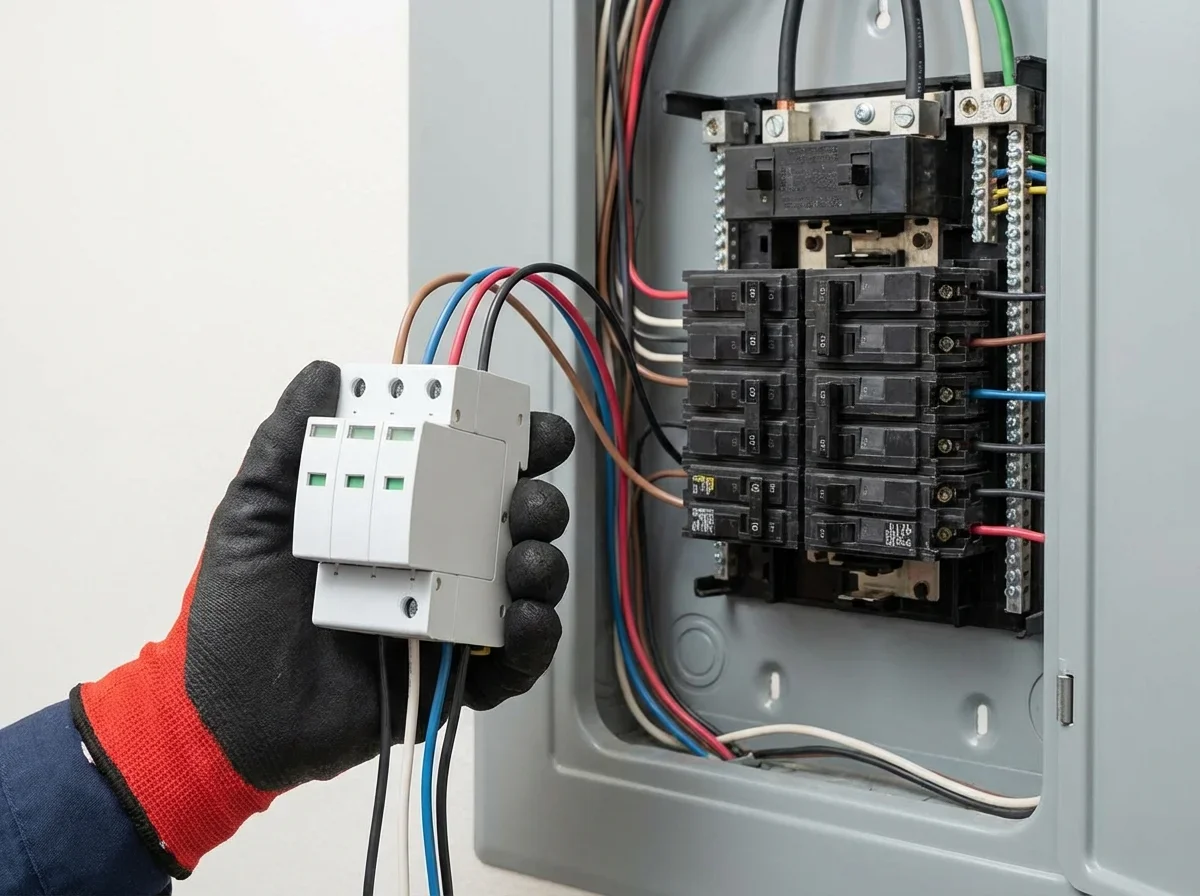
Installation isn't technically complex for experienced electricians, but it requires an active Arizona ROC license (verify at roc.az.gov) and solid understanding of NEC Article 285 requirements. The electrician needs to properly size the SPD to your service capacity, ensure adequate grounding (critical for surge protection effectiveness), and install it in a code-compliant manner that won't compromise your panel's existing protection devices.
Ask about the specific device they're installing.
If they can't tell you the joule rating, clamping voltage, and whether it's Type 1 or Type 2, that's a red flag. Quality electricians stock recognizable brands (Eaton, Siemens, Square D) and can explain the trade-offs between protection levels. Be wary of electricians pushing unknown brands or refusing to show you spec sheets. SPD quality varies dramatically, and the $50 they save using off-brand units isn't worth the risk.
Verify they're pulling a permit if required. Most Arizona municipalities require permits for panel modifications, including SPD installations that involve adding breakers or junction boxes.
Unpermitted work can void your homeowner's insurance and create problems when selling your home. ROC-licensed electricians know local permit requirements. If they suggest skipping permits to "save time," hire someone else.
Get warranty details in writing. The device itself should have a manufacturer warranty (typically 5-10 years), and many include connected equipment coverage. But the electrician's installation warranty matters too. If the SPD fails prematurely due to improper installation (incorrect grounding, inadequate bonding, wrong wire sizing), you need recourse. Quality electricians warranty their labor for at least one year and can explain the manufacturer's claim process if surge damage occurs despite the protection.
Find Licensed Electricians for Surge Protector Installation
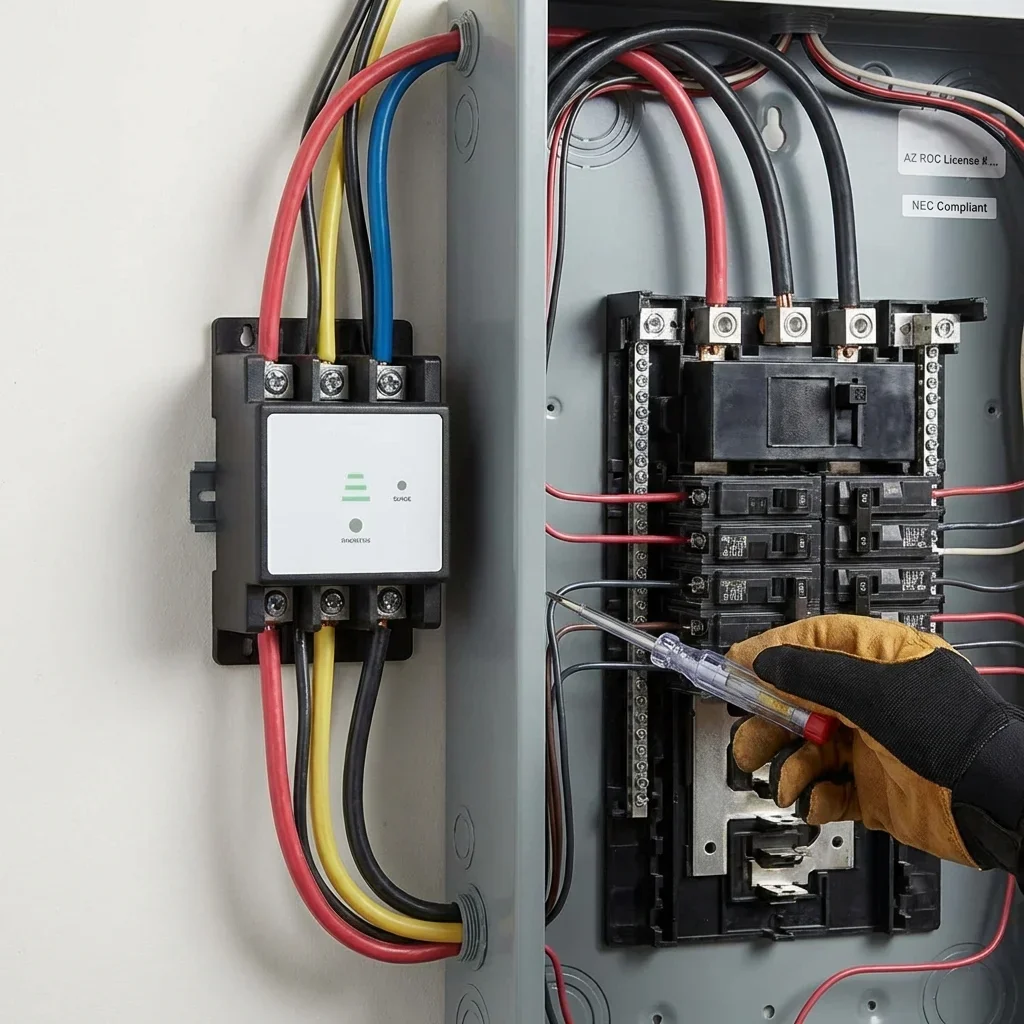
Professional surge protection installation requires coordination between choosing the right device for your home's specific risk factors and finding an electrician who can install it properly. Arizona's NEC adoption means most licensed electricians now install panel-mounted SPDs regularly, but experience with different protection levels and brands varies significantly.
Start by getting quotes from 2-3 ROC-licensed electricians.
Specify your home's panel type (check the main breaker amperage and manufacturer), ask what protection level they recommend given your equipment value, and request detailed quotes that break out equipment cost versus labor. Price shouldn't be your only decision factor. A $300 quote using a 20kJ off-brand device isn't better than a $550 quote with a Siemens 60kJ unit installed by an electrician who's done 200+ panel upgrades.
If you're already planning electrical work — a panel upgrade, sub-panel installation, or whole house rewiring — adding surge protection to that project typically costs less than scheduling it separately. The electrician is already at your panel, permits are already pulled, and the marginal cost for the SPD installation is just device price plus 30-60 minutes of additional labor.
For homes in areas with higher surge risk (near high-voltage transmission lines, older neighborhoods, properties with frequent lightning activity during monsoon season), consider premium protection even if your equipment value doesn't strictly justify it. A $500 installation buys you more than just device protection. You get the confidence that your home's electrical system can handle utility events without cascading failures, which is worth more than the $150 difference between mid-grade and premium SPDs.
- National Fire Protection Association (NFPA). "Article 285. Surge-Protective Devices (SPDs)." https://www.nfpa.org/codes-and-standards/all-codes-and-standards/list-of-codes-and-standards/detail?code=70. Accessed April 06, 2026.
- National Fire Protection Association (NFPA). "NFPA 70, National Electrical Code." https://www.nfpa.org/codes-and-standards/all-codes-and-standards/list-of-codes-and-standards/detail?code=70. Accessed April 06, 2026.
- National Fire Protection Association (NFPA). "2023 Edition of the National Electrical Code (NEC) Changes for Surge Protection." https://www.nfpa.org/news-blogs-and-articles/blogs/2023/01/2023-edition-of-the-national-electrical-code-nec-changes-for-surge-protection. Accessed April 06, 2026.
- National Electrical Manufacturers Association (NEMA). "Surge Protective Devices." https://www.nema.org/Standards/view/Surge-Protective-Devices. Accessed April 06, 2026.
- Electrical Safety Foundation International (ESFI). "Home Surge Protective Devices." https://www.esfi.org/home-surge-protective-devices/. Accessed April 06, 2026.
- U.S. Department of Energy. "Electrical Surge Protection for Homes." https://www.energy.gov/energysaver/electrical-surge-protection-homes. Accessed April 06, 2026.