What Does Professional Ceiling Fan Installation Include?
Professional installation isn't just mounting a fan and flipping a switch. Licensed electricians assess your ceiling structure, verify (or replace) the electrical box, handle the wiring, and test the installation for safety and balance.
Skipping any of these steps creates hazards that building inspectors flag and homeowners insurance scrutinizes after accidents.
Electrical Box Assessment and Replacement
Your existing ceiling box was probably installed for a light fixture weighing 5-10 pounds. Ceiling fans weigh 15-50+ pounds and generate dynamic rotational forces that standard boxes can't handle.
The National Electrical Code requires fan-rated boxes that support at least 35 pounds[4], and most electricians won't install a fan on anything less.
Fan-rated boxes must be labeled as such and secured directly to structural framing[1]. In Arizona's older block homes, this often means installing an adjustable brace bar that spans 16-24 inches between ceiling joists and supports 50+ pounds[3]. You can't tell from the ground whether your box is rated. Electricians open it up and inspect the mounting before they'll proceed.
If your box isn't fan-rated (most aren't), replacement adds $50–$150 to the job. That's not upselling. It's code compliance under NEC 314.27(A)(2)[4].
The U.S. Consumer Product Safety Commission directly links inadequate box support to ceiling fan falls and injuries[5].
Wiring and Switch Configuration
Simple swaps use existing wiring if you're replacing a ceiling light with a fan. But many homeowners want separate controls for the fan motor and light kit, which requires different wiring than what's typically run for a single light fixture.
Electricians will either install a dual-switch setup (requiring three-wire cable if it's not already there) or wire the fan for remote or pull-chain control. If you're adding a fan to a room that never had a ceiling fixture, they'll need to run new circuit wiring from your electrical panel. That's $250–$500 in labor alone, depending on attic access and how far they have to fish wire through Phoenix's stucco walls.
Arizona's 2026 energy code requires separate switching for fans and lights in new construction. While this doesn't apply to retrofits, separating controls gives you better energy efficiency (you can run the fan without the light) and is standard practice for licensed electricians who think beyond the minimum.
Balancing and Safety Testing
After mounting, electricians check blade balance using a balancing kit. Wobbling isn't just annoying. It accelerates wear on the motor and puts extra stress on the mounting box.
They'll also verify that the downrod length is appropriate for your ceiling height (minimum 7 feet clearance from floor to blade tips) and that all wire connections inside the canopy are secure and properly capped.
Final testing includes running the fan on all speeds to check for vibration, confirming the wall switch operates correctly, and verifying grounding connections. In Arizona's dry climate, proper grounding is critical. Static buildup from low humidity increases shock risk if the fan isn't grounded to code.
How Much Does Ceiling Fan Installation Cost?
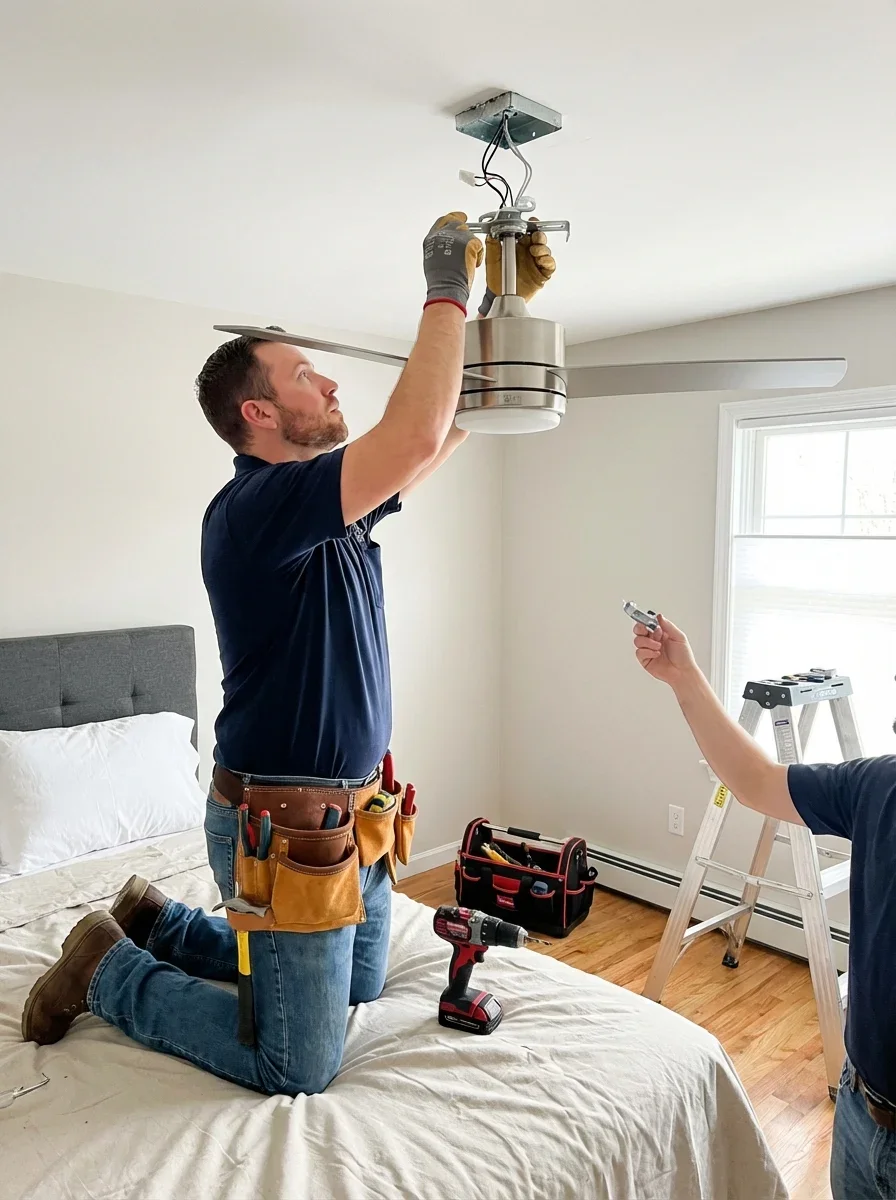
National averages are misleading because they lump together $100 swap-outs and $600 new-location installs. Phoenix-area electricians typically charge $150–$300 for straightforward installations where wiring and a fan-rated box already exist.
Once you need box replacement, new circuits, or difficult access, expect $300–$600.
| Installation Type | Cost Range | Timeline | Complexity |
|---|---|---|---|
| Existing light replacement (fan-rated box present) | $150–$250 | 1.5–2 hours | Low |
| New location with attic access | $300–$450 | 4–5 hours | Medium |
| New location without attic access | $450–$600 | 5–6 hours | High |
| Vaulted/cathedral ceiling | Add $100–$200 | +1–2 hours | Medium-High |
Cost by Installation Type
Replacing an existing ceiling light: $150–$250. This assumes the current box is fan-rated (rare) or easily accessible for replacement, and existing wiring supports your control preference. Electricians charge $50–$100/hour in metro Phoenix, and a simple swap takes 1.5–2 hours including box inspection and balancing.
Installing a fan in a new location: $300–$600. Running new wiring from the panel, cutting into drywall, patching, and installing a fan-rated box with structural bracing pushes labor to 4–6 hours. If the attic is accessible, costs stay toward the lower end. If they're fishing wire through walls in a two-story home, you're at the high end or beyond.
Vaulted or cathedral ceilings: Add $100–$200. The angled mounting requires extension downrods, specialized brackets, and more time on a ladder.
Phoenix homes built in the 1990s–2000s often have vaulted ceilings in primary bedrooms. Factor this in if that's where you want the fan.
Outdoor or covered patio fans: $200–$400, depending on whether wiring exists. Outdoor-rated fans cost more, and electricians need to ensure weatherproof boxes and conduit if running new wire. Arizona's monsoon season (July–September) generates enough wind and moisture to test any outdoor installation, so proper sealing and rated components aren't optional.
What Drives Installation Costs Higher
Box replacement is the most common add-on. If your ceiling box is nailed to a single joist or sitting on drywall (yes, this happens in older flips), electricians won't touch it.
Replacement means cutting into the ceiling to install a brace bar anchored to multiple joists. That's $75–$150 in parts and labor, plus minor drywall patching.
New circuit requirements escalate costs fast. If your existing circuit is maxed out (common in older homes where one circuit serves an entire bedroom's outlets and lights), electricians need to run a dedicated 15-amp circuit from the panel. That's $250–$500 depending on the distance and wall construction. Phoenix's block homes from the 1960s–1970s make wire fishing particularly difficult. Expect costs toward the higher end if you're in an older Arcadia or Maryvale neighborhood.
Switch installation or upgrades add $50–$150. If you want wall control for a fan in a room that only had a pull-chain light, the electrician has to install a switch, cut a box into the wall, and run switch-leg wiring. Dimmer switch installation for the fan light adds another $40–$80, though not all fan motors tolerate standard dimmers. Your electrician will specify compatible controls.
Permit fees vary by city. Most Arizona jurisdictions require permits for new circuits or substantial electrical box work[6]. Phoenix charges $50–$100 for residential electrical permits; Scottsdale and Chandler are similar.
Licensed electricians pull permits as part of the job and include inspection scheduling. If a handyman offers to skip the permit, that's a red flag. Unpermitted work can void your homeowners insurance and complicate future sales.
Why Ceiling Fans Require Licensed Electricians
Arizona law doesn't explicitly ban homeowner DIY electrical work in their own homes, but it does require permits for most electrical modifications. Only ROC-licensed electricians can pull those permits[6].
More importantly, mistakes create real consequences. Improper box support has caused ceiling fans to fall during operation, resulting in injuries the CPSC tracks nationally[5].
Safety Warning: Phoenix-area home inspectors routinely flag DIY ceiling fan installations during pre-sale inspections. Common violations include undersized boxes, reversed wiring, missing ground connections, and fans mounted too low. These aren't cosmetic issues—they're code violations that force expensive corrections and can void homeowners insurance claims.
Here's what goes wrong in DIY installs: undersized or incorrectly mounted boxes, reversed hot and neutral wires, missing ground connections, and fans mounted too low or too close to sloped ceilings. Phoenix-area home inspectors routinely flag these issues during pre-sale inspections, forcing sellers to hire electricians for expensive corrections.
Arizona's Registrar of Contractors requires electrical work to be performed by licensed electricians (C-11 Electrical Contractor license for companies, or work supervised by a licensed contractor). You can verify any contractor's license status at roc.az.gov. Active licenses show no disciplinary actions and current bonding.
ROC bonds only cover $4,000–$15,000 depending on license type, which won't cover major damage from electrical fires or injuries. Verify the contractor carries general liability insurance separately.
Licensed electricians know NEC requirements for box support, wire gauge for circuit capacity, and grounding for fan motors[4]. They also understand Arizona-specific factors. Our low humidity increases static electricity risk (grounding matters more), and extreme attic heat (140°F+ in summer) affects wire insulation ratings. These aren't details you'll find in a fan manufacturer's instructions.
Ceiling Fan Control Options: Switches, Remotes, and Smart Controls
The fan you bought probably includes a remote or pull chains. You have better options, and electricians can wire for them during installation.
Control choice affects both functionality and cost.
Wall switches are the cleanest solution if you want permanent, visible controls. A dual switch setup lets you control fan speed and light separately. Installation costs $50–$100 extra if wiring isn't already in place for two switches. Three-way switching (controlling the fan from two locations) requires three-wire cable and costs $100–$150 more due to the wiring complexity.
Remote controls come standard with most modern fans and don't require special wiring. The receiver installs in the fan canopy. They're convenient but easy to lose, and batteries die at inconvenient times.
If you're replacing a fan that had wall-switch control, keeping the wall switch (even if you also use the remote) preserves the home's resale appeal.
Smart fan controls integrate with home automation systems. You can wire for Wi-Fi-enabled fan controllers that work with Alexa, Google Home, or HomeKit. Electricians charge $150–$250 for smart fan installation including the controller and setup.
This makes sense if you're already investing in smart home wiring elsewhere, but it's overkill for a single bedroom fan.
For the light kit, standard dimmer switches don't work with all fan motors. The dimmer can interfere with motor operation and cause humming. Electricians install fan-rated dimmers or smart switches designed for fan-light combinations. Expect $40–$80 for a quality dimmer installed.
How to Choose a Ceiling Fan Installation Electrician
Start with ROC license verification. Any electrician performing work over $1,000 in Arizona must hold an active Registrar of Contractors license. Check for complaints or disciplinary actions. The ROC website shows the full history.
A clean record doesn't guarantee good work, but a history of violations is a clear warning.
Essential Questions to Ask Before Hiring:
- Do you carry liability insurance beyond the ROC bond? (Get policy number and verify current coverage)
- Will you inspect and replace the electrical box if it's not fan-rated? (Answer must be yes)
- Do you pull permits for box replacement or new circuits? (Should be included in quote)
- What warranty do you offer on installation labor? (90 days to one year is standard)
- Can you show recent ceiling fan installations you've completed? (Request photos or reference addresses)
- Will the quote itemize labor, materials, permit fees, and additional work separately?
Get at least three quotes, and make sure each electrician inspects the installation location. Phone estimates are useless. They can't see your box, attic access, or existing wiring. Quotes should itemize labor, materials (box, wiring, switches), permit fees, and any additional work like drywall patching.
Red flags to avoid: significantly lower quotes than competitors (often means cutting corners or hidden fees), unwillingness to pull permits, no physical business address (ROC-licensed contractors must maintain one), and pressure to pay in full upfront. Legitimate contractors ask for deposits (25-50%) with the balance due upon completion.
Local electricians often have better availability and accountability than national chains. They're also more familiar with Phoenix-area construction. They know which neighborhoods have aluminum wiring (pre-1970s), which subdivisions used substandard electrical boxes (some 1980s developments), and how to navigate city permit offices efficiently.
Find Qualified Electricians for Ceiling Fan Installation
Professional ceiling fan installation removes the guesswork and liability from a project that looks simpler than it is. You're paying for code-compliant box support, correct wiring, proper grounding, and someone who knows when additional electrical work is required to do the job safely.
The cost difference between a basic swap and a complex install is significant, but it reflects real differences in labor and materials. If you need new wiring, box replacement, or switch installation, those aren't optional extras. They're what the job requires.
Emergency electrical services are available if you've already attempted a DIY install and encountered problems, but starting with a licensed professional saves time and stress. For related electrical upgrades, consider dedicated circuit installation if your home's electrical system is already stretched, or electrical troubleshooting if you're experiencing issues with existing ceiling fixtures or switches.
Verify your electrician's credentials, get detailed written quotes, and don't skip the permit if code requires it. Your ceiling fan should provide decades of reliable service. Proper installation from the start makes that possible.
- University of Minnesota Extension (via HowToLookAtAHouse.com, expert home inspection resource). "Ceiling (Fan) Braced Boxes." https://www.howtolookatahouse.com/Blog/Entries/2018/11/what-kind-of-ceiling-electrical-box-for-a-ceiling-fan.html. Accessed April 06, 2026.
- University of Minnesota Extension (via HowToLookAtAHouse.com). "Ceiling Fan Electrical Boxes." https://www.howtolookatahouse.com/Blog/Entries/2019/8/how-do-i-know-if-my-ceiling-box-can-support-a-ceiling-fan.html. Accessed April 06, 2026.
- University of Minnesota Extension (via HowToLookAtAHouse.com). "Ceiling Fan Brace." https://www.howtolookatahouse.com/Blog/Entries/2018/11/how-can-i-tell-if-a-ceiling-fan-box-is-securely-fastened.html. Accessed April 06, 2026.
- National Electrical Code (NEC) via Home Improvement Stack Exchange (code discussion). "Electrical - NEC Requirements for Installing a Ceiling Fan." https://diy.stackexchange.com/questions/2480/nec-requirements-for-installing-a-ceiling-fan. Accessed April 06, 2026.
- U.S. Consumer Product Safety Commission (CPSC). "Ceiling Fan Safety." https://www.cpsc.gov/s3fs-public/5127.html. Accessed April 06, 2026.
- National Electrical Code (NEC) via ElectricianTalk.com (professional forum). "Electrical Code Requirements for Ceiling Fan Installation." https://www.electriciantalk.com/threads/electrical-code-requirements-for-ceiling-fan-installation.288678/. Accessed April 06, 2026.