What Does Landscape Lighting Installation Cost?
Professional landscape lighting installation in the Phoenix metro typically runs $2,000 to $8,000 for most residential properties. That covers the transformer, fixtures, burial-rated cable, installation labor, and setup.
Smaller systems with 8-12 path lights start around $1,800. Larger properties with 30+ fixtures, spotlights, and accent lighting push toward the $10,000 range.
Most electricians quote landscape lighting per fixture or as package pricing based on system size. Expect $100 to $300 per installed fixture depending on type and wiring complexity. Path lights on a simple run cost less per fixture than accent lights requiring individual wire runs to different elevations or architectural features.
Cost by Number of Fixtures and System Size
An 8-fixture path lighting system with a 300-watt transformer typically costs $1,800 to $2,500 installed. This covers basic illumination along walkways or a single landscape bed.
Mid-sized systems with 15-20 fixtures (mixing path lights, spotlights, and well lights) run $3,500 to $5,500. These handle front yard features, entryways, and selected backyard zones.
Whole-property systems with 25-40 fixtures cost $6,000 to $10,000. You're lighting driveways, multiple landscape beds, architectural features, trees, and outdoor living spaces. Transformer capacity increases to 600-900 watts, wiring becomes more complex, and installation time doubles. Properties over an acre with extensive lighting needs can exceed $12,000 when factoring in multiple transformers and dedicated circuits.
The per-fixture cost drops as system size increases because fixed costs like the transformer and main power feed get distributed across more lights. A 10-fixture system might average $220 per fixture installed, while a 30-fixture system averages $180 per fixture.
| System Size | Fixtures | Typical Cost | Cost Per Fixture | Best For |
|---|---|---|---|---|
| Small | 8-12 | $1,800-$2,500 | $200-$220 | Walkways, single landscape bed |
| Medium | 15-20 | $3,500-$5,500 | $190-$230 | Front yard, entryway, selected backyard zones |
| Large | 25-40 | $6,000-$10,000 | $180-$240 | Whole property, multiple zones, architectural features |
| Estate | 40+ | $10,000-$15,000+ | $170-$250 | Properties over 1 acre, multiple transformers |
Low-Voltage vs Line-Voltage Pricing
Low-voltage systems (12V) account for 90% of residential landscape lighting installations and cost $2,000 to $8,000 for typical projects. These systems use a transformer to step down household 120V power to safe 12V output. They're classified as Class 2 circuits under NEC Article 725, which simplifies installation requirements and reduces risk.[2]
Line-voltage systems (120V) run $4,000 to $12,000 for comparable fixture counts due to stricter installation requirements. You need direct burial cable or conduit runs at 18-24 inch depths per NEC Table 300.5, GFCI protection at every outlet, and weatherproof junction boxes rated for wet locations.[5]
Electricians recommend line-voltage for commercial properties, high-wattage flood lighting, or situations where fixtures must be 200+ feet from the power source where voltage drop becomes unmanageable in low-voltage systems.
Most Arizona homes get low-voltage systems unless you're lighting a large property perimeter or need high-output floods for security. The installation cost difference is real, but so is the ongoing maintenance burden with line-voltage wiring exposed to UV and thermal cycling in desert conditions.
How Professional Landscape Lighting Systems Work
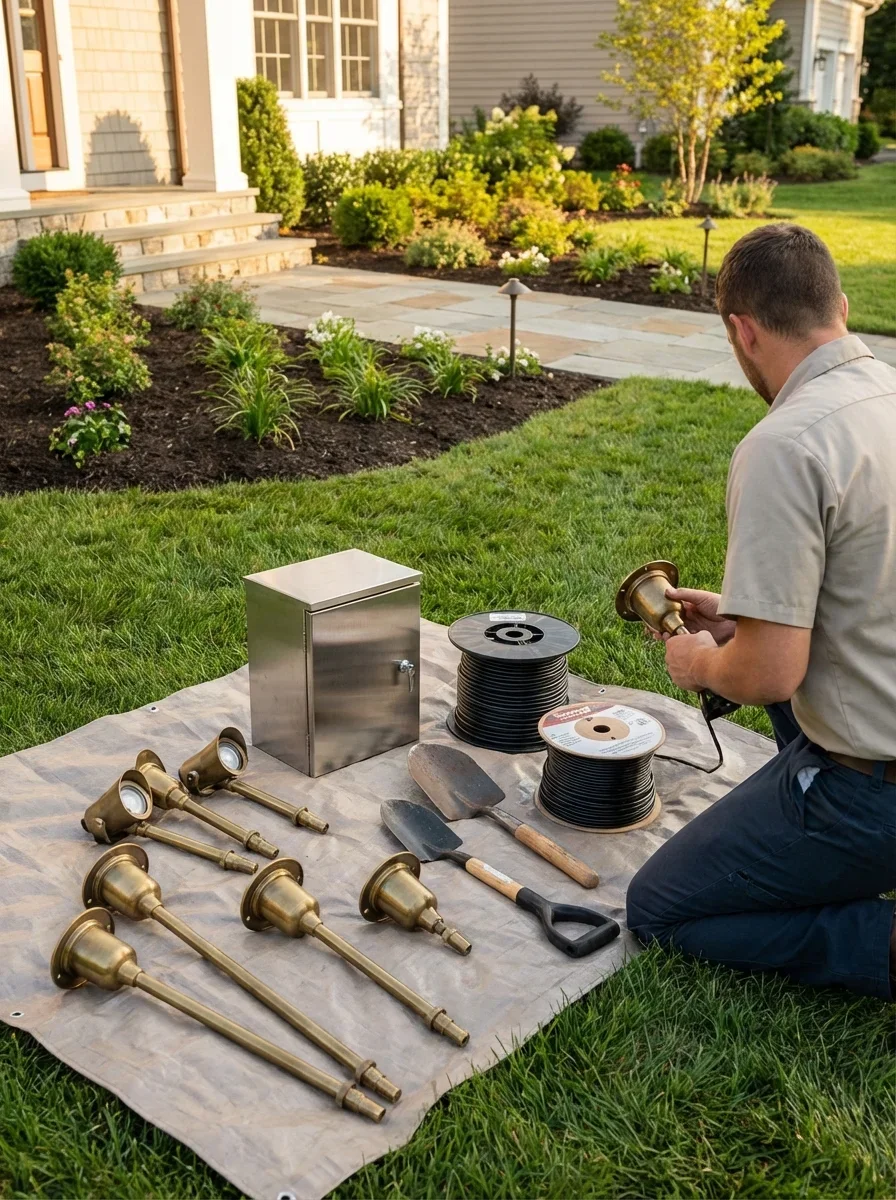
Quality landscape lighting starts with proper transformer sizing and extends through wire gauge selection and fixture placement. Electricians design systems to deliver consistent voltage at every fixture, not just the ones closest to the transformer.
That requires load calculations and voltage drop math that consumer-grade kits skip entirely.
Arizona's extreme temperature swings (106°F summer days to 40°F winter nights) stress electrical connections and transformer components. Professional installations account for thermal expansion in wire runs and use weatherproof enclosures rated for outdoor exposure, not garage-mount transformers retrofitted with extension cords.
Transformer Selection and Placement
Transformers are sized by total wattage load with a 20% buffer for future expansion. If your 20 fixtures draw 240 watts total (12 watts per LED fixture), you need a 300-watt minimum transformer. Most electricians install 300-600 watt transformers for residential systems, with 900-watt units for larger properties.
Placement matters as much as capacity.
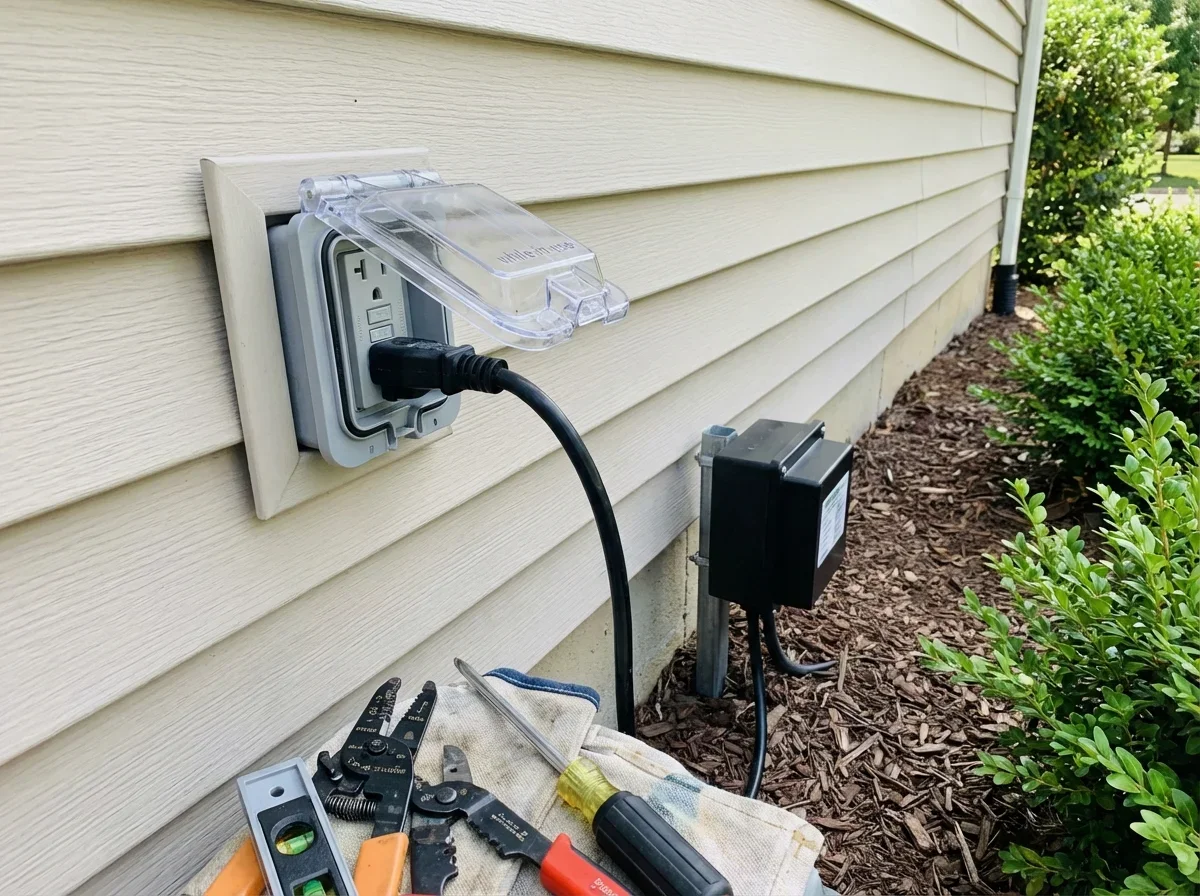
The transformer needs GFCI-protected power from an outdoor outlet meeting NEC 210.8(A) requirements for exterior receptacles.[1] It should be mounted within 10-15 feet of the main fixture zone to minimize voltage drop on the primary wire runs. Garages, covered patios, and exterior walls with roof overhangs work well. Direct sun exposure shortens transformer life, and ground-level mounting in landscape beds invites monsoon flooding and pest intrusion through wire ports.
Quality transformers include multiple taps (12V, 13V, 14V, 15V) to compensate for voltage drop on longer runs. Electricians might set near fixtures to the 12V tap and distant fixtures to the 15V tap so everything receives proper voltage after line loss. Consumer transformers lack this adjustment, leaving distant fixtures dim.
Fixture Types and Lighting Design
Path lights are the volume workhorse of landscape lighting, typically costing $80 to $150 installed per fixture. They mark walkways and driveways with even spacing every 8-10 feet. Spotlights cost $120 to $200 installed and create dramatic uplighting on trees, walls, or architectural features.
Well lights sit flush with the ground for uplighting without visible fixtures. Expect $150 to $250 each due to excavation and drainage requirements in caliche soil.
Deck and step lights integrate into hardscape, running $100 to $180 per fixture. Wash lights illuminate walls or landscape beds from a low angle, highlighting texture. Electricians place fixtures based on beam spread and throw distance, not arbitrary spacing. A 30-degree spot might need 20 feet of distance to light a two-story wall, while a 60-degree flood works at 8 feet.
Phoenix contractors often recommend copper or brass fixtures over plastic or aluminum. Desert UV is brutal, and plastic housings crack within 3-5 years. Powder-coated aluminum corrodes at wire connections. Copper and brass age gracefully and maintain better resale value when you sell the home. The fixture upcharge is $20-40 per unit, but replacement labor costs more than the initial upgrade.
Pro Tip: Copper and brass fixtures cost $20-40 more per unit upfront, but plastic housings crack within 3-5 years under desert UV exposure. The initial upgrade pays for itself by eliminating replacement labor costs and maintaining property value.
Wire Runs and Voltage Drop Management
This is where DIY systems fail and professional installations separate themselves.
Low-voltage cable loses voltage over distance based on wire gauge and current load. A 100-foot run of 16-gauge wire carrying 5 amps drops 8 volts. Your 12V system delivers 4V to the last fixture, producing almost no light.
Electricians use 12-gauge or 10-gauge wire for main runs, stepping down to 14-gauge for short branch runs. They calculate voltage drop for every fixture and adjust wire gauge or transformer tap voltage accordingly. The cable must be listed for direct burial and wet locations per NEC requirements, with UV-resistant jacketing for exposed sections.[3]
Burial depth for low-voltage cable isn't strictly regulated under Class 2 circuit rules, but 6-8 inches is standard practice in Arizona to avoid damage from landscape maintenance and thermal cycling. Contractors bury wire in trenches, not surface-laid under mulch like many DIY installs. Caliche soil makes trenching expensive. Expect $3-5 per linear foot for excavation, more if you hit hardpan at 2-3 feet and need equipment upgrades.
Proper installations include drip loops at every fixture connection to prevent water intrusion. The wire dips below the connection point so water runs off instead of following the wire into the fixture. It's a small detail that prevents 90% of moisture-related failures during monsoon season.
What Does Outdoor Outlet Installation Cost?
Adding a GFCI-protected outdoor outlet for your landscape lighting transformer costs $250 to $500 as a standalone project, less when bundled with lighting installation. The outlet must have weatherproof "while-in-use" covers that protect the receptacle even with a plug inserted, and GFCI protection is mandatory per NEC 210.8(F) for all outdoor receptacles.[4]
Installation includes running cable from an existing circuit or sub-panel, mounting a weatherproof box, and installing the GFCI receptacle.
If you're adding a dedicated 20-amp circuit from the panel, costs increase to $400-700 depending on wire run length and access difficulty.
Electricians install outlets at 16-24 inches above grade to avoid ground splash and flooding. In Arizona, this also keeps the outlet above typical monsoon water accumulation around building perimeters. The weatherproof box gets sealed with caulk rated for outdoor use, and connections inside use anti-oxidant compound on terminals to prevent corrosion in our dry climate where dust intrusion is constant.
Many homes already have exterior outlets suitable for landscape lighting transformers. Your electrician will verify the existing outlet has GFCI protection and adequate capacity. Adding transformer load to a circuit already serving outdoor outlets, patio lights, and pool equipment can overload a 15-amp circuit. Expect $450-650 for a dedicated circuit installation if needed.
Why Professional Installation Beats DIY Systems
You can buy a low-voltage lighting kit for $300-800 and install it yourself. Two years later, half the fixtures are dim or dead, the transformer buzzes, and you're replacing corroded wire nuts every spring.
The issue isn't the fixtures. It's the installation details that consumer kits don't explain and YouTube videos gloss over.
Voltage drop calculations require knowing wire resistance per gauge, total circuit length, and cumulative load. DIY kits ship with 16 or 18-gauge wire regardless of system size. Run 150 feet of 18-gauge wire to eight fixtures and you'll deliver 6-7 volts to the last light. The fixture says it needs 12V, so it outputs 30% brightness and appears "broken."
Professional installations use proper wire gauge for each run, calculate voltage drop to every fixture, and adjust transformer taps or wire size to deliver correct voltage. They bury cable below root zones and landscape maintenance depth. They use corrosion-resistant connectors instead of twist-on wire nuts that fail in wet locations.
The other advantage is design knowledge.
Contractors space fixtures for even illumination without dark gaps or overlapping hot spots. They angle spotlights to eliminate glare from windows and outdoor seating. They run wire paths that avoid future conflicts with irrigation, hardscape, or tree root zones. A well-designed system looks intentional, not random.
Warranty coverage is the final separator. Professional installations include 1-3 year labor warranties and manufacturer warranties on transformers and fixtures. When a fixture fails, you call the contractor for replacement under warranty terms. DIY system failures mean you're buying new components and troubleshooting voltage issues yourself.
Why Professional Installation Outperforms DIY:
- Proper voltage drop calculations ensure consistent brightness at every fixture
- Correct wire gauge selection (12-14 gauge) vs. inadequate DIY kit wire (16-18 gauge)
- Burial depth at 6-8 inches protects cable from landscape maintenance damage
- Corrosion-resistant connectors rated for wet locations vs. hardware store wire nuts
- Strategic fixture placement eliminates glare and creates intentional lighting effects
- 1-3 year labor warranties plus manufacturer coverage on all components
- Design expertise for even illumination without dark gaps or hot spots
Smart Controls and Automation Options
Professional-grade lighting controllers add $300 to $1,200 to installation costs depending on features and integration complexity. Basic photo sensors and timers cost $80-150 and turn lights on at dusk, off at dawn, or on programmed schedules. These work independently without Wi-Fi or app control.
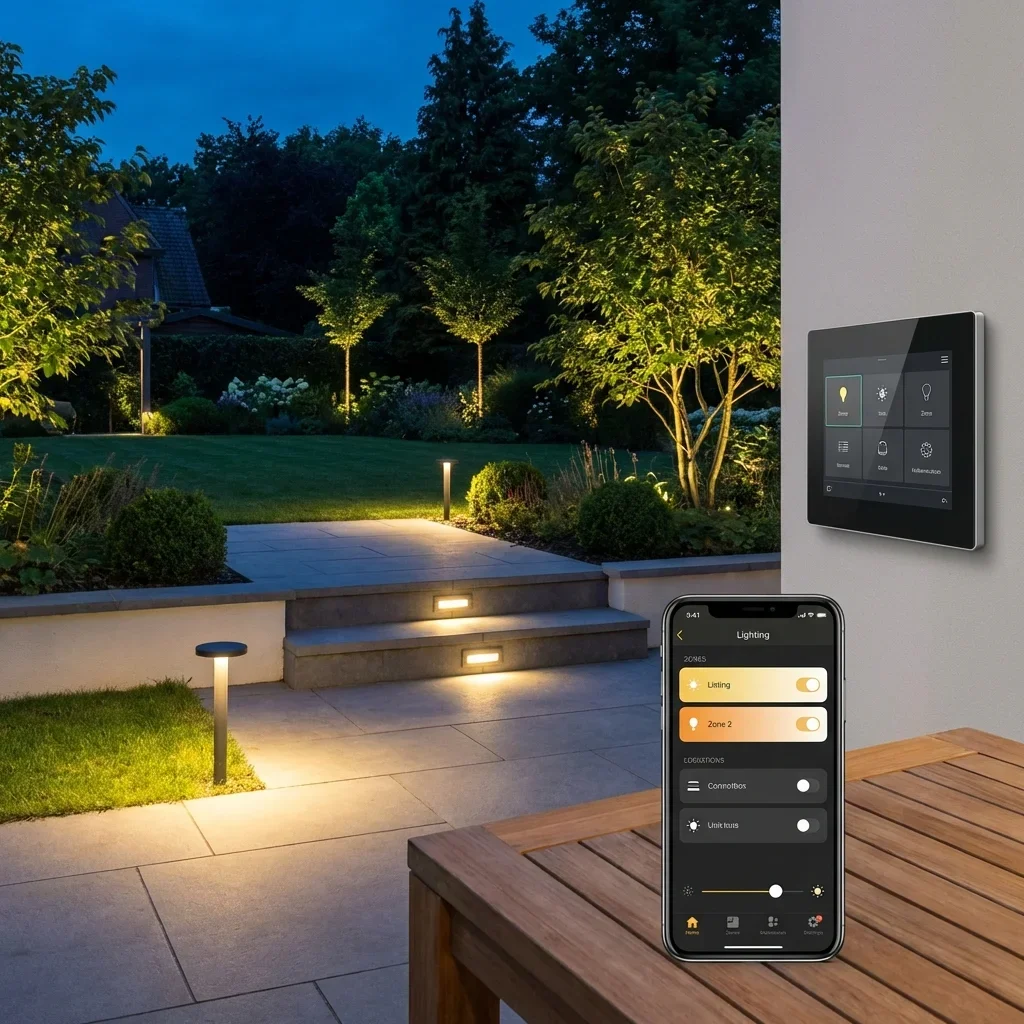
Smart controllers with app-based programming, zone control, and voice assistant integration run $400-900 installed.
You can dim zones independently, create lighting scenes, and integrate with whole-home automation systems. Brands like Smart Home Wiring compatible systems let you tie landscape lighting into broader property automation.
Astronomical timers adjust on/off times automatically as sunrise and sunset shift through the year. They cost $150-300 installed and eliminate the twice-yearly reprogramming that basic timers require. In Arizona, sunset varies by 3+ hours between summer and winter solstice, making astronomical timers particularly valuable.
Contractors install controllers inside the transformer housing or in separate weatherproof enclosures. The controller needs the same weather protection as the transformer itself. Desert dust intrusion and thermal cycling kill electronics faster than advertised. Consumer-grade smart plugs and outdoor timers rated for "outdoor use" typically fail within 18-24 months in Phoenix summer heat.
Zone control lets you run front yard lighting on different schedules than backyard zones. You might want entry and driveway lights until midnight but turn off backyard accent lighting at 10 PM. Professional controllers handle 2-8 zones depending on model and price point.
What to Look for in a Landscape Lighting Electrician
Verify the contractor holds an active ROC license through the Arizona Registrar of Contractors at roc.az.gov. Landscape lighting installation over $1,000 requires licensure, and working with unlicensed contractors voids insurance coverage if something goes wrong. Look for residential electrical licenses (R designation) or dual residential/commercial credentials.
Ask for references from landscape lighting installations completed in the past 12-24 months.
You want to see how the system looks after a summer of UV exposure and a monsoon season of rain. Recent installs look good. Two-year-old installations show whether wire burial was adequate, connections stay corrosion-free, and fixtures hold up to environmental stress.
Request voltage drop calculations for your specific property layout. Quality contractors measure distances, calculate loads, and specify wire gauges before ordering materials. If the estimate doesn't mention wire gauge or voltage drop, they're guessing. That's fine for small systems under 15 fixtures on short runs, but it's a problem for larger properties.
Verify they'll pull permits if required. Most municipalities require electrical permits for line-voltage landscape lighting installations. Low-voltage systems under 30V typically don't require permits, but larger installations or those integrated with home electrical systems might. The contractor should know local requirements and handle permits as part of the installation.
Insurance verification matters in Arizona because the state doesn't require contractors to carry workers compensation coverage.
The ROC bond ranges from $4,000 to $15,000 depending on license class. That's not enough to cover injury claims or property damage on most projects. Ask for proof of general liability insurance and workers comp if they employ anyone beyond the owner.
Get itemized quotes breaking out transformer costs, fixture costs, wiring materials, and labor. This lets you compare proposals accurately. A $3,800 quote using $50 aluminum fixtures and 16-gauge wire isn't comparable to a $4,500 quote with $90 brass fixtures and 12-gauge wire, even though the fixture counts match.
Get Quotes from Qualified Lighting Electricians
Landscape lighting installation costs depend on system size, fixture quality, wire run complexity, and installation details that separate reliable systems from maintenance headaches. Most Phoenix-area homeowners invest $2,000 to $8,000 for professional installations that deliver even illumination, survive desert conditions, and include warranties on parts and labor.
The difference between adequate and excellent installations comes down to voltage drop management, proper burial techniques, weather-resistant components, and design knowledge that creates intentional lighting effects instead of arbitrary fixture placement.
Quality contractors calculate loads, specify appropriate wire gauges, and install systems built to last 15-20 years with minimal maintenance.
Compare quotes from licensed Arizona electricians who specialize in landscape lighting installation. Verify credentials, ask for recent project references, and request detailed proposals showing transformer specs, fixture types, and wire gauges. The lowest quote rarely delivers the best long-term value when you factor in service calls and premature component replacement.
- Mike Holt Enterprises (NEC expert reference). "Exterior Power Outlets." https://www.mikeholt.com/technical-electrical-articles-exteriorpoweroutlets.php. Accessed April 06, 2026.
- Mike Holt's Electrical Forum (NEC code discussion). "Low Voltage Landscape Lighting NEC Requirements." https://forums.mikeholt.com/threads/low-voltage-landscape-lighting.2578277/. Accessed April 06, 2026.
- Mike Holt's Electrical Forum (NEC code discussion). "Underground Installation of Low Voltage Landscape Lighting." https://forums.mikeholt.com/threads/underground-installation-of-low-voltage-landscape-lighting.2558953/. Accessed April 06, 2026.
- Mike Holt Enterprises (NEC expert reference). "National Electrical Code 2023 Basics: Grounding and GFCI Protection Part 2." https://www.mikeholt.com/mojonewsarchive/ET-HTML/HTML/NEC-2023-GroundFaultProtection~20230518. Accessed April 06, 2026.
- Stack Exchange DIY (community electrical reference). "Low Voltage Outdoor Lighting." https://diy.stackexchange.com/questions/4730/low-voltage-outdoor-lighting. Accessed April 06, 2026.