Why Pool and Spa Electrical Work Requires Licensed Electricians
Pool and spa electrical installations fall under NEC Article 680, one of the most detailed sections of the National Electrical Code. The requirements exist because water and electricity create unique shock and electrocution risks that standard residential wiring rules don't address.
You're dealing with GFCI protection zones, equipotential bonding grids, dedicated high-amperage circuits, and underground conduit runs. All of which must meet precise specifications to pass inspection.
In Arizona, any electrical work over $1,000 requires an active ROC license, and pool electrical almost always exceeds that threshold. The Registrar of Contractors maintains separate classifications for electrical work (C-11 for residential), and you can verify any contractor's license status at roc.az.gov. Licensed electricians carry liability insurance and workers comp (though Arizona doesn't mandate the latter, so verify coverage independently). More importantly, they pull permits and schedule inspections, which means a third-party inspector confirms code compliance before the work gets buried or covered.
Unlicensed work on pool electrical is a red flag for buyers and insurers.
If you sell your home and the buyer's inspector finds unpermitted pool wiring, you may be forced to tear out decking or plaster to expose and correct the work. Insurance claims related to pool electrical failures can be denied outright if the installation wasn't permitted. This isn't a corner worth cutting.
NEC Code Requirements for Pool Electrical Systems
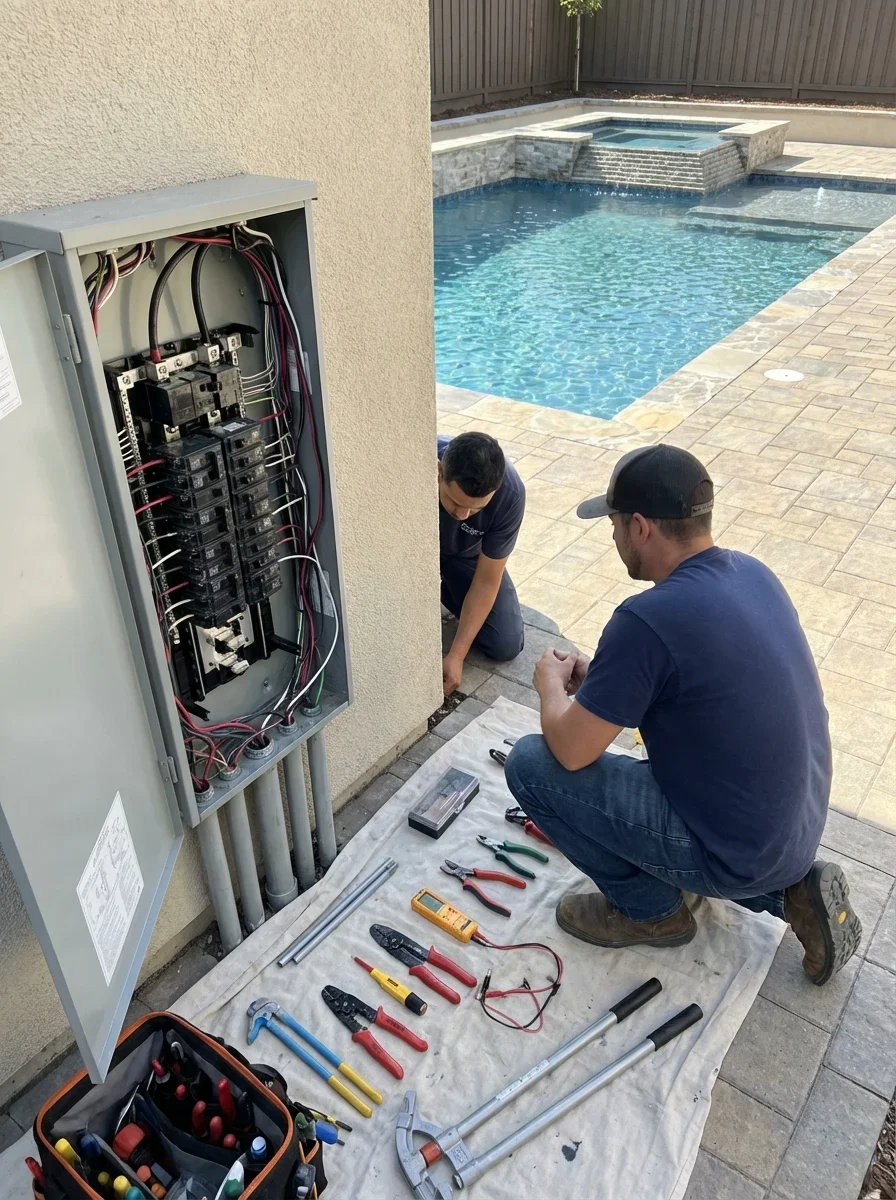
NEC Article 680 divides pool electrical requirements into several overlapping systems: GFCI protection for shock prevention, bonding grids to eliminate voltage gradients, grounding for fault protection, and dedicated circuits sized for the connected load. Each system serves a distinct safety function, and inspectors check all of them during rough-in and final inspections.
The code treats pools, spas, and hot tubs as separate categories with different rules based on whether they're permanent or storable, indoor or outdoor, above-ground or in-ground.
For permanent in-ground pools (the most common type in Arizona), you're looking at the strictest requirements across the board.
GFCI Protection and Safety Shutoff Requirements
Ground-fault circuit interrupter protection is mandatory for all pool-related electrical equipment and receptacles. A GFCI trips the circuit in milliseconds if it detects current leakage, which is what happens when electricity finds an unintended path, like through a person standing in water.
All 15A and 20A, 125V receptacles within 20 feet of the inside wall of a pool must have GFCI protection.[1] That includes convenience outlets on the patio, landscape lighting controls, and any equipment plugged into a standard outlet. For hardwired equipment like pool pumps, heaters, and lighting, the 2023 NEC requires GFCI protection for all electrical equipment installed within 5 feet of the pool, or within 12 feet above the pool if not separated by a solid fence or wall.[3]
You'll typically see GFCI protection implemented at the breaker level in the main panel or subpanel, rather than with individual GFCI outlets. This approach is cleaner and easier to maintain.
Test your pool GFCIs monthly by pressing the test button. They should trip immediately and require a manual reset. In Arizona's UV-intense environment, outdoor GFCI breakers can degrade faster than indoor units, so annual testing during spring maintenance is smart.
Bonding Grid Installation and Grounding
Bonding and grounding are two different safety systems that people often confuse. Grounding connects electrical equipment to the earth to provide a fault current path. Bonding ties together all metal parts around the pool to eliminate voltage differences between them.
For non-conductive pool shells (fiberglass, vinyl), the code requires a #8 solid copper bonding wire buried 4 to 6 inches below finished grade, placed 18 to 24 inches from the pool shell.[5] This creates an equipotential plane, a continuous grid of copper that ensures everything near the pool is at the same electrical potential. If a fault occurs, you won't get shocked stepping from the pool deck to the grass because both are bonded together.
The bonding grid must connect to all metal within 5 feet of the pool: ladders, handrails, pumps, filters, heaters, light niches, wet-niche junction boxes, metal conduit, and even reinforcing steel (rebar) in concrete decks.
Each connection must be mechanical. Wire nuts don't cut it. Licensed electricians use bonding lugs, exothermic welds, or listed compression connectors that won't corrode or loosen over time.
Arizona's alkaline soil and hard water (300+ ppm calcium carbonate) accelerate corrosion on buried copper. Quality installations use tinned copper wire or include sacrificial anodes at connection points to extend bonding grid life. This isn't code-required, but experienced pool electricians in the Phoenix area know it prevents callback visits five years down the line when bonding connections fail.
Grounding is separate.
All pool electrical equipment must have an insulated copper equipment grounding conductor sized per NEC Table 250.122, but never smaller than 12 AWG.[2] This wire runs back to the panel and connects to the grounding bus, providing a path for fault current to trip the breaker.
Critical Safety Note: Bonding and grounding work together but serve different purposes. Bonding eliminates voltage differences between metal objects around your pool. Grounding provides a path for fault current to trip breakers. Both are required by code, and both are essential for preventing electrocution. Never skip either system to save money.
Dedicated Circuits for Pool Equipment
Every piece of major pool equipment gets its own dedicated circuit. Pool pumps, heaters, and control systems have specific amperage and voltage requirements that don't share well with other loads.
A typical 1.5 HP pool pump draws 12-15 amps at 240V. Variable-speed pumps (now required by California code and increasingly common in Arizona due to energy savings) may draw less, but the circuit still needs to be sized for continuous-duty rating, which is 125% of the motor's full-load amperage.
Pool heaters are the heavy hitters. Gas heaters may only need a 15A circuit for the control board and ignition system, but electric resistance heaters can demand 50-60 amps at 240V. Heat pumps fall somewhere in between at 20-30 amps. If you're adding a spa alongside an existing pool, each heater gets its own circuit.
Control systems, automation panels, and landscape lighting transformers typically run on 15A or 20A circuits at 120V. Even LED pool lights require GFCI-protected circuits, though their amperage draw is minimal. The trend toward smart pool controls (Pentair ScreenLogic, Hayward OmniLogic) adds low-voltage communication wiring, but the main relays and power supplies still need standard circuits.
Load calculations matter more in Arizona than in cooler climates because so many pools include multiple heating and cooling systems.
It's common to have a heat pump for winter use, a gas heater for quick temperature boosts, and a chiller or misting system for summer cooling. Add a variable-speed pump, two-speed pump for a spa spillover, landscape lighting, and a pool sweep, and you're easily pulling 100+ amps of new load. Many older homes need a main panel upgrade or a dedicated pool subpanel to handle it.
What Does Pool Electrical Installation Include?
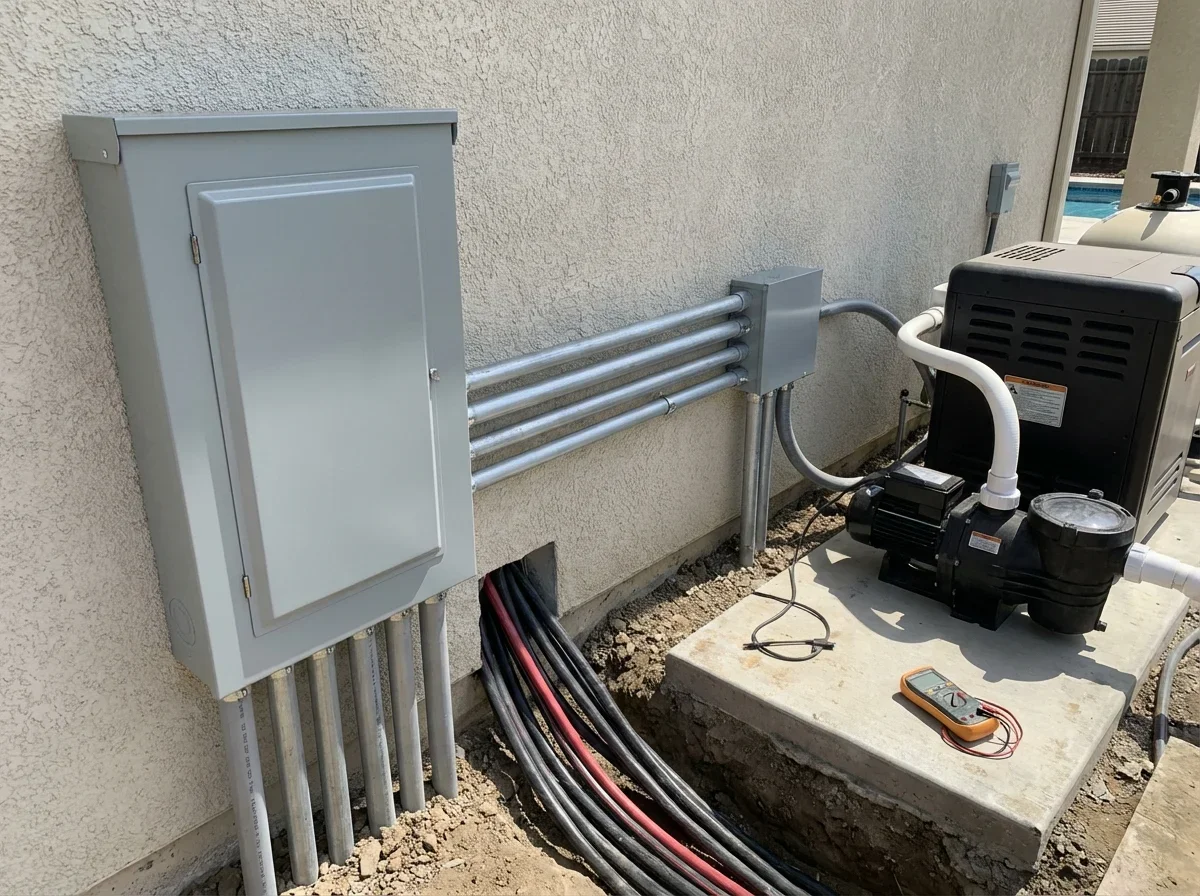
A complete pool electrical installation isn't a single task. It's a coordinated project that spans from the main panel to the pool equipment pad, and often includes trenching across your yard. Understanding the scope helps you evaluate bids and spot contractors who are underestimating the work.
Typical Pool Electrical Installation Timeline:
- Permit submission and approval: 3-7 business days
- Panel upgrade or subpanel installation: 1-2 days
- Trenching and conduit installation: 1-3 days (depending on distance and soil conditions)
- Rough-in inspection: Scheduled after trenching, before backfill
- Wire pulling and equipment hookups: 1-2 days
- Final inspection: Scheduled after all connections complete
- Total project duration: 2-4 weeks from permit to final inspection
Main Panel Upgrades and Subpanels
Most pool installations start at your electrical panel. If you're retrofitting a pool into a home built in the 1980s or earlier, your existing 100A or 125A panel probably doesn't have enough spare capacity for pool equipment. Load calculations will tell you whether you need a service upgrade to 200A, or whether you can install a subpanel fed from your main panel.
Subpanels are common for pool installations because they centralize all pool circuits in one location, making it easier to shut down pool equipment for maintenance or winterization.
A 60A or 100A subpanel mounted near the pool equipment pad keeps wire runs short and simplifies troubleshooting. The subpanel itself must be located at least 5 feet from the pool edge unless separated by a permanent barrier, and all subpanel breakers serving pool equipment need GFCI protection.
Panel upgrades in Arizona typically require coordination with your utility (APS, SRP, or your local co-op) for meter disconnect and reconnection. This adds 2-3 weeks to project timelines during peak summer months when utility crews are slammed with AC-related service requests. Licensed electricians handle the utility coordination, permit pulls, and inspections, all of which are required for panel work.
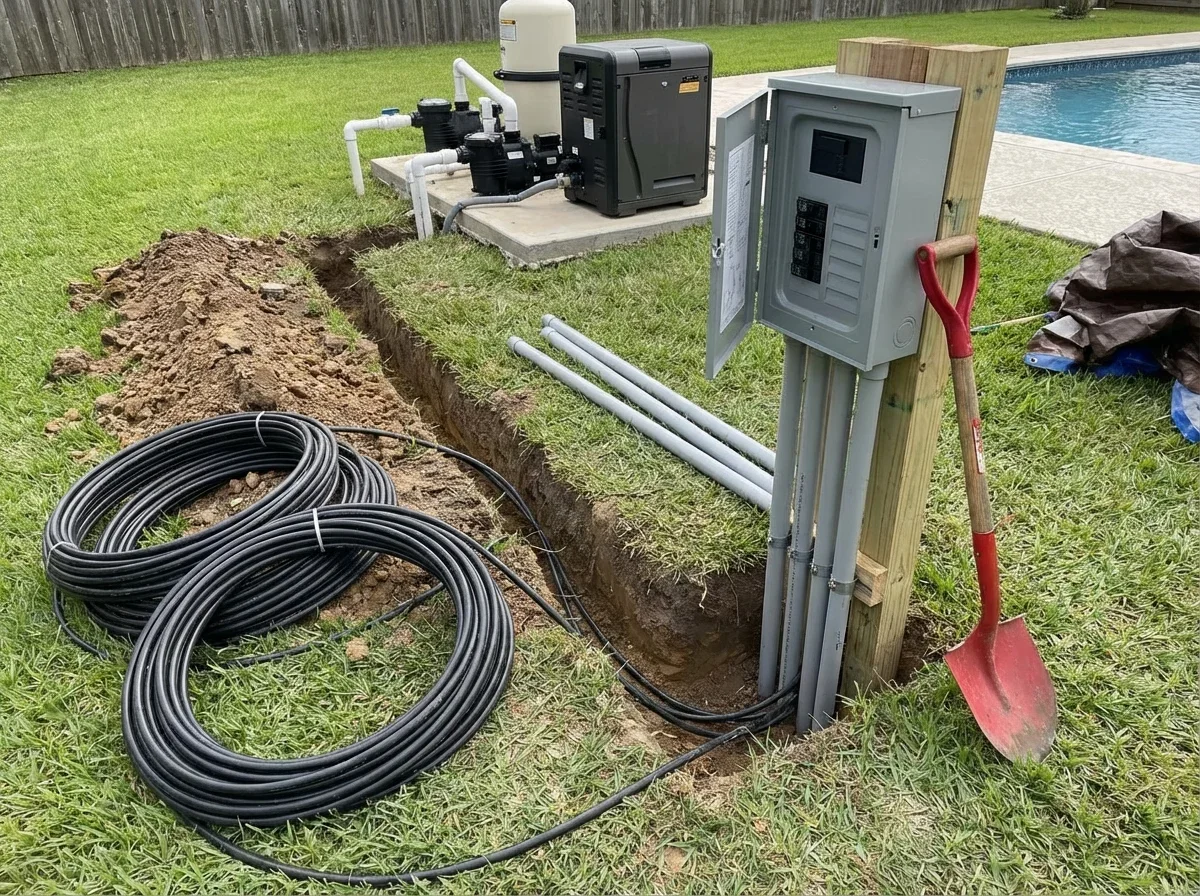
Underground Conduit and Wiring
Getting power from your panel to the pool equipment pad means running wire underground. NEC specifies minimum burial depths based on conduit type and location.
For rigid metal conduit (RMC) or intermediate metal conduit (IMC), the minimum depth is 6 inches. For rigid nonmetallic conduit (PVC), it's 18 inches under normal soil, or 24 inches under driveways or areas subject to vehicular traffic.
Arizona's caliche layer complicates trenching. Caliche is a calcium carbonate hardpan that forms 1 to 6 feet below the surface across much of the Phoenix metro area. Breaking through caliche requires a trencher with carbide teeth or hand excavation with a pickaxe. It's slow, labor-intensive work that can double trenching costs compared to sandy loam soil. If your pool equipment pad is 50+ feet from your panel and the trench crosses caliche, expect the underground portion of the bid to reflect that.
PVC conduit is standard for pool electrical in Arizona because it's non-corrosive, UV-resistant (if properly buried), and easier to work with than metal conduit in hard soil.
Schedule 40 PVC is code-minimum. Schedule 80 provides extra impact resistance under driveways. All wire inside the conduit must be THWN-2 or XHHW-2 rated for wet locations and high temperatures. Arizona summer soil temps can exceed 100°F at 18 inches deep.
Conduit runs must avoid sharp bends (no more than 360° total between pull points) and include expansion fittings if the run exceeds 100 feet or crosses a building expansion joint. Sweeps and long-radius elbows prevent wire insulation damage during pulls. Licensed electricians pull wire with lubricant and measure pulling tension to avoid exceeding manufacturer specs. DIY attempts often damage wire insulation, which won't be discovered until the circuit fails years later.
Equipment Hookups and Control Systems
Once power reaches the equipment pad, each device gets individual hookups following manufacturer specs. Pool pumps require disconnects within sight of the motor, typically a non-fused disconnect switch rated for the motor horsepower. Arizona pool electricians often mount disconnects inside weatherproof NEMA 3R enclosures to protect against monsoon rain and UV degradation.
Time clocks and automation panels need their own circuits and must be GFCI-protected if within 20 feet of the pool.
Modern pool automation systems communicate over low-voltage RS-485 networks, but the main power relays still operate at line voltage. Integration with smart home systems (Alexa, Google Home, Hubbell) requires smart home wiring beyond basic pool electrical. Not all pool electricians handle this, so clarify scope upfront if you want full automation.
Underwater pool lights are a specialty install. Each light fixture requires a junction box mounted above the water line (typically 18 inches above the pool deck), with a wet-niche housing for the light itself. LED lights have largely replaced halogen and incandescent models due to energy savings and longer life, but the wiring requirements remain the same: GFCI protection, bonding of metal niches, and proper sealing to prevent water infiltration.
Pool vs Hot Tub Electrical Requirements
Pools and hot tubs share many code requirements, but there are important differences in circuit sizing and equipment configuration. Hot tubs typically come as self-contained units with integrated heaters, pumps, and controls, which simplifies the electrical install compared to pools but creates different load demands.
Most modern hot tubs require a dedicated 50A or 60A circuit at 240V.
The hot tub control panel includes a GFCI breaker (built into the spa pack), which means you don't need GFCI protection at the main panel, though some jurisdictions and electricians prefer double protection. The circuit must terminate at a disconnect within sight of the spa and at least 5 feet from the water's edge.
Hot tub electrical work is often simpler than pool electrical because you're running a single circuit to a single device, rather than multiple circuits for pumps, heaters, lights, and controls. However, hot tub manufacturers specify exact wire sizing, conduit type, and connection methods, and voiding the warranty by deviating from those specs is a common mistake. Our hot tub wiring service page covers spa-specific requirements in more detail.
One practical difference: hot tubs are more common in retrofits on existing patios, which means the electrical run often crosses finished landscaping or hardscaping.
Trenching through pavers, flagstone, or decorative concrete adds complexity and cost that pool installs (which typically happen during new construction or major backyard remodels) don't face.
| Feature | In-Ground Pool | Hot Tub/Spa |
|---|---|---|
| Typical Circuit | Multiple 15-60A circuits | Single 50-60A circuit |
| GFCI Location | Main panel or subpanel | Often built into spa pack |
| Equipment Complexity | Separate pump, heater, lights, controls | Integrated system |
| Bonding Grid | Extensive (#8 copper perimeter) | Limited (equipment only) |
| Installation Timing | Usually new construction/remodel | Often retrofit on existing patio |
| Permit Inspection | Rough-in + final required | Final inspection only |
How Much Does Pool Electrical Work Cost?
Pool electrical costs vary based on equipment complexity, distance from the panel, and whether you need a service upgrade. For a new in-ground pool with standard equipment (single-speed pump, gas heater, two LED lights, and basic automation), expect $2,500 to $5,500 for complete electrical installation in the Phoenix metro area. That assumes your existing panel has capacity for the new load and the equipment pad is within 50 feet of the panel.
Add these costs for common upgrades:
- Main panel upgrade from 100A to 200A: $2,000-$3,500 including utility coordination and permit
- Dedicated pool subpanel (60A-100A): $800-$1,500 installed
- Trenching through caliche: Add $15-$30 per linear foot over normal soil costs
- Variable-speed pump circuit: $400-$700 (requires more sophisticated wiring for speed control)
- Electric heat pump (30A circuit): $600-$900 hookup
- Salt water chlorinator: $300-$500 electrical connection
- Underwater pool lights: $200-$400 per light including junction box and wet-niche wiring
Distance matters significantly.
If your pool equipment pad is 100+ feet from your panel, add $1,000-$2,000 in wire and conduit costs for the longer runs and larger wire gauge needed to minimize voltage drop. Arizona's summer heat exacerbates voltage drop issues because conductor resistance increases with temperature, so electricians often upsize wire by one gauge on long runs.
Adding a spa to an existing pool typically costs $1,800-$3,500 for electrical, depending on whether the spa has its own heater or shares the pool heater through a valve system. Spa additions often require new circuits for a second pump, separate controls, and sometimes a dedicated heater.
Permit costs in most Arizona municipalities run $150-$400 for pool electrical work, with inspections required at rough-in (before backfill) and final (after equipment connection).
Some jurisdictions require a separate electrical inspection and a separate pool barrier inspection. Verify with your city or county building department.
Get at least three bids and verify all include permit costs, inspections, bonding grid installation, and equipment connections. The lowest bid often skips the bonding grid or uses undersized wire, both of which will fail inspection or cause problems later.
Questions to Ask Before Hiring a Pool Electrician
Not all licensed electricians specialize in pool work, and NEC Article 680 isn't something you master by osmosis. Ask specific questions that reveal whether the contractor knows pool electrical systems or is just willing to take your money and figure it out as they go.
"How many pool electrical installations did you complete last year?" You want someone who does pools regularly, not occasionally. Seasonal electricians who spike into pool work during summer often lack the detailed Article 680 knowledge that prevents code violations.
"Will you pull the permit and schedule inspections, or is that on me?" The answer should always be that the contractor handles permits. If they suggest you pull the permit as the homeowner to "save money," they're either unlicensed or trying to avoid code compliance scrutiny.
"What gauge wire will you run for the pool pump, and how did you calculate it?" This checks whether they understand voltage drop calculations.
For a 15A, 240V pump circuit 75 feet from the panel, you typically need 10 AWG copper to stay within NEC's 3% voltage drop recommendation. If they answer "12 AWG is fine," they're cutting corners.
"Where will you locate the bonding grid connections, and how will you attach them to the rebar?" Detailed answers about exothermic welding or listed compression connectors indicate experience. Vague answers like "we'll bond it all together" suggest they don't know the specific requirements.
"What happens if the inspection fails?" The answer should include how they'll correct the work at no additional cost. Contractors who've been doing pool electrical for years rarely fail inspections. First-timers fail often and may try to bill you for re-work.
Ask for references from pool electrical jobs completed in the last 12 months.
Contact those homeowners and ask if the work passed inspection on the first attempt, whether the GFCI breakers have tripped unexpectedly (a sign of poor wiring), and if the contractor left the site clean after trenching and backfill.
Verify the contractor's ROC license includes the C-11 residential electrical classification. You can search by business name or license number at roc.az.gov. Check that the license is active, not expired or suspended, and review any complaint history. The ROC posts disciplinary actions publicly. Multiple complaints about unlicensed work or abandoned projects are deal-breakers.
Find Licensed Pool Electricians Near You
Pool electrical work combines electrical expertise, code knowledge, and practical experience with trenching, conduit, and bonding systems. It's not a job for general handymen or even electricians who primarily do indoor residential service work.
You need someone who knows Article 680, has worked through Arizona's caliche soil, understands heat-related voltage drop issues, and can coordinate permit inspections with your pool builder's schedule.
Our directory connects you with ROC-licensed electricians who specialize in pool and spa electrical installations across the Phoenix metro area. Every contractor listed carries verified liability insurance, maintains an active electrical license, and has completed pool electrical projects in the last 12 months. Filter by your city, read homeowner reviews, and request quotes from multiple contractors to compare scope and pricing.
If you're also planning outdoor outlet installation for landscape lighting or patio features, or need dedicated circuits for other high-amperage equipment, the same pool electrician can often handle that work while they're trenching and pulling wire for your pool.
- Town of Windsor Locks, CT. "ARTICLE 680—SWIMMING POOLS, SPAS, HOT TUBS ...." https://windsorlocksct.org/wp-content/uploads/2020/09/Swimming_Pools_and_Spas_2014NEC.pdf. Accessed April 06, 2026.
- Town of Windsor Locks, CT. "ARTICLE 680—SWIMMING POOLS, SPAS, HOT TUBS ...." https://windsorlocksct.org/wp-content/uploads/2020/09/Swimming_Pools_and_Spas_2014NEC.pdf. Accessed April 06, 2026.
- National Fire Protection Association (NFPA). "Ensuring Code Compliance in Swimming Pools - NFPA." https://www.nfpa.org/news-blogs-and-articles/blogs/2022/06/01/code-compliant-electrical-installation-the-key-to-swimmer-safety-and-a-secure-electrical-system. Accessed April 06, 2026.
- North Carolina Department of Health and Human Services. "RULES GOVERNING PUBLIC SWIMMING POOLS." https://ehs.dph.ncdhhs.gov/docs/rules/RulesGoverningPublicSwimmingPools.2500.pdf. Accessed April 06, 2026.
- Borough of Dormont, PA. "Electrical Requirements for Swimming Pool." https://boro.dormont.pa.us/wp-content/uploads/2020/05/Electrical-Requirements-for-Swimming-Pool.pdf. Accessed April 06, 2026.
- International Code Council (ICC). "APPENDIX V SWIMMING POOLS SPAS AND HOT TUBS." https://codes.iccsafe.org/content/NCRC2018/appendix-v-swimming-pools-spas-and-hot-tubs. Accessed April 06, 2026.