What Does Professional Recessed Lighting Installation Include?
Electricians don't just install the lights you picked out online. They plan the layout, confirm your panel has capacity for the new load, route wire through ceiling cavities, and mount fixtures that meet Arizona building code requirements.
The process involves at least four distinct phases, each affecting what you'll pay.
First comes layout planning. Your electrician measures ceiling height, identifies furniture placement, and calculates spacing to avoid dark spots or glare. Then they assess circuit capacity. Most 15-amp circuits handle 8-10 LED recessed lights, but only 4-6 older halogen fixtures due to higher wattage.[3]
If your panel is already loaded, you might need a dedicated circuit run from the main panel, adding $300-$600 to the project.
Layout Planning and Light Spacing
Spacing matters more than most homeowners expect. The standard formula calls for fixtures spaced at half the ceiling height. For Arizona's typical 8-10 foot ceilings, that's 4-5 feet between lights.[5]
Go wider and you get shadowy gaps. Closer placement wastes electricity and creates a spotlight effect that highlights every ceiling texture flaw.
Beam angle determines how much floor area each light covers. Narrow 25-degree beams work for accent lighting over art or countertops. Wide 60-degree floods provide ambient light for general living areas.
Your electrician will mix beam angles based on how you use each part of the room. Task lighting over the kitchen island, ambient lighting in seating areas, accent lighting on architectural features.
Ceiling Access and Wiring
Attic access changes everything about installation cost.
If your electrician can walk through an attic and drill down through top plates, wiring is straightforward. They'll run 14/2 or 12/2 Romex between fixtures, connecting everything back to a switch location you choose.
No attic access means cutting ceiling holes, fishing wire through cavities, and hoping structural members cooperate. In Arizona's block construction homes built before 1980, interior walls often have framing at 24-inch centers instead of 16, which helps. But you're still paying for the extra labor of blind wire-fishing and drywall patching.
Expect 30% higher labor costs when ceiling access is limited.
Fixture Selection: IC-Rated vs Non-IC
IC-rated fixtures are required anywhere insulation contacts the housing.[1] Non-IC fixtures must maintain a 3-inch air gap around the entire housing, which is nearly impossible to achieve in Arizona's well-insulated newer homes where R-38 or R-49 attic insulation is standard.
IC-rated housings cost $20-$40 more per fixture than non-IC, but they're not optional in insulated ceilings. The rating prevents overheating when fiberglass or cellulose insulation buries the fixture.
Non-IC lights installed in contact with insulation have caused attic fires. Building inspectors will fail your installation if you skip IC-rated fixtures where they're required.[2]
How Much Does Recessed Lighting Installation Cost?
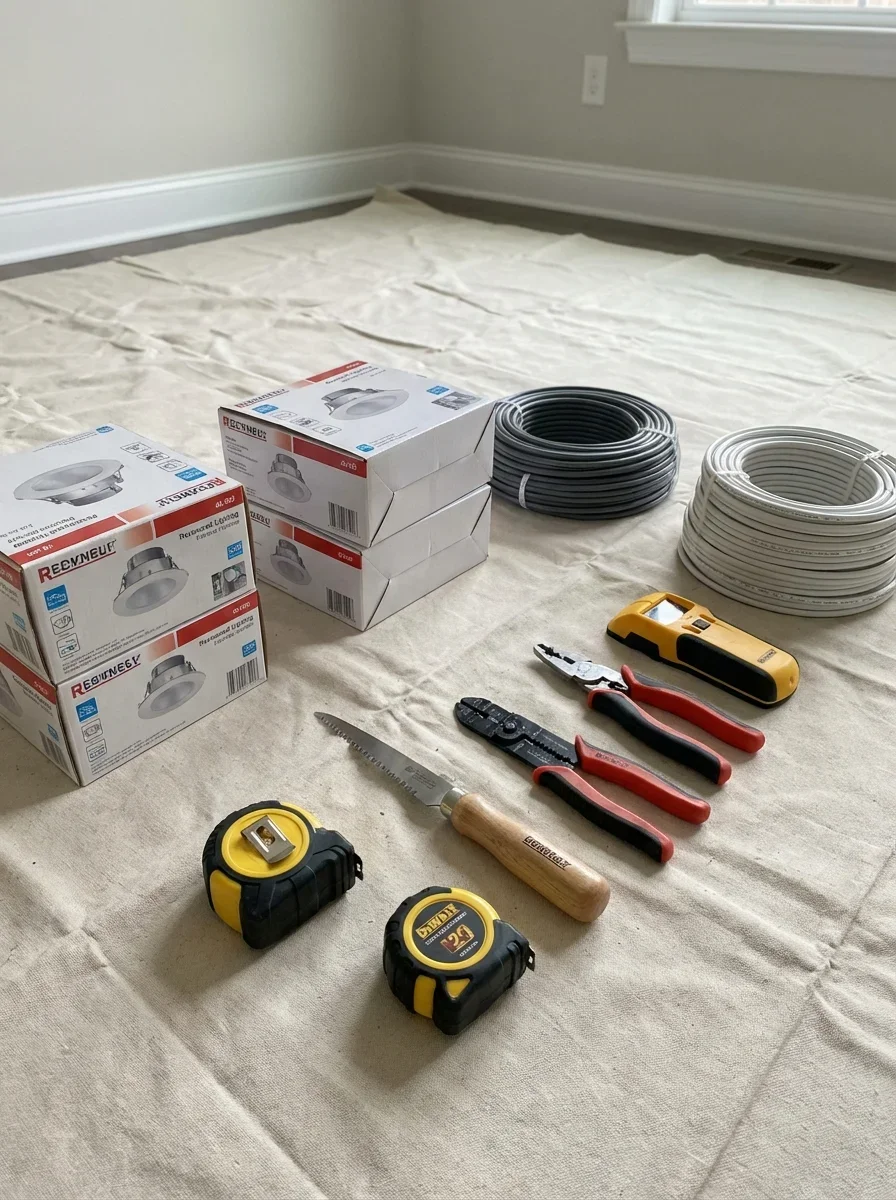
Professional installation averages $200-$300 per light including fixture, labor, and wiring in Arizona. That number assumes accessible ceiling space, a circuit with available capacity, and standard LED retrofit housings.
You'll pay more when conditions require extra work.
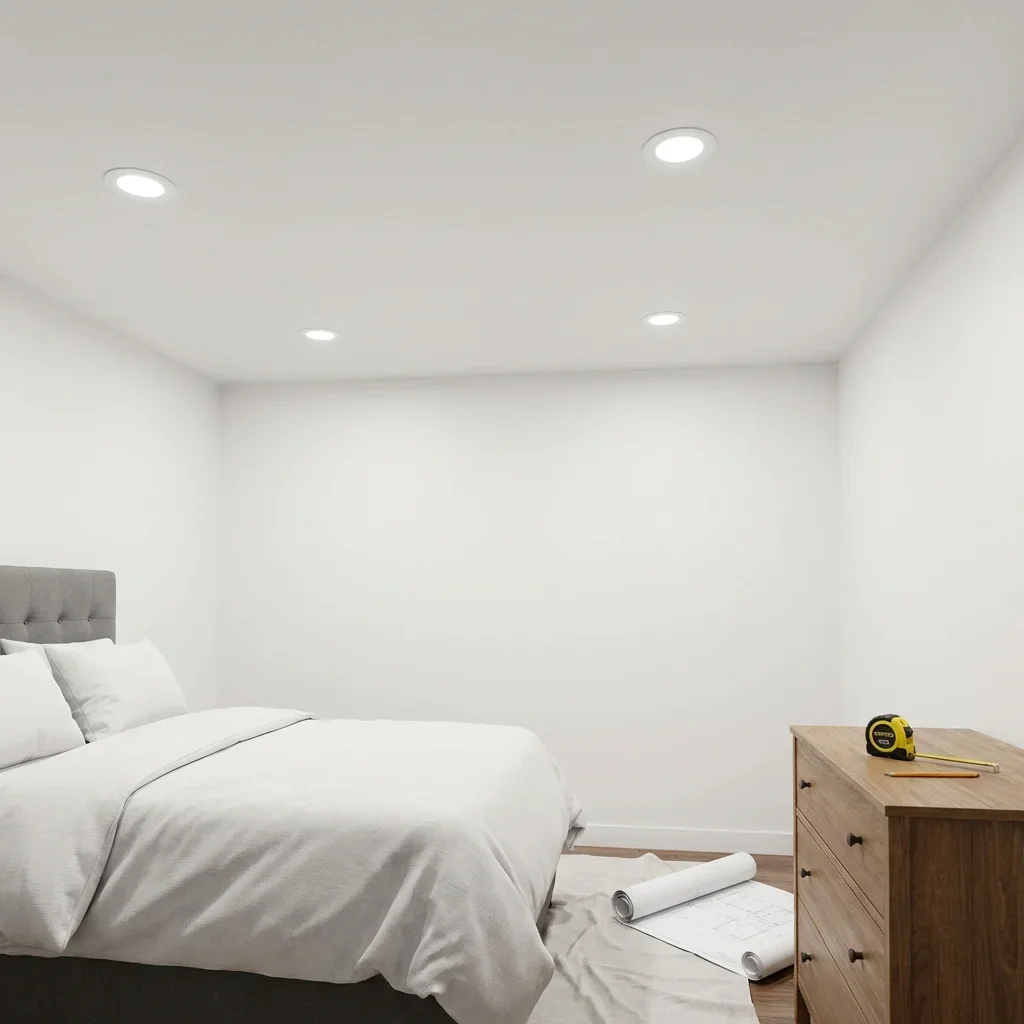
Most living rooms need 6-8 recessed lights depending on size and layout. A 16x20 living room typically costs $1,200-$2,400 installed. Smaller bedrooms might need only 4 lights ($800-$1,200).
Kitchens with task lighting over islands and counters often run $1,500-$2,500 for 8-10 fixtures.
| Room Type | Typical Lights Needed | Average Cost Range |
|---|---|---|
| Small Bedroom (10x12) | 4 lights | $800-$1,200 |
| Living Room (16x20) | 6-8 lights | $1,200-$2,400 |
| Kitchen | 8-10 lights | $1,500-$2,500 |
| Master Bedroom (14x16) | 6 lights | $1,200-$1,800 |
Cost Per Light and Per Room
Labor accounts for 60-75% of total project cost. Electricians in Phoenix charge $75-$125 per hour, and each light takes 45-90 minutes depending on ceiling access and wiring complexity.
Fixture cost ranges from $15 for basic LED retrofits to $120 for designer trims or specialty beam angles.
Smaller projects cost more per light because setup time is fixed. Running a new circuit, pulling permits, and the first ceiling cut take the same time whether you're installing 4 lights or 12. That's why per-light pricing drops from $300 each for a 3-light project to $175 each for a 12-light whole-home installation.
What Makes Installation More Expensive
Vaulted ceilings add $50-$100 per light due to difficult access and angled housings. You can't use standard recessed cans in sloped ceilings. The fixtures must be designed for the angle, and they cost more.
Limited attic access forces electricians to work from below, cutting access holes in closets or cutting the ceiling itself to fish wire. Drywall repair adds $150-$300 to the project.
If your home has blown-in cellulose insulation, the electrician will need to vacuum it out of the work area, install the lights, then re-blow insulation. That adds another $200-$400 in coordination costs.
Circuit upgrades increase cost when your existing panel lacks capacity. Adding a new 15-amp circuit from the main panel to the room runs $300-$600 depending on wire length. Older homes with aluminum wiring or Federal Pacific panels might need a full electrical panel upgrade before safe recessed lighting installation is possible.
Common Cost Add-Ons:
- Vaulted ceilings: +$50-$100 per light
- Limited attic access: +30% labor costs
- Drywall repair: +$150-$300 total
- New circuit installation: +$300-$600
- Blown-in insulation coordination: +$200-$400
- IC-rated fixtures: +$20-$40 per fixture
Recessed Lighting Fixture Types: What Electricians Recommend
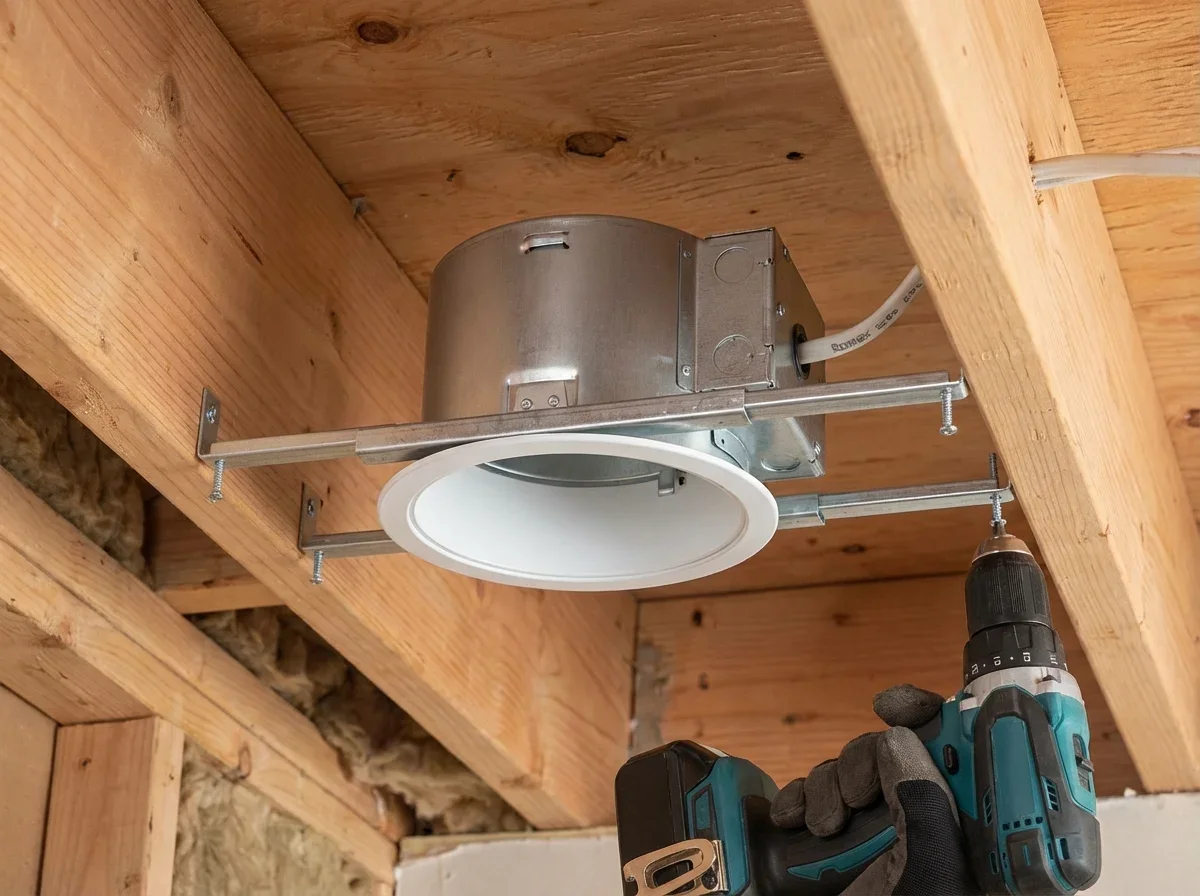
New construction housings mount directly to ceiling joists before drywall goes up. They're the least expensive option at $12-$25 per housing, but they only work in exposed framing.
If your ceiling is already finished, you need remodel housings.
Remodel housings (also called retrofit or old-work cans) have spring clips that grab the drywall from inside the ceiling cavity. You cut a hole with a hole saw, push the housing through, and the clips lock it in place. These cost $18-$45 each and install faster than new construction cans when you're working in existing ceilings.
Canless LED fixtures eliminate the housing entirely. They're thin LED modules with integrated drivers that mount flush to the ceiling. Installation is faster because there's no bulky housing to maneuver through insulation, and most are IC-rated by design since there's minimal heat output.
Canless fixtures cost $25-$80 each but save 30-45 minutes of labor per light, often making them cost-neutral or cheaper than traditional housings when you factor labor savings.
Airtight fixtures prevent conditioned air from leaking into the attic through the recessed light opening. Arizona homes lose 10-15% of cooling capacity through unsealed ceiling penetrations during summer.[2]
Airtight-rated recessed lights cost $5-$15 more than standard housings but pay for themselves in reduced AC costs within 2-3 years in Phoenix's climate where cooling runs May through October.
New Construction vs Remodel Recessed Lights
Choosing the wrong housing type is the most common DIY mistake.
New construction housings have a metal frame that nails to ceiling joists. If you try to install one in an existing ceiling, you'll need to cut a much larger hole to access the joists for nailing, then patch around the oversized opening.
Remodel housings are designed for finished ceilings.[6] The spring clips grip drywall thickness (typically 1/2 inch), creating enough tension to hold the fixture securely without fasteners. They work in plaster ceilings too, though plaster's extra thickness sometimes requires clip adjustment.
You can't use new construction housings in a remodel project without cutting access holes far larger than necessary. The labor to install them in finished ceilings negates any cost savings. You'll spend more on drywall repair than you saved on the cheaper housing.
How Many Recessed Lights Do You Need?
Start with ceiling height and room dimensions. For an 8-foot ceiling, lights should be 4 feet apart and 2 feet from walls.
That means a 12x12 bedroom needs four lights minimum, one in each quadrant. A 16x20 living room needs at least six lights in a grid pattern, though most electricians recommend eight to avoid dark corners.[5]
Beam angle affects coverage. Wide 60-degree floods let you space lights farther apart than narrow 25-degree spots. If you're using 6-inch housings with 60-degree trims, you can stretch spacing to 5-6 feet on 9-10 foot ceilings.
Narrow beams require closer spacing or they'll create spotlit zones with dark gaps between.
Don't forget task lighting. Kitchens need dedicated lights over the sink, stove, and countertops. Ambient lighting alone won't give you enough illumination for food prep.
Most electricians install 3-4 task lights over the kitchen peninsula or island, then add 4-6 ambient lights in a perimeter layout for general room lighting.
Pro Tip: The biggest lighting mistake homeowners make is using the same beam angle throughout the room. Mix narrow 25-degree spots for task areas with wide 60-degree floods for ambient lighting. This creates depth and prevents the flat, commercial look of uniform spacing.
Questions to Ask Your Electrician About Recessed Lighting
Does my panel have capacity for new lights? If your main panel is at or near capacity, you'll need a sub-panel installation or panel upgrade before adding circuits. Ask the electrician to check amp load during the estimate. Finding out during installation delays the project and adds emergency service fees.
What fixture type do you recommend for my ceiling? IC-rated requirements vary by insulation type and depth. Some electricians prefer canless LEDs in heavily insulated Arizona attics because they're faster to install and inherently IC-compliant. Others stick with traditional housings for easier trim changes down the road.
Both approaches work. You want an electrician who can explain their reasoning based on your specific ceiling conditions.
Are you including dimmer switch installation in the quote? LED recessed lights require compatible dimmers. Not all dimmers work with all LED fixtures. Incompatible combinations cause buzzing, flickering, or limited dimming range.
Your electrician should specify dimmer model and confirm compatibility with the fixtures they're installing.
How will you access the ceiling? This question reveals whether they've actually assessed the workspace. An electrician who hasn't checked attic access might quote low, then hit you with change orders when they discover complications.
You want someone who's already planned the wire routes and knows exactly how they'll access each light location.
Verify ROC licensing at https://roc.az.gov/ before signing any contract. Arizona requires electricians to carry an active Residential Electrical (R-2) or Commercial Electrical (C-11) license for work over $1,000. The ROC bond provides limited protection, but it's not a substitute for general liability and workers comp coverage.
Ask for certificates of insurance directly.
Find Electricians Who Specialize in Recessed Lighting
Recessed lighting looks simple until you're in the attic calculating circuit loads and routing wire around HVAC ducts.
The electricians who do this work regularly finish faster, waste less material, and deliver layouts that match how you use each room.
Look for contractors who include layout planning in their estimates. Not just a price per light, but a diagram showing fixture placement and switch locations. The best electricians will ask about furniture placement, which walls you want switches on, and whether you plan to use dimming or smart controls.
Those details determine wire gauge, box sizing, and dimmer selection before any holes get cut.
Check recent reviews for recessed lighting projects specifically. An electrician might have 50 five-star reviews for panel upgrades and outlet repairs, but zero experience with lighting design and consultation.
You want someone who's solved the same ceiling access challenges your home presents. Attic layouts in 1985 Phoenix tract homes are very different from 2015 custom builds in Scottsdale.
Frequently Asked Questions
- U.S. Department of Energy. "Recessed Lighting." https://www.energy.gov/energysaver/recessed-lighting. Accessed April 06, 2026.
- U.S. Department of Energy. "Electrical - Recessed Lighting." https://www.energy.gov/energysaver/electrical-recessed-lighting. Accessed April 06, 2026.
- National Electrical Manufacturers Association (NEMA). "Installation Guidelines." https://www.nema.org/standards/view/installation-guidelines-for-led-recessed-luminaires. Accessed April 06, 2026.
- National Fire Protection Association (NFPA). "Electrical Code Calculations." https://www.nfpa.org/codes-and-standards/all-codes-and-standards/list-of-codes-and-standards/detail?code=70. Accessed April 06, 2026.
- Penn State University Extension. "Selecting Recessed Lighting Fixtures." https://extension.psu.edu/selecting-recessed-lighting-fixtures. Accessed April 06, 2026.
- University of Minnesota Extension. "Electrical Wiring: Recessed Lights." https://extension.umn.edu/electrical-wiring-homes/recessed-lights. Accessed April 06, 2026.