What Is a Sub Panel and How Does It Work?
A sub panel is a secondary electrical panel that feeds from your main service panel through large feeder wires. It distributes power to local circuits in a specific area — your garage, workshop, detached casita, or home addition — without running individual circuits all the way back to your main panel.[1]
Think of it as a relay station.
Your main panel sends bulk power through two hot wires and a neutral, sized according to the sub panel's amperage rating (typically 50, 60, or 100 amps). The sub panel then breaks that power into individual circuits — 120V outlets, 240V appliance circuits, lighting — just like your main panel does for the rest of your house. The key difference: sub panels must have separate neutral and ground bars with proper bonding, a code requirement that prevents dangerous voltage on metal components.[1]
In Arizona's slab-on-grade homes (no basements), sub panels are often surface-mounted in garages or on exterior walls near additions. The feeder wires usually run through conduit above ground or buried in trenches, depending on location and local code interpretation.
For detached structures like workshops or casitas, the sub panel needs its own grounding electrode system — a ground rod driven into Arizona's caliche soil, which can add excavation complexity and cost.[4]
When Do You Need a Sub Panel Instead of a Main Panel Upgrade?
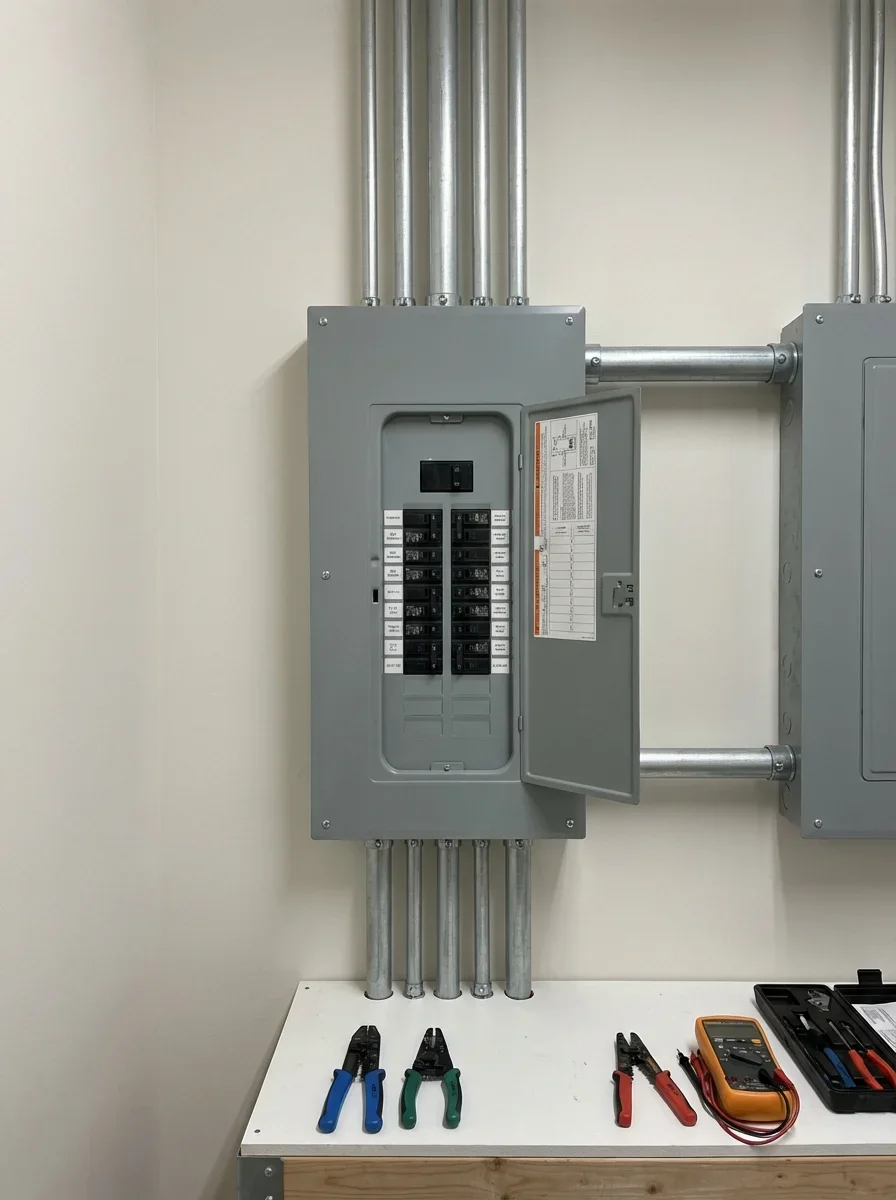
Sub panels make sense when you need additional circuits in one concentrated area, but your main panel has enough total capacity to handle the extra load. If your main panel is already maxed out (common in older Arizona homes with 100-amp service), you'll need a full panel upgrade before adding a sub panel.
But if you have capacity to spare and just need circuits closer to where you're working, a sub panel costs $400-$1,800 versus $1,500-$4,000+ for a main panel replacement.
Your electrician should perform a load calculation per NEC Article 220 before recommending a solution.[5] This calculation accounts for continuous loads (things that run for 3+ hours, like pool pumps) and non-continuous loads (tools, chargers, lighting) to determine whether your main service can handle the additional amperage. In Phoenix-area homes built before 2000, you'll often see 100-125 amp main panels that have enough headroom for a 60-amp garage sub panel but would struggle with a 100-amp addition.
| Solution | Best For | Typical Cost | Timeline |
|---|---|---|---|
| Sub Panel | Adding circuits to one area; main panel has capacity | $400-$1,800 | 1 day |
| Main Panel Upgrade | Whole-home capacity increase; maxed out existing service | $1,500-$4,000+ | 1-2 days |
| Dedicated Circuit | Single appliance (EV charger, hot tub) | $200-$600 | 2-4 hours |
Sub Panels for Garages and Workshops
Arizona garages serve triple duty as workshops, storage, and often secondary living spaces during the cooler months. A detached or poorly-served garage might share a single 20-amp circuit with outdoor outlets, which trips the breaker the moment you fire up a table saw and compressor simultaneously.
A 60-100 amp sub panel in a garage typically supports 6-12 circuits, enough for multiple 120V outlets, 240V welder or compressor circuits, overhead lighting, and an EV charger if needed.
Homeowners consistently report garage sub panels as the most cost-effective install — short wire runs (often 10-30 feet from the main panel), easy accessibility, and straightforward permitting. One Gilbert homeowner paid $650 for a 60-amp sub panel installed 15 feet from their main panel, using direct burial wire and a single ground rod. Higher quotes in the $1,200-$1,500 range usually reflect conduit requirements, longer runs, or 100-amp capacity for future-proofing.
Home Additions and Detached Structures
Additions — whether a converted garage apartment, casita, or new room — need their own circuit cluster to avoid overloading existing panel capacity. Running six individual circuits from your main panel to the addition creates voltage drop issues over long distances and clutters your main panel with breakers.
A sub panel consolidates the feeder to one large wire run, then distributes locally.
For detached structures (workshops, casitas, pool equipment rooms), NEC 250.32 requires a separate grounding electrode system at the sub panel location.[4] In Arizona, that means driving an 8-foot ground rod into soil that's often caliche — calcium carbonate hardpan that starts 1-6 feet down. Electricians report needing jackhammers or specialized driving tools in some areas, which adds $150-$300 to labor costs compared to softer soil.
The feeder wire must also be sized for distance — a 100-amp sub panel 80 feet from the main panel might require 1/0 AWG aluminum or 2 AWG copper instead of the 3 AWG copper you'd use for a 30-foot run.
How Much Does Sub Panel Installation Cost?
Sub panel pricing breaks into two buckets: the panel and materials ($150-$600) and labor ($250-$1,200+).
Labor dominates the total cost, driven by wire run distance, accessibility, and how much demo or conduit work is required.
Cost by Amperage and Wire Run Distance
Panel and materials only:
- 50-60 amp sub panel kit: $80-$150
- 100 amp sub panel kit: $120-$250
- Feeder wire (copper THHN or aluminum XHHW): $2-$8 per foot depending on gauge and type
- Conduit (PVC or EMT): $1.50-$3 per foot
- Ground rod, connectors, breakers: $50-$150
Typical all-in installed costs:
- Simple garage sub panel (60 amp, 10-20 foot run, easy access): $400-$800
- Garage sub panel with conduit and permitting (100 amp, 30-50 foot run): $800-$1,400
- Detached structure (100 amp, 50-100 foot run, ground rod, trenching): $1,200-$1,800
- Complex installs (long buried runs, tight access, older home code upgrades): $1,500-$2,500
Homeowners in Chandler and Tempe consistently report $900-$1,300 as the median quote for a 60-amp garage sub panel with a 25-foot wire run and permit.
Quotes over $1,500 for simple installs often reflect high-overhead companies. Quotes under $600 typically come from smaller ROC-licensed electricians who skip the billboard advertising.
Pro Tip: The biggest surprise cost in sub panel installations comes from hidden grounding upgrades. If your main panel lacks proper grounding or uses an incorrect neutral-ground bond, Arizona code requires fixing that first — potentially adding $200-$500 to your quoted price. Always ask electricians if they've inspected your main panel's grounding configuration before accepting a quote.
What Professional Installation Includes
A code-compliant sub panel install includes load calculations, permit application, feeder wire sizing per NEC Table 310.15(B)(16), proper grounding and bonding, and final inspection. Arizona requires permits for all sub panel work, with fees ranging $50-$200 depending on jurisdiction.
The electrician pulls the permit, but you're the legal permit holder — make sure they close it out with the final inspection, or you'll face issues when selling your home.
The installation process:
- Load calculation: Determines required amperage based on planned circuits
- Feeder wire sizing: Accounts for voltage drop over distance (longer runs need thicker wire)
- Grounding and bonding: Separate neutral and ground bars in the sub panel; ground electrode for detached structures
- Physical installation: Panel mounting (36 inches of clear working space required per NEC 408), conduit runs, wire pulling
- Connection and testing: Final hookup at main panel, voltage checks, inspection sign-off
One Scottsdale electrician noted that older Arizona homes often need additional grounding upgrades when adding sub panels — if your main panel lacks proper grounding or uses a neutral-ground bond in the wrong location, code requires fixing that before the sub panel install.
That can add $200-$500 to the project, a surprise that catches homeowners off-guard when they're quoted $700 then receive a final bill of $1,100.
Sub Panel vs Dedicated Circuit: Which Do You Need?
If you only need one or two new circuits (a 240V hot tub circuit, a kitchen appliance outlet), a dedicated circuit is simpler and cheaper than a sub panel. A dedicated circuit runs directly from your main panel to the appliance location — no intermediate panel, lower material cost, faster install.
When a dedicated circuit makes sense:
- Single appliance needs (EV charger, hot tub, kiln, welder)
- Short distance from main panel (under 50 feet)
- Main panel has available breaker slots
- Cost: $200-$600 per circuit
When a sub panel is the better solution:
- Multiple circuits needed in one area (garage with outlets, 240V compressor, lighting, future expansion)
- Long distance from main panel (50+ feet) where multiple individual circuits would create voltage drop
- Main panel is full but you have capacity to spare (sub panel consolidates multiple circuits into one main panel breaker)
- Future-proofing for additions or changing equipment needs
In Phoenix and Tucson, pool equipment is a common sub panel trigger.
A pool might need circuits for a pump, heater, lights, auto-fill valve, and cleaner — five circuits that would clutter your main panel and require five separate wire runs. A 60-amp sub panel near the equipment pad handles everything on local circuits fed by one feeder wire.
Code Requirements and Permit Process for Sub Panels
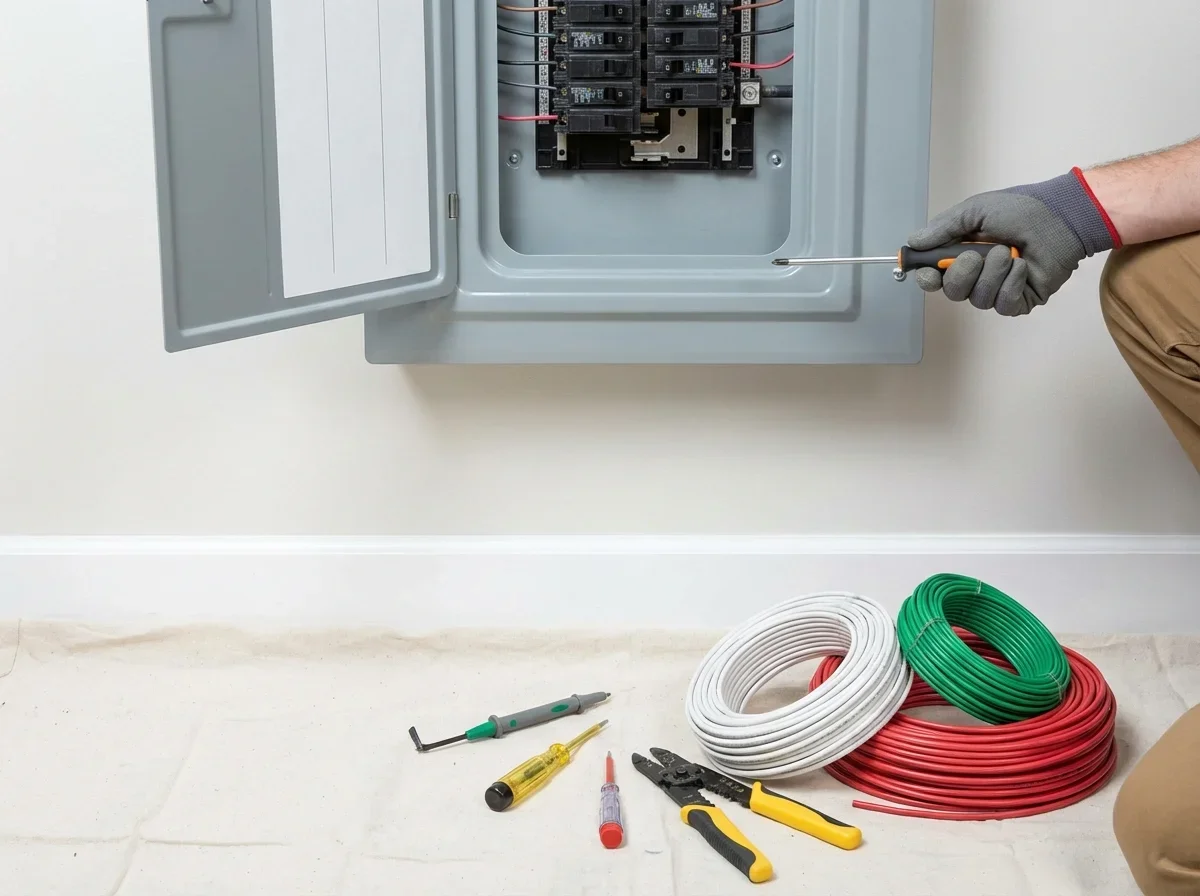
Arizona follows the International Residential Code with state amendments, enforcing NEC Article 408 for all panelboard installations.[2] The key requirements electricians must follow:
Location and clearances:
- 36 inches of clear working space in front of the panel
- 30 inches lateral clearance
- Panel accessible without moving permanent fixtures or appliances
- Indoor panels must be in dry locations; outdoor panels require NEMA 3R or better ratings
Grounding and bonding:
- Sub panels must have separate neutral and ground bars
- Bonding screw removed (neutral and ground only bond at the main panel, not the sub)
- Detached structures require a local grounding electrode (ground rod or Ufer ground)
- Grounding electrode conductor sized per NEC Table 250.66
Feeder wire sizing:
- Wire gauge based on amperage, distance, and voltage drop calculations
- Arizona's high ambient temperatures (120°F+ in attics, conduit) require de-rating wire ampacity per NEC 310.15(B)(3)(a)
- Aluminum wire is code-compliant and commonly used for long runs (costs less than copper, but requires anti-oxidant paste and proper terminations)
Verify your electrician holds an active ROC license at https://roc.az.gov/. Look for a CR-11 (Residential Electrical) or CR-7 (Electrical—Low Voltage) designation.
Arizona doesn't require contractors to carry workers' comp insurance, so ask for proof of liability coverage independently — the ROC bond is only $7,000 for residential electrical contractors, which won't cover significant damage or injury claims.
Sub Panel Installation Quick Facts:
- Permit required in all Arizona jurisdictions ($50-$200 fee)
- Installation timeline: 3-6 hours for simple garage installs, full day for detached structures
- Main panel must have available capacity (load calculation determines this)
- Detached structures need separate ground rod (8-foot minimum depth)
- Typical electrician labor rate: $75-$175/hour depending on company size
- Final inspection required before project closure
- Arizona's high heat requires wire ampacity de-rating in attics and conduit
Find Electricians Who Install Sub Panels Properly
The gap between a $650 install and a $1,500 install often comes down to accurate load calculations and proper feeder wire sizing, not just labor rates.
An undersized sub panel creates problems immediately — breakers trip under normal loads, or you can't add the circuits you expected. An oversized panel wastes money on wire and materials you'll never use.
Ask prospective electricians:
- "Do you perform load calculations per NEC Article 220 before sizing the sub panel?" (The answer should be yes, not a guess based on "what usually works.")
- "What wire gauge and type will you use for the feeder, and how did you calculate voltage drop?" (They should reference NEC tables and account for distance.)
- "Will you pull the permit and handle the final inspection?" (Some contractors charge extra for permitting; clarify upfront.)
- "What's included in your quote — panel, wire, conduit, ground rod, permit, labor?" (Itemized quotes prevent surprise add-ons.)
Small ROC-licensed electricians in Gilbert, Chandler, and Tempe consistently quote $75-$100/hour for sub panel installs, with 3-6 hours typical for straightforward jobs. Larger companies with billboard advertising often charge $125-$175/hour — you're paying for marketing overhead, not necessarily better work.
Check recent project photos, verify licensing status, and get 2-3 quotes for comparison.
For electrical code compliance and permitting support, licensed electricians handle the paperwork and scheduling — a service that's worth paying for rather than navigating city building departments yourself. The final inspection confirms your sub panel is installed safely and won't cause insurance or resale complications down the road.
- Mike Holt Enterprises (NEC Expert). "Subpanels." https://www.mikeholt.com/nec-subpanels.php. Accessed April 06, 2026.
- National Fire Protection Association (NFPA). "Article 408 — Switchboards, Switchgear, and Panelboards." https://www.nfpa.org/codes-and-standards/all-codes-and-standards/list-of-codes-and-standards/detail?code=70. Accessed April 06, 2026.
- U.S. Department of Energy. "Electrical Service Subpanels." https://www.energy.gov/energysaver/electrical-service-subpanels. Accessed April 06, 2026.
- National Fire Protection Association (NFPA). "250.32 Buildings or Structures Supplied by a Feeder(s) or Branch Circuit(s)." https://www.nfpa.org/codes-and-standards/all-codes-and-standards/list-of-codes-and-standards/detail?code=70. Accessed April 06, 2026.
- Penn State University Extension. "Load Calculations for Electrical Services and Feeders." https://extension.psu.edu/load-calculations-for-electrical-services-and-feeders. Accessed April 06, 2026.
- U.S. Department of Energy. "Residential Electrical Code Requirements." https://www.energy.gov/energysaver/residential-electrical-code-requirements. Accessed April 06, 2026.