What Makes Commercial Electrical Work Different?
Commercial electrical projects start where residential code requirements end. While a home electrician might handle a 200-amp single-phase panel and residential branch circuits, commercial work involves coordinated power distribution for multiple tenants, backup generator integration, and electrical systems designed for 20-30 year operational lifecycles.
The National Electrical Code (NEC) applies to both sectors, but commercial installations trigger additional requirements under NFPA 70 that most residential contractors never encounter.[4] You're dealing with fire alarm integration, emergency egress lighting, elevator power systems, and accessibility standards that don't exist in residential construction.
In Arizona, commercial projects face stricter permit review. The City of Phoenix Building Department applies different inspection protocols for commercial tenant improvements than for residential remodels, often requiring stamped engineering drawings before issuing permits.
Code Requirements and Compliance Standards
Commercial buildings follow the International Building Code (IBC) rather than the International Residential Code (IRC) that governs homes. That shift brings ADA-compliant outlet heights, specific conduit fill requirements for exposed raceways, and mandatory arc-fault protection in areas that residential code exempts.
Arizona adopted the 2021 NEC with state amendments in 2023. Commercial inspectors enforce those amendments more stringently than residential plan reviews.
OSHA standards for electrical safety add another compliance layer that doesn't affect homeowners.[1] Commercial contractors must document lockout/tagout procedures, maintain electrical safety programs for employees working on energized equipment, and comply with recordkeeping requirements under 29 CFR 1904. When a contractor tells you they're "OSHA compliant," they should be able to produce their written electrical safety plan and documentation of annual employee training.
| Requirement Category | Residential Electrical | Commercial Electrical |
|---|---|---|
| Governing Code | International Residential Code (IRC) | International Building Code (IBC) + NFPA 70 |
| Typical Service | 200-amp single-phase | 400-800 amp three-phase |
| OSHA Compliance | Not required | Mandatory safety programs & documentation |
| Permit Review | Standard residential process | Requires engineered drawings & stricter inspection |
Three-Phase Power and High-Voltage Systems
Most Arizona homes run on 120/240-volt single-phase power. Commercial buildings typically use 208Y/120-volt or 480Y/277-volt three-phase systems to efficiently distribute power across multiple floors or large equipment loads.
A commercial electrician needs to calculate voltage drop across longer distribution runs, balance loads across all three phases, and specify transformers when office equipment requires 120-volt power but the building service delivers 277 volts. Three-phase motor controllers, variable frequency drives, and power factor correction equipment don't appear in residential work.
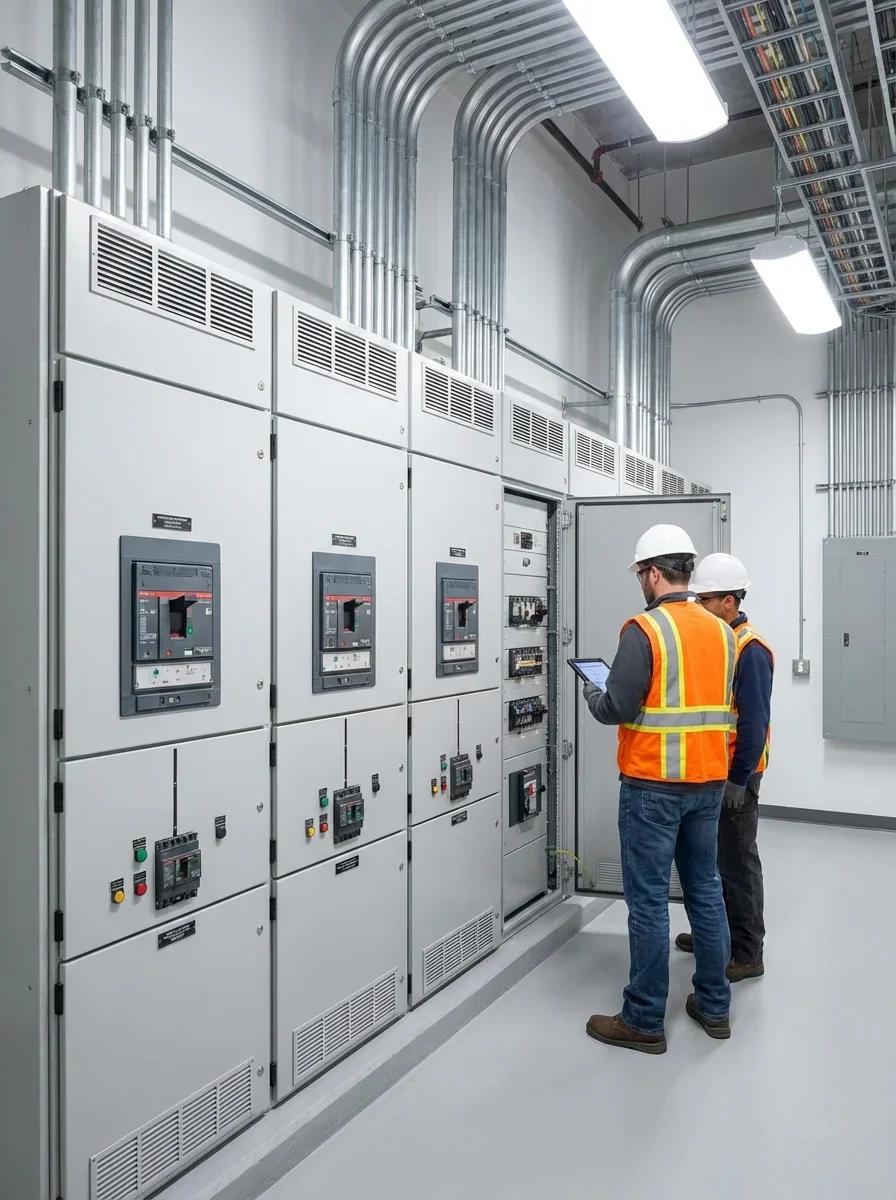
Neither do 400-amp or 800-amp switchgear assemblies, metered tenant sub-panels, or parallel generator systems that automatically sync with utility power. These aren't just bigger versions of residential components. They require different training, specialized test equipment, and familiarity with equipment manufacturers that don't sell to the residential market.
Types of Commercial Electrical Services
Tenant Improvement and Build-Out Electrical
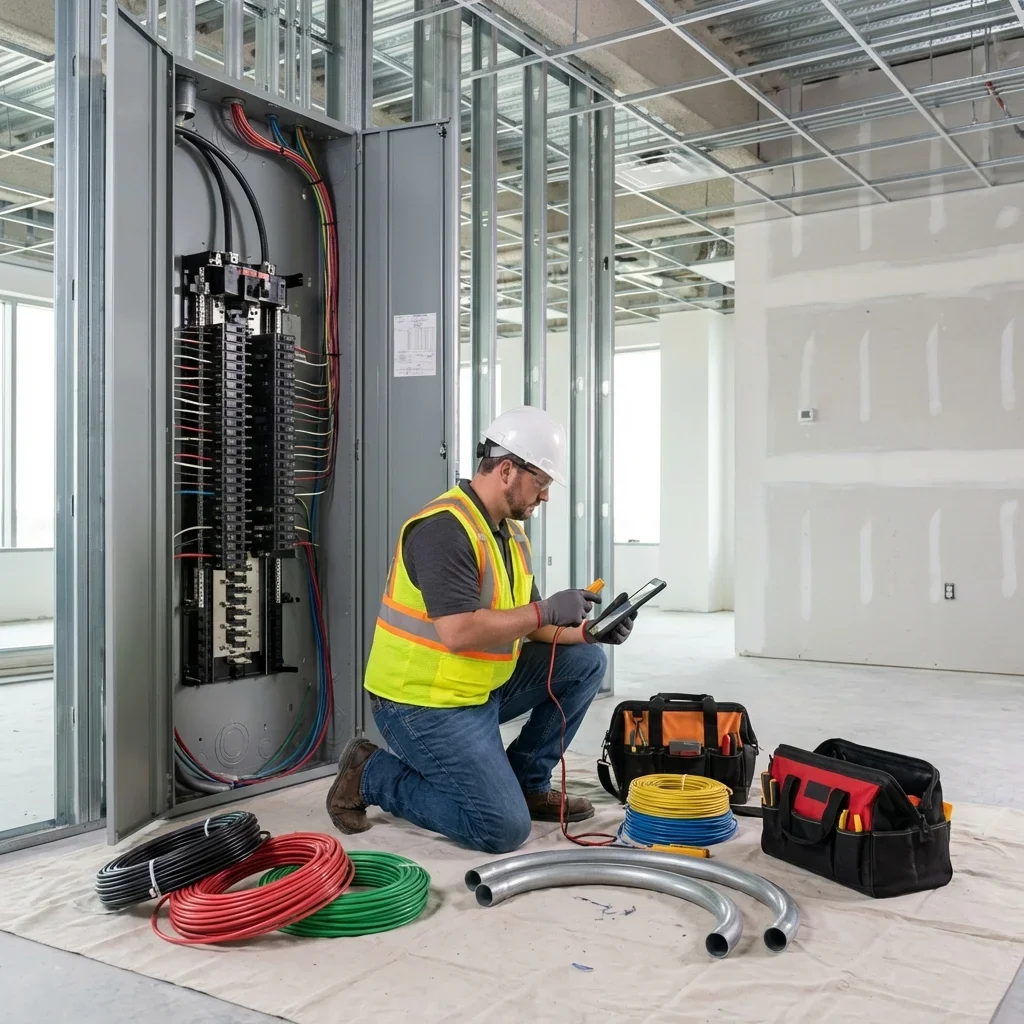
Converting raw commercial space into usable offices, retail stores, or medical suites drives most commercial electrical work. Tenant improvements (TIs) often start with empty shell space: concrete floors, exterior walls, and a utility service, but no interior electrical distribution.
The electrician designs the entire power layout. Panel locations, circuit routing, data/telecom pathways, and lighting systems that meet energy code requirements under ASHRAE 90.1.
Arizona's dry climate creates unique considerations for conduit routing in TI projects. Unlike humid regions where electricians run EMT conduit exposed along walls, Arizona commercial spaces often use exposed conduit as a design element since corrosion isn't a concern. That saves money on drywall soffits but requires precise bending and alignment. Sloppy conduit work is visible forever.
For medical or food service TIs, health department requirements dictate specific electrical configurations like sealed light fixtures in food prep areas or isolated ground circuits for medical imaging equipment.
Electrical Panel Upgrades and Service Increases
Office buildings adding server rooms, restaurants installing new kitchen equipment, or warehouses adding EV charging stations quickly exceed their existing electrical service capacity. Upgrading from 200-amp to 400-amp service isn't just swapping panels.
It involves utility coordination for new transformer installation, trenching for larger service conductors, and often structural work to accommodate bigger switchgear.
In Phoenix's older commercial districts near downtown, buildings frequently have 1960s-era electrical services sized for far less power demand than modern businesses require. Upgrading these systems sometimes reveals aluminum service conductors or obsolete fuse-based disconnects that need complete replacement. Budget $15,000-$40,000 for commercial service upgrades depending on amperage increase and whether utility transformer replacement is required.
If you need more comprehensive information on commercial panel work specifically, our guide to commercial panel upgrades covers the technical requirements and permitting process in detail.
Pro Tip: Before finalizing your commercial space lease, request the building's electrical capacity documentation. Many older buildings can't support modern equipment loads without costly service upgrades that become your responsibility as the tenant. A 10-minute review could save you $30,000+ in unexpected electrical work.
Emergency and Backup Power Systems
Arizona commercial buildings often require emergency power systems under IBC Chapter 27 and NFPA 101. Exit signs, egress lighting, fire alarm panels, and elevator recall systems must remain operational during utility outages.
That means battery backup systems, emergency lighting inverters, or standby generators with automatic transfer switches that engage within 10 seconds of power loss.
Restaurants, data centers, and medical facilities typically install optional standby power systems (beyond code-required emergency systems) to prevent business disruption and product loss during outages. A properly specified commercial generator system includes load shedding controls that prioritize critical circuits, utility monitoring to prevent backfeed, and integration with building management systems.
Desert UV exposure in Arizona degrades generator enclosures and fuel lines faster than humid climates. Commercial generators here need UV-resistant components and more frequent cooling system maintenance due to sustained 110°F+ summer temperatures.
Commercial Lighting Design and Retrofits
Energy codes now mandate lighting power density limits measured in watts per square foot, which most older commercial buildings exceed by 40-60%. LED retrofits reduce energy costs while meeting ASHRAE 90.1 and Arizona's 2021 energy code amendments.
But commercial lighting design isn't just swapping bulbs. It involves photometric analysis showing foot-candle levels at work surfaces, emergency lighting calculations proving adequate illumination during power outages, and daylight harvesting controls in spaces with exterior windows.
Arizona's high solar exposure makes daylight harvesting especially effective. Properly designed systems use photosensors to dim or shut off fixtures near windows during peak daylight hours, reducing electrical demand when utility rates are highest. For warehouses and retail spaces, high-bay LED fixtures with occupancy sensors can cut lighting energy use 70% compared to old metal halide systems.
The U.S. Department of Energy establishes efficiency standards for commercial lighting products, which affects fixture selection for projects pursuing utility rebates.[5]
Commercial Electrician Licensing and Qualifications
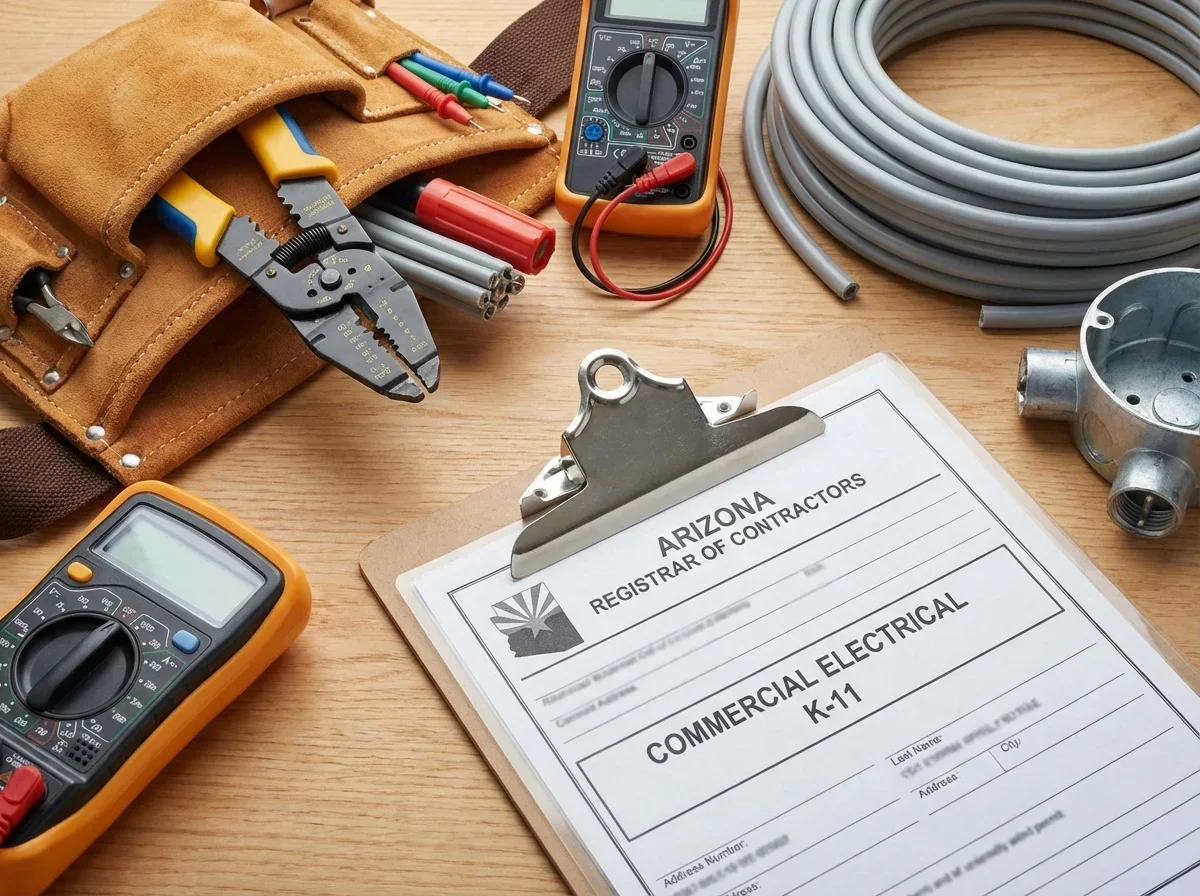
Arizona requires separate licensing for commercial electrical work through the Arizona Registrar of Contractors (ROC). Electricians performing commercial projects need either a K-11 (Commercial Electrical) or CR-11 (Residential & Commercial Electrical) license classification.
Residential electricians holding only R-11 licenses cannot legally bid or perform commercial electrical work. Their insurance won't cover commercial job sites.
License verification takes 30 seconds at roc.az.gov. Enter the license number and confirm it's current, that the classification includes commercial work, and that the bonding and insurance are active. Most commercial projects require contractors to carry $1 million or $2 million general liability coverage, far exceeding the $500,000 typical for residential work. Arizona doesn't mandate workers compensation insurance, but reputable commercial contractors carry it anyway since job site injuries on commercial projects often involve higher liability exposure.
The National Electrical Contractors Association notes that states with statewide licensing typically administer examinations covering commercial code knowledge, load calculations, and specifications interpretation that residential-only exams don't test.[3] Arizona's commercial electrical exam includes questions on three-phase calculations, feeder sizing for motor loads, and coordinating overcurrent protection devices. Topics that don't appear on residential tests.
Experience matters too. Look for contractors who've completed projects similar to yours in size and complexity, not just someone who claims they "can handle commercial."
Arizona Commercial Electrician License Requirements Quick Reference:
- Required License: K-11 (Commercial) or CR-11 (Residential & Commercial)
- Verify Status: roc.az.gov using contractor license number
- Insurance Minimums: $1-2 million general liability (vs. $500K residential)
- Exam Coverage: Three-phase calculations, motor load sizing, commercial code interpretation
- Workers Comp: Not state-mandated but carried by reputable contractors
- License Restrictions: R-11 (Residential only) licenses cannot legally perform commercial work
What Should Commercial Electrical Services Cost?
Commercial electrical pricing follows different economics than residential work. You're paying for specialized knowledge, higher insurance premiums, commercial-grade materials with longer lead times, and often prevailing wage rates if your project involves public funding or certain development incentives.
Hourly rates for commercial electricians in the Phoenix metro area run $95-$165 per hour depending on project complexity and timing. That's 30-50% higher than residential rates, but you're also getting contractors who carry proper insurance, pull permits correctly, and coordinate with inspectors who enforce commercial code standards.
Emergency or after-hours service to minimize business disruption costs even more. Expect premium rates of $175-$250 per hour for weekend or overnight work that keeps your business operational.
Factors That Affect Commercial Electrical Pricing
Project timing significantly impacts cost. Working during business hours in an occupied space requires additional safety protocols, dust containment, and coordination to avoid disrupting operations. Many contractors add 15-25% to the base labor rate for occupied-space work.
Conversely, scheduling electrical work during a planned closure or overnight can reduce total project cost by allowing faster, more efficient installation without constant interruptions.
Permit fees for commercial electrical work in Arizona cities scale with project valuation. A $50,000 tenant improvement might incur $800-$1,200 in permit and plan review fees, compared to $200-$300 for similar-sized residential work. Plan review can take 2-4 weeks, and inspectors often require corrections before issuing approval to energize new circuits.
Those holding costs (paying rent on space you can't occupy yet) often exceed the permit fees themselves.
Material costs for commercial projects reflect different specifications than residential work. Commercial-grade breaker panels, three-phase distribution equipment, and UL-listed emergency lighting components cost substantially more than residential equivalents. Lead times matter too. Ordering a 400-amp main breaker panel might require 6-10 weeks, while residential 200-amp panels ship next-day.
Contractors typically add 10-15% contingency to material estimates for commercial projects to cover spec changes and unforeseen conditions discovered during installation.
How to Choose a Commercial Electrical Contractor
Start with projects in your sector. An electrician experienced with retail build-outs understands different requirements than someone who primarily wires office spaces or industrial facilities.
Ask for reference projects similar in scope, and actually call those references. Ask whether the contractor coordinated effectively with other trades, stayed on schedule, and handled inspection corrections without drama or upcharges.
OSHA compliance isn't optional for commercial work. Ask candidates about their electrical safety program, lockout/tagout procedures, and employee training documentation.[2] A contractor who hesitates or dismisses the question lacks the safety infrastructure required for commercial job sites. You need to see their OSHA 300 log (injury recordkeeping), proof of safety training for workers, and their written electrical safety plan.
These aren't bureaucratic extras. They're indicators of how seriously the contractor takes job site safety and regulatory compliance.
Get detailed proposals that break out labor, materials, permits, and inspection fees separately. Lump-sum bids obscure what you're actually paying for and make change orders harder to evaluate. The proposal should reference specific NEC articles governing your work, list the inspection sequence, and include a realistic timeline that accounts for permit review and material lead times.
If the bid seems unusually low, the contractor probably missed something or plans to use residential-grade materials that won't pass commercial inspection.
Verify that the contractor will handle all permit applications and inspection coordination. You shouldn't be the intermediary between your electrician and the building department. Ask who will be the designated point of contact during inspections. It should be a licensed electrician who can discuss code requirements with inspectors and authorize field corrections if needed.
Find Licensed Commercial Electricians Near You
Commercial electrical work demands specialized expertise that most residential contractors don't possess. You need someone who understands three-phase power distribution, interprets commercial energy codes, carries appropriate insurance, and coordinates effectively with building inspectors who enforce standards beyond residential requirements.
Our directory includes licensed commercial electricians throughout Arizona who hold active ROC K-11 or CR-11 classifications. Every contractor listing shows their license number (verify at roc.az.gov), insurance coverage, areas of specialization, and verified project experience.
For emergency situations requiring immediate commercial electrical service, our emergency electrical service page connects you with contractors offering 24/7 response for business-critical situations.
Whether you're planning a multi-tenant office build-out, upgrading your restaurant's electrical service for new equipment, or retrofitting warehouse lighting to meet current energy codes, start with contractors who have demonstrable commercial experience and the proper licensing to back it up. The stakes are higher than residential work, both in project cost and in the consequences of hiring someone unqualified.
- Occupational Safety and Health Administration (OSHA). "Electrical Contractors Industry - Standards." https://www.osha.gov/electrical-contractors/standards. Accessed April 06, 2026.
- Occupational Safety and Health Administration (OSHA). "Electrical - Standards." http://www.osha.gov/electrical/standards. Accessed April 06, 2026.
- National Electrical Contractors Association (NECA). "State Regulations and Licensing." https://www.necanet.org/topics/codesandstandards/the-nec/state-regulations-and-licensing. Accessed April 06, 2026.
- Electrical Safety Foundation International (ESFI). "The National Electrical Code (NEC)." https://www.esfi.org/workplace-safety/industry-codes-regulations/the-national-electrical-code-nec/. Accessed April 06, 2026.
- U.S. Department of Energy (DOE). "Standards and Test Procedures." https://www.energy.gov/cmei/buildings/standards-and-test-procedures. Accessed April 06, 2026.