What Are the Signs of Dangerous Electrical Problems?
Your electrical system operates behind walls where you can't see deteriorating connections, overheating wires, or insulation breaking down. The warning signs leak out as sensory cues — sounds, smells, visual changes, and physical sensations that reveal what's happening inside your walls.
The National Fire Protection Association identifies frequent breaker trips, tingling when touching appliances, and warm or discolored outlets as primary indicators of electrical hazards[2] that require professional evaluation.
Most electrical failures follow a progression. A loose connection creates resistance, resistance generates heat, heat damages insulation, and damaged insulation eventually sparks or catches fire. The visible symptoms you notice represent different stages in this breakdown.
A flickering light might be the first sign of a connection coming loose. By the time you smell burning plastic, that connection has degradated to the point where it's melting wire insulation.
Arizona's extreme temperature swings accelerate this deterioration. Summer days above 106°F in Phoenix followed by overnight lows 30 degrees cooler create thermal expansion and contraction that loosens connections over time. This hits particularly hard in older homes where wire terminations weren't rated for desert heat cycling. The desert UV exposure that fades your car paint also breaks down electrical insulation faster than it would in humid climates, especially in attic spaces where temperatures routinely exceed 150°F during summer months.
Pro Tip: If you detect electrical problems in Arizona during summer months, address them immediately. The combination of extreme heat and electrical faults accelerates deterioration exponentially — what might take months to become dangerous in mild climates can progress to fire hazard in weeks during Phoenix's 110°F+ stretches.
Warning Signs That Require Immediate Action
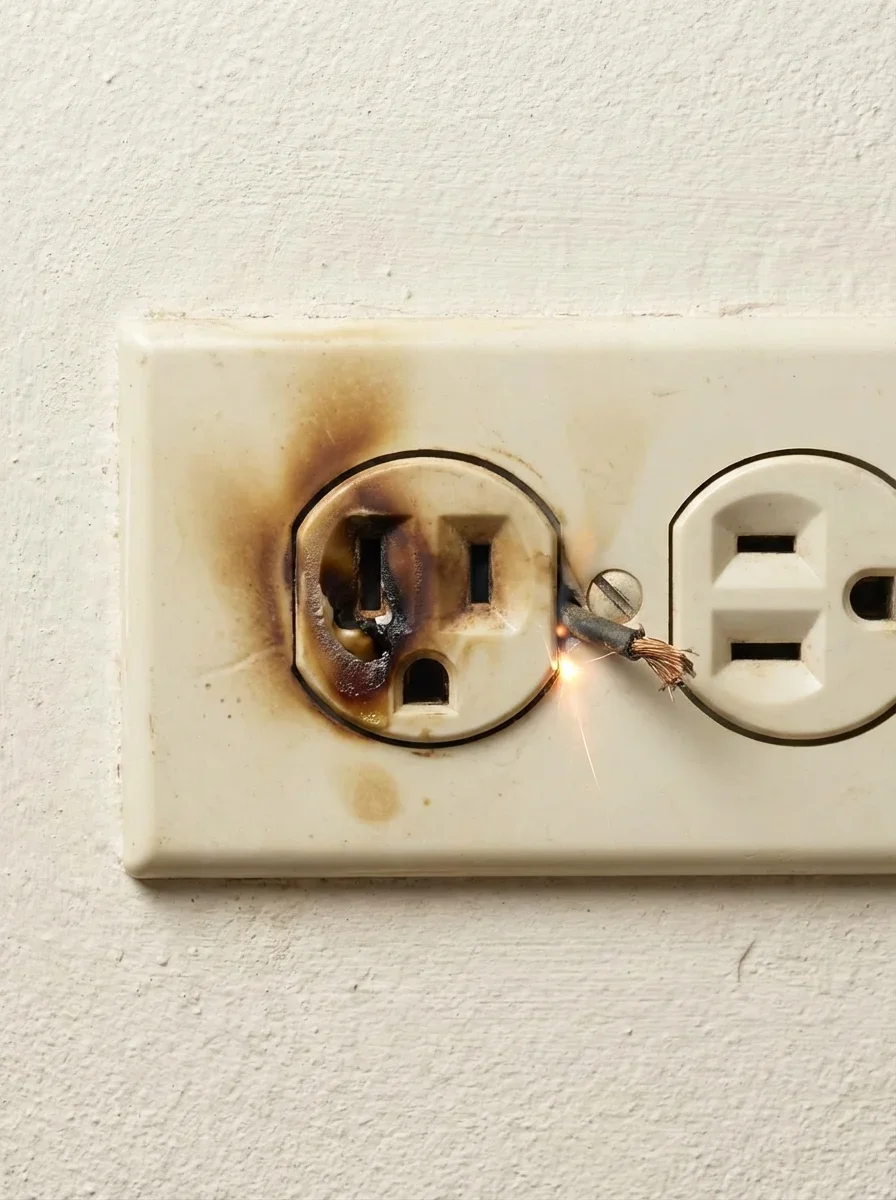
Some electrical problems give you time to research contractors and schedule appointments. Others demand that you shut off power and call for help right now.
The difference comes down to whether active degradation is happening. If something is actively burning, arcing, or smoking, you're watching a fire in progress.
Burning Smells from Outlets or Walls
That acrid plastic smell near an outlet or light switch means wire insulation is melting from excessive heat. The odor is distinctive — not like burnt food or candle wax, but sharp and chemical. If you can trace the smell to a specific outlet, switch, or fixture, turn off the breaker controlling that circuit and leave it off. Don't use that outlet again until a licensed electrician identifies and repairs the problem.
Sometimes the burning smell appears without an obvious source. You walk through a room and catch it, but can't pinpoint which wall or device it's coming from.
This scenario is actually more dangerous because it suggests the problem is inside a junction box or behind drywall where overheating wire connections are harder to locate. The Consumer Product Safety Commission warns that bad contacts at junctions create fire hazards[1] that may smolder for hours before visible smoke appears.
In Arizona's summer heat, attic junction boxes routinely reach 140°F before any electrical load is added. Add a loose connection generating its own heat, and you've got wire insulation breaking down in an enclosed space filled with dry wood framing and blown insulation. Homeowners often discover these problems when they smell burning through ceiling vents or recessed light fixtures.
If you detect burning odors coming from your ceiling, especially during peak afternoon heat, this qualifies as an emergency requiring same-day evaluation.
Sparking, Smoking, or Discolored Outlets
Any visible spark, smoke, or flame from an electrical device is an active fire event. Unplug devices from that outlet immediately, flip the breaker off, and call an electrician. Don't reset the breaker to "test" whether the problem persists — you're just giving the fire more opportunities to restart.
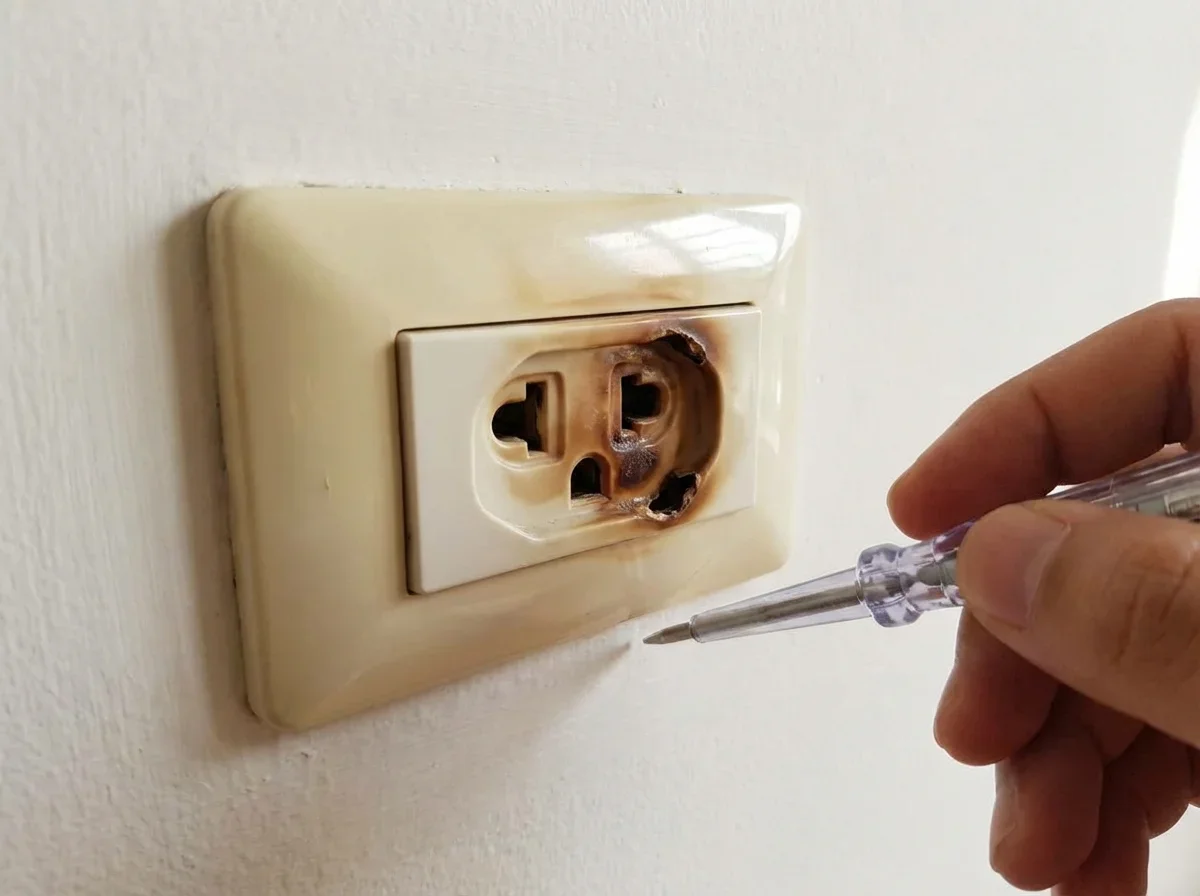
Discoloration tells a slower story. Brown or black marks around outlet slots, on the face of switch plates, or spreading across the wall surface indicate that heat has been escaping from that device for some time. The plastic is literally scorching from sustained temperatures above 150°F.
You'll often notice the outlet plate feels warm to the touch or that the plastic has started to deform slightly. These heat signatures mean connections inside the electrical box are failing and creating resistance hot spots.
This problem accelerates in aluminum wiring, which was installed in many Arizona homes built during the 1960s and early 1970s when copper prices spiked. HUD research confirms that aluminum wiring problems occur specifically at connections[3], where dissimilar metal contact points create corrosion and resistance over time. If your home has aluminum wiring (check your electrical panel for "AL" or "ALUM" stamped on wire insulation), discolored outlets should trigger an immediate whole-system evaluation. Aluminum wiring replacement prevents the house fire risk that comes from outdated connection methods incompatible with modern standards.
Frequent Breaker Trips Across Multiple Circuits
A single circuit that trips when you run the microwave and toaster simultaneously just means you're overloading that circuit's 15 or 20-amp capacity. That's inconvenient but not dangerous — the breaker is doing exactly what it's designed to do.
But when multiple circuits trip randomly, or when a breaker trips with minimal load, you're looking at a more serious failure mode.
Nuisance tripping across different circuits suggests deteriorating connections at the panel, corrosion on breaker terminals, or a grounding fault affecting the whole system. In older panels common to pre-1990 Arizona construction, bus bar corrosion creates intermittent contact points that can't reliably carry rated current. The breaker trips not because you've exceeded its capacity, but because the connection itself has degraded to where it can't conduct current without overheating.
Arc fault circuit interrupter (AFCI) breakers, now required by code for most circuits, will trip when they detect the specific electrical signature of arcing connections. If an AFCI breaker trips repeatedly and you haven't changed your usage patterns, it's detecting arc faults somewhere in that circuit — loose wire nuts in junction boxes, deteriorated connections at switches, or damaged cable where it passes through framing.
This is the breaker warning you about a fire hazard in progress. The electrical code requires AFCIs precisely because they catch problems before you smell burning plastic.
| Warning Sign | Urgency Level | Typical Cause | Immediate Action Required |
|---|---|---|---|
| Burning smell from specific outlet | Emergency | Wire insulation melting from overheating | Turn off breaker, call electrician same-day |
| Sparking or smoking outlet | Critical emergency | Active arcing/short circuit | Shut off power, call 911 if flames visible |
| Multiple circuits tripping randomly | Urgent | Panel deterioration or grounding fault | Schedule electrician within 24-48 hours |
| Single circuit trips with heavy load | Low priority | Circuit overload (normal operation) | Redistribute loads or add dedicated circuit |
Symptoms of Deteriorating or Outdated Wiring
Not all electrical hazards announce themselves with smoke and sparks. Chronic deterioration produces subtler symptoms that homeowners live with for months or years without realizing they indicate serious problems.
These are the slow-burn warning signs that give you time to address issues before they become emergencies, but only if you recognize them.
Flickering Lights Throughout the House
A single light that flickers when you switch it on probably just needs a new bulb or has a loose bulb connection. But lights flickering throughout multiple rooms, especially when the air conditioning cycles on or when wind gusts outside, reveal system-level problems.
The CPSC specifically identifies flickering lights and variation in TV picture size during wind events as indicators of bad contacts at junctions[1] that compromise the entire electrical system.
This pattern points to loose connections at the service entrance, at the main panel, or along the main feed conductors. In Arizona's block construction homes from the 1950s through 1970s, the service entrance typically penetrates through the roof in an exposed conduit system. Years of thermal cycling, UV exposure, and physical vibration from wind gradually loosen these connections. When current flows through a high-resistance connection point, voltage drops across that resistance — not enough to trip a breaker, but enough to dim your lights noticeably when heavy loads turn on.
The outdoor service entrance connections are particularly vulnerable in desert climates. Temperature swings of 60-70 degrees between day and night cause metal expansion and contraction that works connections loose over decades. Phoenix-area electricians routinely find corroded, loose service entrance connections on homes built before 1980 that have never been upgraded.
If your lights dim when your AC compressor starts, or if you notice flickering during wind events, schedule an electrical wiring inspection that specifically evaluates service entrance integrity.
Whole-house flickering can also indicate undersized service capacity. Homes built before 1980 typically have 100-amp or even 60-amp service, originally adequate for the electrical loads of that era. Add modern AC systems, pool equipment, EV chargers, and kitchen appliances, and you're pushing that service to its rated limit every day. The voltage sag you see as flickering represents your electrical system struggling to deliver the current your home now demands.
This scenario calls for a service upgrade to 200-amp capacity, which requires utility company coordination and ROC-licensed electrical contractor work. For more detail on when undersized capacity versus wiring deterioration causes these symptoms, see our guide on flickering lights.
Tingling Sensations When Touching Appliances
That mild shock or tingle you feel when you touch your refrigerator, washing machine, or metal sink while standing on a wet floor isn't static electricity. It's leakage current finding a path to ground through your body.
This sensation indicates a grounding failure somewhere in your home's electrical system, and the NFPA lists it as a key warning sign[2] requiring professional correction.
Modern electrical systems use three-wire circuits: hot (delivers current), neutral (returns current), and ground (safety path). The ground wire connects to the metal chassis of appliances and to metal junction boxes, creating a deliberate path for fault current that trips the breaker immediately if a hot wire contacts metal. When grounding fails — through corroded ground connections, missing ground wires in old two-wire systems, or broken ground paths — fault current has nowhere to go except through whatever conductor it finds.
If that conductor is you touching a metal appliance case while standing on a conductive surface, you become the ground path.
Arizona's combination of very hard water (300+ ppm calcium carbonate) and slab-on-grade construction creates specific grounding vulnerabilities. In homes built before 1990, the main grounding electrode was typically a copper rod driven into caliche soil, which has poor conductivity compared to the moist clay soils found in other regions. Over time, calcium deposits encrust the ground rod, further degrading its effectiveness. Meanwhile, metallic water supply lines that used to provide supplemental grounding have been replaced with PEX plastic during re-piping projects, eliminating that ground path entirely.
If you notice tingling from appliances, particularly in kitchens and bathrooms where ground-fault circuit interrupters (GFCIs) should be protecting you, call an electrician immediately. The problem might be as simple as a loose ground wire at a single outlet, or as complex as a whole-system grounding failure requiring new ground rods, bonding corrections, and panel modifications.
Either way, this is not a symptom you live with. It means the safety system designed to prevent electrocution isn't working.
Electrical Hazards Common in Older Homes
Arizona's housing stock concentrates around two construction booms: post-WWII expansion from 1945-1965 and rapid suburban growth from 1995-2007. Homes from that earlier era were built to electrical codes that prioritized basic functionality over safety redundancies we now consider essential.
If your home predates 1980, specific age-related hazards deserve attention regardless of whether you're experiencing active symptoms.
Knob-and-tube wiring is rare in Arizona because most development happened later. But aluminum branch circuit wiring is extremely common in homes built between 1965 and 1974. Aluminum expands and contracts more than copper when it heats and cools under electrical load, which causes connections to loosen over time. Those loose connections create resistance, resistance generates heat, and heat damages insulation.
HUD documentation confirms that aluminum wiring problems concentrate at connection points[3], where you'll find the characteristic warning signs: warm cover plates, distinctive burning odors near outlets and switches, sparking, arcing, and flickering lights.
If you haven't verified your home's wiring type, check the electrical panel for wire insulation markings. Aluminum wire will show "AL" or "ALUM" stamped on the insulation. You can also look at exposed wire in the attic or garage — aluminum conductors have a dull silver appearance versus copper's distinctive orange-brown color. Homes with aluminum wiring need special connection methods (COPALUM crimping or AlumiConn connectors) at every outlet, switch, and junction point.
Standard wire nuts designed for copper will fail on aluminum, and those failures cause the majority of aluminum wiring fires.
Two-prong ungrounded outlets indicate your home uses the older two-wire system without ground conductors. This was legal and standard practice before the 1960s. These circuits can't support modern three-prong appliances safely, and they lack the ground-fault protection path that prevents shock hazards. Homeowners sometimes "solve" this by installing three-prong outlets on two-wire circuits, creating a dangerous false sense of safety — the outlet looks grounded but provides no actual ground protection.
If your home has original two-prong outlets, or if someone has replaced them with three-prong outlets without verifying ground wire presence, you're operating without the safety systems modern appliances expect. Whole house rewiring becomes the most reliable long-term solution, particularly if you're planning kitchen or bathroom remodels that will require GFCI protection and grounded circuits anyway.
Older panels from manufacturers like Federal Pacific Electric (FPE) and Zinsco carry specific fire hazards related to breaker failures. FPE Stab-Lok panels, installed in countless Arizona homes during the 1960s and 70s, have documented failure rates where breakers don't trip during overcurrent conditions. The breaker is supposed to interrupt current flow when load exceeds rating; instead, the breaker stays closed and the circuit continues to overheat. Zinsco panels suffer from similar problems with bus bar connections and breaker contact points.
If your home has one of these panel brands, replacement should be on your planning radar regardless of whether you're experiencing problems. Arizona's ROC-licensed electricians can evaluate panel condition and recommend whether immediate replacement is warranted or if you can defer the upgrade until other electrical work makes it cost-effective.
Key Hazards in Pre-1980 Arizona Homes:
- Aluminum branch circuit wiring (1965-1974 construction boom)
- Two-wire ungrounded systems without safety ground paths
- Federal Pacific Electric (FPE) Stab-Lok panels with breaker failure history
- Zinsco panels with bus bar connection deterioration
- Undersized 60-100 amp service inadequate for modern loads
- UV-degraded attic wiring insulation from extreme heat exposure
- Corroded service entrance connections from thermal cycling
When to Call an Electrician vs When It's an Emergency
Not every electrical problem requires an emergency service call with premium rates, but certain situations demand immediate response. Sometimes that means shutting off power and evacuating rather than waiting for a contractor.
The decision tree comes down to three questions: Is there active fire or smoke? Is there a shock hazard? Is the problem progressively worsening?
Active fire, smoke, or sustained sparking from any electrical component requires you to shut off the main breaker and call 911 first, electrician second. Don't try to troubleshoot, don't test whether the problem persists, and don't assume you've fixed it by unplugging devices. Electrical fires can smolder inside walls for hours after visible flames disappear.
Once the fire department has cleared the scene, then you schedule an emergency electrician to identify the cause and make repairs before power can be safely restored.
Shock hazards demand same-day electrical response. This means your grounding or bonding system has failed, and the next person who touches that energized surface under the wrong conditions (wet hands, standing on wet floor, simultaneous contact with grounded metal) could receive a lethal shock. Shut off the circuit feeding the problem area and call an electrician immediately.
This is what emergency electrical service exists to handle.
Progressive problems give you time to schedule properly but shouldn't be ignored indefinitely. If a circuit that never tripped before now trips weekly, the problem is getting worse. If an outlet that was warm to the touch last month is hot this month, deterioration is accelerating. These situations won't resolve themselves, and the longer you wait, the higher the probability of a middle-of-the-night emergency.
The CPSC recommends professional electrical inspections every 10 years[5], but homes experiencing any of the warning signs described in this guide should move that inspection to the front of the schedule regardless of when the last one occurred.
For routine safety inspections, electrical panel evaluations, or systematic troubleshooting of intermittent problems that aren't actively dangerous, you can schedule during normal business hours. Look for ROC-licensed electricians with residential (R) classification, verifiable at roc.az.gov. Arizona doesn't require contractors to carry workers compensation insurance, which makes it especially important to verify general liability coverage independently — the ROC bond maxes out at $15,000 depending on license classification, not enough to cover significant property damage or personal injury claims.
Find Licensed Electricians for Safety Inspections
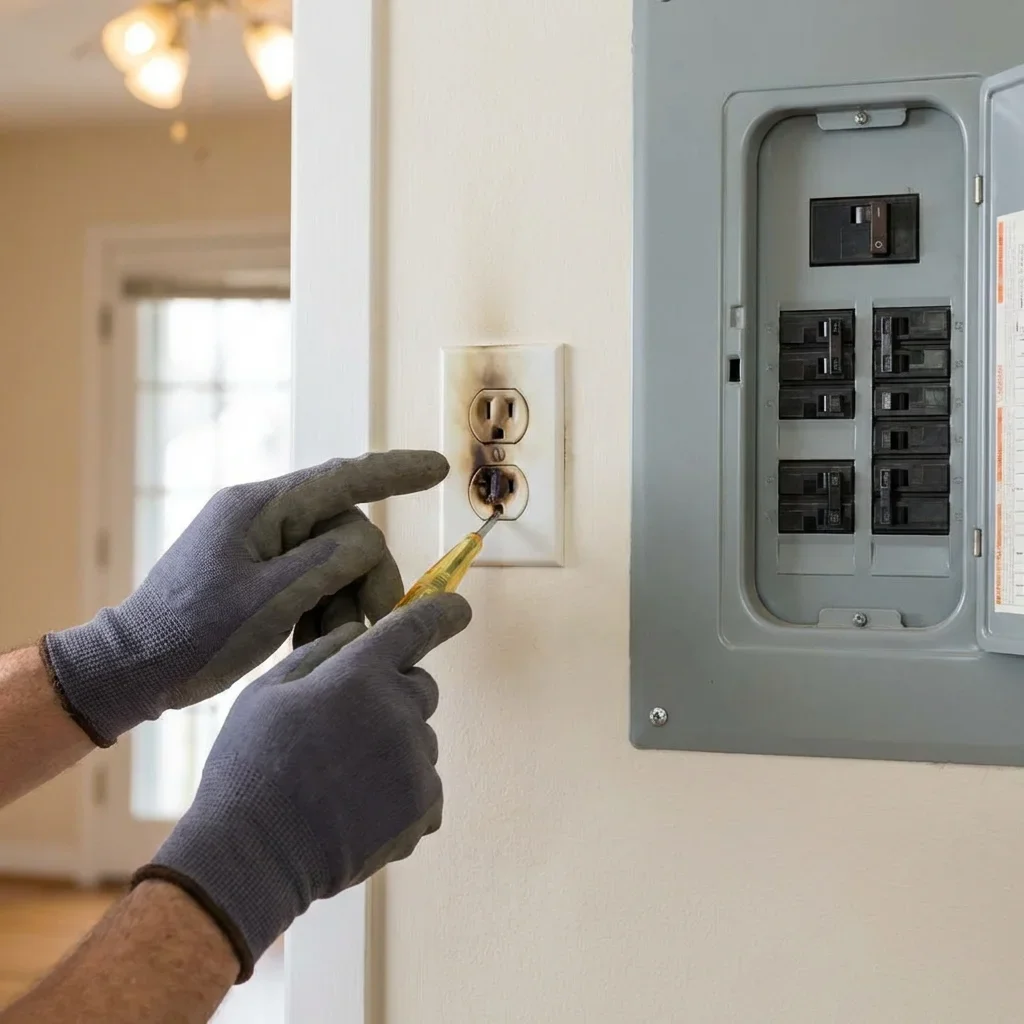
When electrical warning signs appear, the temptation to diagnose and repair problems yourself can be strong, especially for issues that seem simple like replacing an outlet or tightening a breaker. But electrical work carries risks that aren't immediately visible. You can't see whether a circuit is energized, you can't tell if a junction box has proper support without opening walls, and you can't verify grounding integrity without test equipment and knowledge of code-compliant methods.
Arizona requires all electrical work beyond basic device replacement to be performed by licensed electricians or under direct supervision of licensed electricians. More importantly, your homeowner's insurance policy likely requires electrical modifications to be performed by licensed contractors.
DIY electrical work that causes a fire or injury gives insurers grounds to deny your claim. The money you save doing it yourself evaporates the moment you file a claim and the adjuster asks who did the work.
Licensed electricians carry the diagnostic tools to measure voltage, current, resistance, and ground continuity — the actual parameters that determine whether your system is safe rather than whether it seems to work. They can perform thermal imaging to identify hot spots behind walls before they become visible. They know which connections require specific torque values, which wire types are compatible, and how to size overcurrent protection for specific loads.
This expertise matters particularly in troubleshooting intermittent problems where the symptom you observe doesn't clearly point to a single cause.
For systematic safety evaluations, an electrical wiring inspection provides documentation of your home's electrical condition — useful not just for identifying immediate hazards, but for planning future upgrades and establishing baseline condition if you're buying or selling. These inspections typically cost $200-400 for a standard single-family home and produce a written report identifying code violations, safety concerns, and recommended improvements prioritized by urgency.
If inspection reveals capacity issues, you may be looking at panel upgrades, circuit additions, or service entrance modifications. Our guide on electrical panel upgrades covers what to expect, typical costs, and permitting requirements specific to Arizona's building department processes. For homes where problems concentrate in specific areas like kitchens that have been remodeled without updating electrical capacity, dedicated circuit installation provides targeted solutions without requiring whole-system rewiring.
The electrical warning signs detailed in this guide — burning smells, discolored outlets, frequent breaker trips, flickering lights, shock sensations, and hazards specific to aluminum wiring or outdated panels — represent your home communicating that something is wrong.
The difference between a minor repair and a catastrophic fire often comes down to whether you recognize these symptoms and respond appropriately.
Don't wait for smoke to call for help, but don't panic over every flickered light either. Use this framework to distinguish routine annoyances from genuine hazards, and bring in qualified professionals when the situation warrants it.
- U.S. Consumer Product Safety Commission. "CPSC Guide to Home Wiring Hazards." https://www.cpsc.gov/s3fs-public/518.pdf. Accessed April 06, 2026.
- National Fire Protection Association. "Electrical Home Fire Safety." https://www.nfpa.org/education-and-research/home-fire-safety/electrical-safety-in-the-home. Accessed April 06, 2026.
- U.S. Department of Housing and Urban Development. "5 Electrical System." https://www.huduser.gov/publications/pdf/rehabinspect_3.pdf. Accessed April 06, 2026.
- U.S. Occupational Safety and Health Administration. "1910.304 - Wiring design and protection." http://www.osha.gov/laws-regs/regulations/standardnumber/1910/1910.304. Accessed April 06, 2026.
- Underwriters Laboratories. "8 Signs You May Have a Problem with Your Electrical Wiring." https://www.ul.com/insights/8-signs-you-may-have-problem-your-electrical-wiring. Accessed April 06, 2026.