Electrical Services for Buckeye's New Communities
Buckeye's master-planned developments don't have the aging-infrastructure problems you'll find in central Phoenix. Instead, you're dealing with brand-new systems engineered to minimum code specs — which means maximum profit margin for the builder and minimum flexibility for you as the homeowner.
Most tract homes built here since 2020 include 100-amp main panels, single GFCI devices protecting multiple wet locations, builder-grade LED fixtures, and a conduit stubout on the roof labeled "solar ready" that doesn't actually connect to anything functional. Arizona's 2023 energy code requires builders to provide either a 240V/50A circuit rough-in for EV charging OR allocate panel space for future solar. Most Buckeye builders choose the solar-ready option because it saves them $800-$1,200 per house compared to running an actual EV circuit.
New Construction Electrical Needs
Your home's electrical system was designed for what the builder installed, not what you'll actually use. A typical 2,400-square-foot Buckeye tract home has electrical capacity calculated for two AC units, standard kitchen appliances, a water heater, and lighting. That's about it.
When you add the pool equipment package (pumps, heaters, automation) that 40% of new Buckeye homeowners choose, an EV charger pulling 40 amps, and landscape lighting controlled by smart switches, you're asking a 100-amp panel to handle 130+ amps of potential load. The math doesn't work.
Panel upgrades from 100A to 200A are one of the most common electrical projects in communities less than five years old. Expect to pay $1,800-$2,400 for the panel swap itself, plus $150-$225 for the Town of Buckeye permit and a half-day wait for the utility to disconnect and reconnect service. If your builder installed aluminum feeder wire from the meter to the panel (common in production homes despite copper wiring inside the house), factor another $600-$900 to upgrade that service entrance cable to copper for proper ampacity and connection integrity.
Pool electrical runs $2,200-$3,500 depending on equipment complexity. Single-speed pump and basic lighting land on the lower end, while variable-speed pumps with heaters, waterfalls, and color-changing LED systems push toward the upper range. RV hookup electrical (50-amp, 240V service with dedicated outlet) costs $1,400-$2,200, but here's the surprise: trenching through Buckeye's caliche soil layer runs $18-$24 per linear foot instead of the $12-$16 you'd pay in sandy areas. That calcium carbonate hardpan 18-36 inches down requires a rock saw or jackhammer attachment.
A 40-foot trench from your panel to an RV pad on the side yard can add $720-$960 just for excavation before your electrician pulls a single wire.
Post-Builder Upgrades and Additions
Builder-grade electrical works fine until you start living the way you actually live. That single GFCI outlet in the master bathroom? It's feeding the second bathroom and the powder room through daisy-chained connections inside the walls.
When it trips (and it will, because three bathrooms worth of hair dryers and curling irons exceed what one 20-amp GFCI is designed to handle), your electrician will recommend dedicated GFCI protection for each bathroom at $180-$280 per location.
Exterior outlet additions run $200-$350 per outlet depending on accessibility and whether you need to fish wire through finished walls or can surface-mount conduit. Check your HOA rules first — Verrado's Design Review Committee requires all exterior conduit to be concealed or painted to match stucco per their v6.2 guidelines. Landscape lighting systems cost $800-$2,400 installed, with the wide range reflecting whether you're adding six path lights on a single transformer or a full yard design with uplighting, wall-washers, and smart controls.
The "solar ready" conduit stubout on your roof becomes useful when you're ready to activate that dormant feature, but turning it on requires actual electrical work. You'll need a main panel upgrade to 200A if you're still on the builder's 100A panel ($1,800-$2,400), a solar breaker interlock or load center addition ($400-$600), and trenching for battery backup if your builder didn't pre-stub conduit to the garage ($800-$1,200 through caliche soil).[3]
SRP's Customer Generation Price Plan pays $0.10/kWh for exported solar, and APS's battery rebates offer up to $1,800 for qualifying systems, which offsets some of the electrical infrastructure costs. Budget $3,000-$4,800 total for the electrical work before your solar installer even shows up.
Whole house surge protection costs $450-$650 installed and makes particular sense in Buckeye's new homes, where July-through-September monsoon lightning strikes and dust-storm power fluctuations can damage the sensitive electronics in smart thermostats, pool automation, and EV chargers that weren't common when whole-home surge devices were optional. APS customers qualify for a $100 rebate on whole-home surge protection installed in 2024-2025, which brings the net cost down to $350-$550.
Key Facts About Buckeye New Home Electrical:
- Most tract homes built since 2020 have 100-amp panels (insufficient for modern loads)
- 40% of new homeowners add pools, requiring $2,200-$3,500 in electrical work
- Caliche soil increases trenching costs to $18-$24/linear foot vs $12-$16 in sandy areas
- "Solar ready" stubouts require $3,000-$4,800 in actual electrical work to activate
- Permit review takes 3-5 business days (vs same-day in established Phoenix areas)
- Emergency service response averages 75-90 minutes from Phoenix, 20-40 minutes from local contractors
What Electrical Work Costs in Buckeye
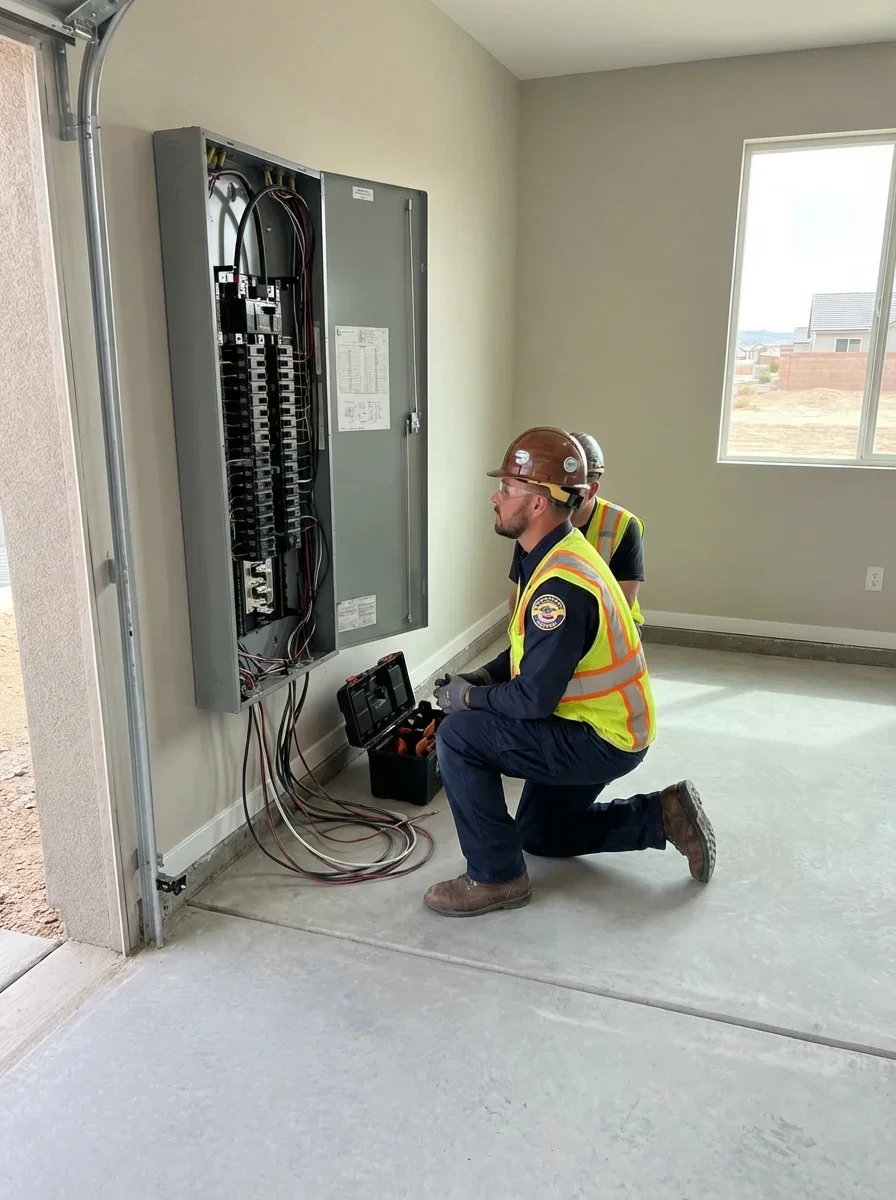
Electrical labor rates in Buckeye run $85-$110 per hour, which is 10-15% lower than Phoenix or Scottsdale rates of $95-$125 per hour. That's the good news.
The complicating factor is distance. Buckeye sits 40+ miles from Phoenix's core, so electricians traveling from central valley locations add trip charges of $95-$150 to cover drive time and fuel. Contractors based in Avondale or Goodyear (15-20 miles closer) typically charge $65-$95 for the trip, while locally-based Buckeye electricians like Sundance Electrical LLC eliminate trip charges entirely but may have longer scheduling windows during peak season.
Standard service calls (diagnose and repair minor issues like a tripped breaker, failed outlet, or broken light switch) run $150-$280 total including the trip charge. Panel upgrades from 100A to 200A cost $1,800-$2,400 for labor and materials, plus $150-$225 for the Town of Buckeye electrical permit. EV charger installation ranges from $800-$1,600 depending on whether you already have a 240V circuit stubbed (rare in Buckeye tract homes unless you upgraded during construction) or need a new dedicated circuit run from the panel.
Emergency electrical service (after-hours, weekends, or same-day response for hazardous conditions like sparking outlets, burning smell from the panel, or total power loss) adds 50-100% to standard rates. A $200 service call becomes $300-$400 after 5pm or on Sundays. Response time for emergency service averages 75-90 minutes in Buckeye versus 30-45 minutes in Phoenix proper, because most emergency electricians dispatch from central valley locations and fight westbound I-10 traffic to reach you.
Locally-based contractors cut that response time to 20-40 minutes but may have fewer trucks available for immediate dispatch.
| Contractor Location | Trip Charge | Emergency Response Time | Best For |
|---|---|---|---|
| Phoenix-based | $95-$150 | 75-90 minutes | Scheduled work, better availability |
| Avondale/Goodyear | $65-$95 | 45-60 minutes | Balance of cost and response time |
| Buckeye-based | $0 | 20-40 minutes | Emergencies, local HOA knowledge |
Here's what common electrical projects actually cost in Buckeye, including permit fees where applicable:
- Panel upgrade (100A → 200A): $1,950-$2,625 total (includes $150-$225 permit)
- EV charger circuit and outlet: $950-$1,750 (includes $75-$100 permit)
- Pool electrical package: $2,400-$3,775 (includes $200-$275 permit)
- RV hookup (50A, 240V): $1,650-$2,450 (includes trenching through caliche)
- Whole-home surge protection: $450-$650 ($350-$550 after APS rebate)
- Dedicated bathroom GFCI circuit: $180-$280 per bathroom
- Landscape lighting system: $800-$2,400 depending on fixture count
- Ceiling fan installation: $200-$450 per fan (existing wiring) or $350-$650 (new circuit required)
- Smart home wiring upgrades: $600-$1,800 for panel consolidation and neutral wire additions
Those ranges reflect material choices, job complexity, and whether you're using a Phoenix-based contractor with trip charges or a local Buckeye provider. Request itemized quotes that separate labor, materials, permit fees, and trip charges so you can compare accurately.
Buckeye Electrical Permit Requirements
The Town of Buckeye requires electrical permits for all work except replacing switches, outlets, or light fixtures on existing circuits.[1] Panel upgrades, new circuits, EV charger installations, pool equipment, hot tubs, and generator connections all require permits pulled before work begins.
Permit fees follow this schedule: panel upgrades $150-$225, EV charger installations $75-$100, pool/spa electrical $200-$275, and generator connections $175-$250.
Here's the timing issue nobody mentions: Buckeye's Building Department is overwhelmed by the city's explosive growth, and electrical permit review currently takes 3-5 business days versus same-day or next-day turnaround in established Phoenix neighborhoods. Your contractor's promise of "we can start tomorrow" actually translates to "we can start in 4-7 days after permit approval." Don't blame your electrician for the delay. Blame the fact that Buckeye issued permits for 2,800+ new residential units in 2024 and the inspection staff hasn't scaled at the same rate.
You can check permit status online through the Town of Buckeye Development Services portal at buckeyeaz.gov/departments/development-services/ or call 623-349-6240 for status updates. Licensed contractors handle the permit application process as part of their service, but you're legally responsible for ensuring the work is permitted and inspected. Unpermitted electrical work discovered during a home sale can force you to open walls for inspection, bring everything to current code (even if it was compliant when installed), and delay your closing by weeks.
Final electrical inspection must occur within 180 days of permit issuance or the permit expires and you'll pay full fees to reapply. This catches DIY homeowners who pull permits for panel upgrades, get halfway through the project, realize they're in over their heads, and abandon the work for months.
When they finally call a licensed electrician to finish, the permit has expired and the Town requires starting over with a new application and fee.
Arizona follows the 2020 National Electrical Code (NEC) with state amendments published in ARS Title 32, Chapter 10, Article 4. Panel upgrades must meet NEC Article 408 requirements and provide working space clearances per NEC 110.26. That means 36 inches of clear space in front of the panel, 30 inches of width, and 78 inches of headroom. Panels installed in garages with storage creeping into that clearance zone fail inspection, so move those shelves before your inspector arrives.
Finding Licensed Electricians in Buckeye
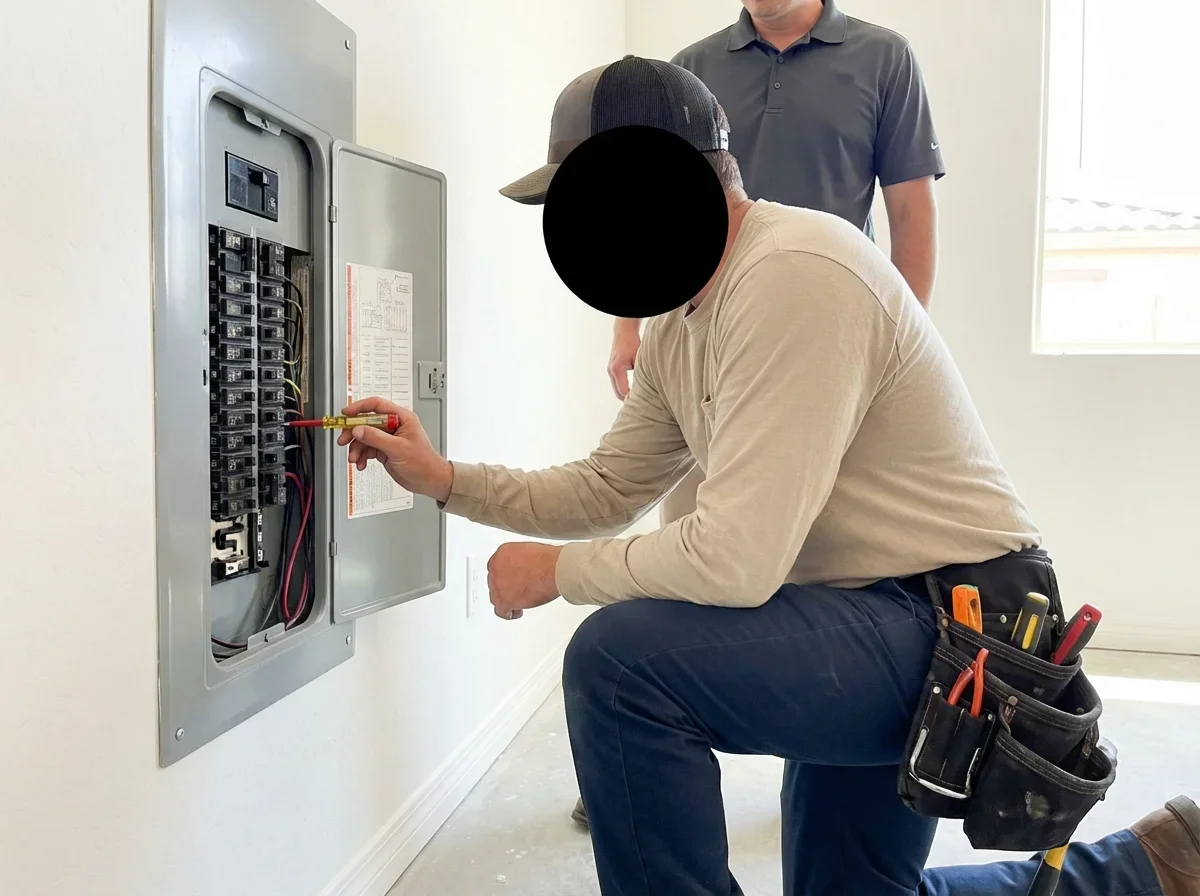
Arizona Revised Statutes Title 32 requires electrical contractors to hold active licenses issued by the Arizona Registrar of Contractors (ROC). Residential electrical work requires a "CR-11" license classification. Commercial and industrial work requires "CR-10" or "C-11" depending on project scope.[2]
You can verify license status at roc.az.gov by searching the contractor's name or license number. Check that the license is active (not suspended or revoked) and that the classification matches your project type.
Buckeye had 12 unlicensed contractor enforcement actions filed by the ROC in 2023-2024, which is higher per-capita than Phoenix. The pattern is predictable: someone advertises "handyman electrical services" on Facebook Marketplace, undercuts licensed contractors by 30-40%, and disappears after collecting a deposit or leaves you with work that won't pass inspection. The ROC bond backing each CR-11 license is only $7,500, which may not fully cover your losses if something goes wrong.
Your best protection is verifying the license before signing a contract and paying a deposit.
Request proof of liability insurance (minimum $500,000 in coverage recommended) and workers' compensation insurance if the contractor has employees. Arizona doesn't require contractors to carry workers' comp unless they have staff, but you want that coverage in place so you're not liable if someone gets hurt on your property. Ask for certificates of insurance and verify they're current. Certificates show issue dates and coverage periods, so a certificate from 2023 doesn't prove current coverage in 2025.
Get at least three quotes for projects over $1,000, and make sure each quote itemizes labor, materials, permit fees, and trip charges separately. Vague quotes that lump everything into "total project cost" make comparison difficult and leave room for change orders later.
Detailed quotes demonstrate professionalism and give you recourse if disputes arise about what was included.
Pro Tip: Always verify your contractor's ROC license at roc.az.gov before signing any contract. Buckeye had 12 unlicensed contractor enforcement actions in 2023-2024 — higher per capita than Phoenix. The $7,500 ROC bond may not fully cover your losses if an unlicensed contractor disappears mid-project or leaves you with work that fails inspection.
Service Area and Response Time Considerations
Buckeye's 40-mile distance from Phoenix's core affects service availability and response times in ways most homeowners don't anticipate. Emergency electrical service from Phoenix-based contractors averages 75-90 minutes from your phone call to a truck arriving. The electrician has to finish their current job in Tempe or Scottsdale, fight westbound I-10 traffic (often backed up from 3pm-7pm), and navigate Buckeye's sprawling developments to find your address.
Contractors based in Goodyear or Avondale cut that to 45-60 minutes. Locally-based Buckeye electricians drop it to 20-40 minutes, but they may have fewer trucks available for immediate dispatch.
If you're facing a genuine emergency (sparking outlets, burning smell from the panel, or total power loss with no utility outage), paying a higher trip charge for faster response from a local contractor beats waiting 90 minutes for a Phoenix provider to arrive.
For non-emergency service (scheduled panel upgrades, EV charger installs, landscape lighting), Phoenix-based contractors offer more scheduling flexibility and often have better availability during peak season (May-September when AC-related electrical load causes panel failures). Balance trip charges against convenience: paying an extra $75 trip charge might be worthwhile if it means getting your panel upgraded this week instead of waiting three weeks for the local contractor's next opening.
Different Buckeye developments present different electrical challenges. Verrado (9,000+ homes planned, started 2004) has underground utilities and HOA Design Review Committee requirements for exterior electrical modifications. All conduit must be concealed or painted to match stucco, and some lighting fixtures require DRC approval 10-15 business days before you can even apply for a Town permit. Sundance (started 2003) has many lots with pre-wiring stubouts for future casitas or guest houses, which makes additions easier but requires verifying what's actually stubbed versus what's just shown on old builder plans.
Festival Foothills (started 2018) includes solar pre-wire on most homes but panel space allocation varies by builder and lot. Some have room for solar breakers, others require panel replacements to activate the roof stubouts.
Finding an electrician familiar with your specific development's quirks saves time and prevents surprises mid-project. Ask contractors during your initial call: "Have you worked in [Verrado/Sundance/Festival Foothills] before, and are you familiar with the HOA requirements?" Their answer tells you whether you'll spend half the project educating them about local rules or whether they already know what permits and approvals you'll need.
Connect with Buckeye Electrical Contractors
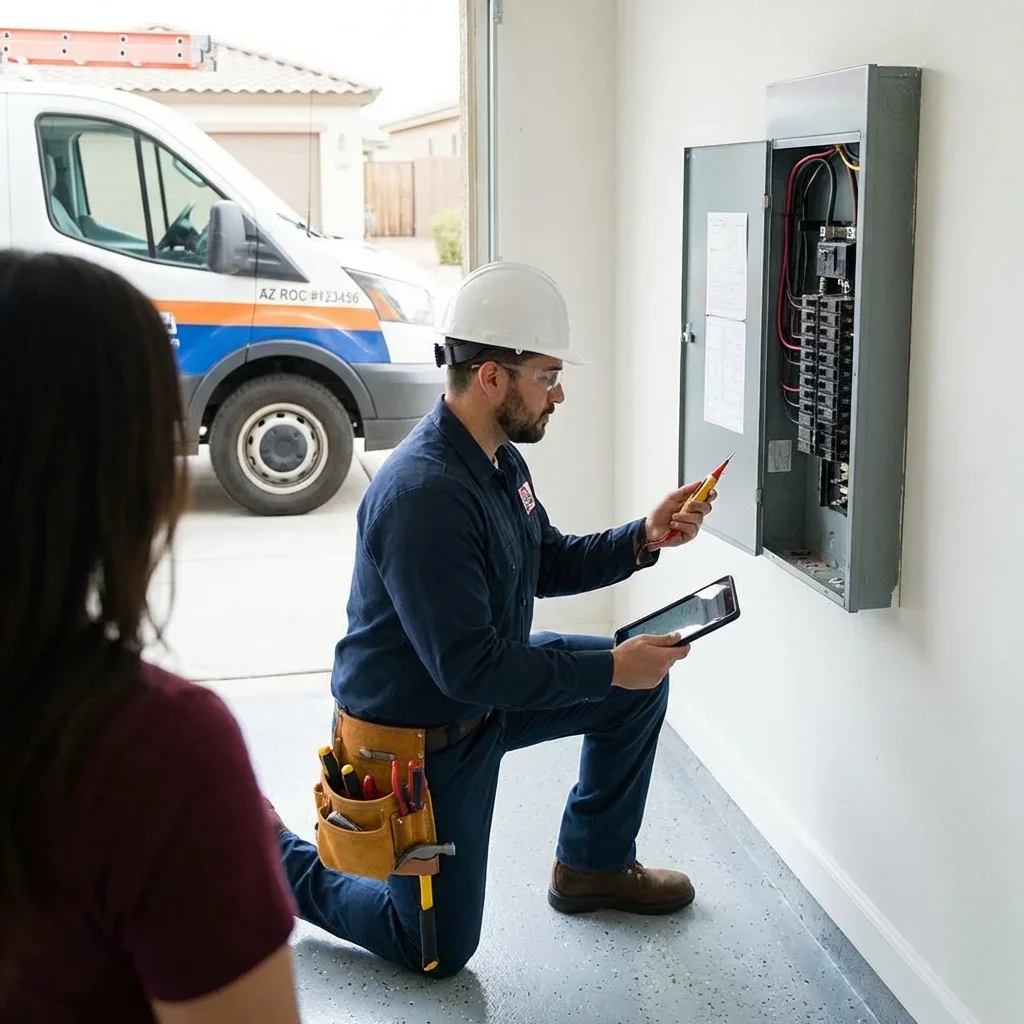
Our directory includes ROC-licensed electrical contractors serving Buckeye and the West Valley. Each listing shows license classifications, years in business, service area details, and homeowner reviews. You can filter by services offered (pool electrical, panel upgrades, smart home wiring), response time commitments, and whether the contractor is locally-based in Buckeye or dispatches from Phoenix/Goodyear.
Verify every contractor's license at roc.az.gov before requesting quotes. Look for active "CR-11" (residential) or "CR-10" (commercial) status and confirm the business name matches exactly. Check that their insurance certificates show current coverage dates and list you as "certificate holder" for additional protection.
Request detailed written quotes that separate labor, materials, permit fees, and trip charges. For projects requiring Town of Buckeye permits, confirm the contractor will handle the application and coordinate inspections. That's included in most quotes but worth verifying explicitly. Ask about warranty coverage on labor (typically 1 year) and whether they guarantee their work will pass inspection on the first attempt.
Schedule your project with permit timelines in mind. If you need work completed by a specific date (closing on a home sale, finishing a pool before summer, activating solar before a utility rate change), build in 7-10 business days for permit review and approval plus potential inspection delays.
Buckeye's rapid growth means nothing happens as fast as it did when you last renovated a house in an established neighborhood.
- City of Buckeye. "Buckeye Development Code." https://mcclibraryfunctions.azurewebsites.us/api/ordinanceDownload/15034/1118471/pdf. Accessed April 06, 2026.
- Arizona Registrar of Contractors (ROC). "Regulatory Context for Arizona Electrical Systems." https://arizonaelectricalauthority.com/regulatory-context-for-arizona-electrical-systems.html. Accessed April 06, 2026.
- Salt River Project (SRP). "Electric Service Specifications." https://www.srpnet.com/assets/srpnet/pdf/doing-business/builders-developers-contractors/commercial-specifications-guidelines-and-handbooks/electrical-service-specifications.pdf. Accessed April 06, 2026.
- Arizona Department of Health Services. "Arizona Administrative Code, Article 1, Section R21-8-110." https://regulations.justia.com/states/arizona/title-21/chapter-8/article-1/r21-8-110/. Accessed April 06, 2026.