Why Hiring a Licensed Electrician Matters
Electrical work in Arizona carries legal requirements that don't apply to most other trades. Any electrical project involving structural changes, circuit additions, or panel modifications legally requires a licensed contractor, not a handyman with a voltage tester.[3]
The distinction isn't just bureaucratic. Licensed electricians complete thousands of documented training hours, pass state exams on the National Electrical Code, and maintain active registrations with the Arizona Registrar of Contractors (ROC).
Unpermitted electrical work doesn't just void your homeowner's insurance. It creates liability during home sales. Title companies in Arizona routinely flag unpermitted improvements during escrow, forcing sellers to either legalize the work retroactively (expensive) or reduce the sale price to cover the buyer's risk. A licensed electrician pulls permits as part of the job, ensuring your work appears in county records and passes inspection before the inspector signs off.
Arizona's climate adds another layer of risk.
Desert UV exposure degrades wire insulation faster than humid climates, and summer attic temps exceeding 150°F stress electrical connections in ways most handymen don't account for. Licensed electricians working in Arizona understand how thermal expansion affects wire sizing, junction box placement, and conduit materials. That knowledge only comes from formal training and field experience.
Understanding Electrician Licensing Levels
Arizona's ROC issues electrician licenses in two main categories: residential (R-11) and commercial (C-11). Residential electricians can work on single-family homes, duplexes, and residential remodels. Commercial electricians handle everything else: multi-family buildings, retail spaces, industrial facilities. Some contractors hold dual licenses, but most specialize in one category.[2]
Within those categories, you'll encounter journey-level and master electricians.
A journeyman electrician completes a state-registered apprenticeship (typically 8,000 hours of supervised work), passes a competency exam, and can perform electrical installations under a master's supervision. A master electrician has additional years of journeyman experience, passes a more comprehensive exam, and can pull permits, supervise other electricians, and run an independent contracting business.
When you hire an electrical contractor in Arizona, you're hiring the company's ROC license. Not necessarily the individual electrician who shows up. The contractor's qualifying party (the person whose credentials back the license) must be a master electrician, but the technician on-site might be a journeyman working under that master's supervision.
That's legal and common. What's not legal: a contractor without an ROC license doing electrical work over $1,000 in total project value, including labor and materials.
| License Type | Training Required | Can Pull Permits | Can Supervise Others | Can Own Business |
|---|---|---|---|---|
| Journeyman Electrician | 8,000 hours apprenticeship + exam | No | No | No |
| Master Electrician | Journeyman experience + advanced exam | Yes | Yes | Yes |
| ROC-Licensed Contractor | Master electrician as qualifying party | Yes | Yes | Yes |
Insurance and Bonding Requirements
Arizona requires all ROC-licensed contractors to carry a surety bond ranging from $4,000 to $15,000 depending on license classification. That bond protects you if the contractor abandons the job or violates licensing law, but it won't cover most accident scenarios. It's capped too low.
The real financial protection comes from the contractor's general liability insurance and workers' compensation coverage.
General liability insurance covers property damage and bodily injury caused by the electrician's work. If a wiring error causes a fire six months after installation, general liability covers your repairs and displacement costs. Policies for licensed electricians typically start at $1 million per occurrence, $2 million aggregate. Always ask for a certificate of insurance naming you as an additional insured before work begins.
Here's where Arizona gets tricky: the state does not require contractors to carry workers' compensation insurance if they don't have employees.
A one-person electrical contractor can legally operate without workers' comp, shifting all injury liability onto you if they're hurt on your property. Ask directly whether the contractor carries workers' comp. If they say no, ask whether they're the sole employee (acceptable) or whether they use subcontractors or helpers. That's a red flag. Those people aren't covered, and you might be liable.
When You Need a Licensed Electrician vs a Handyman
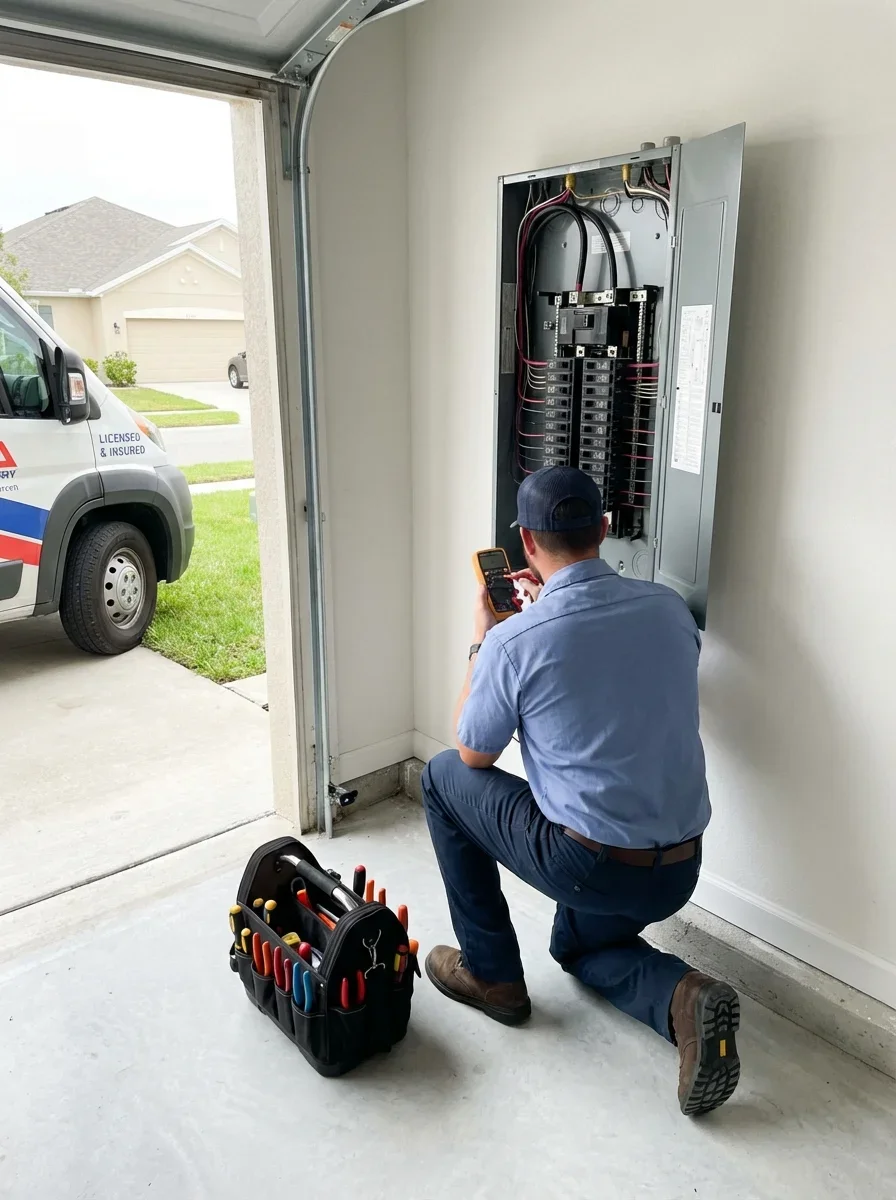
Arizona law doesn't prohibit handymen from doing electrical work. It prohibits unlicensed individuals from doing electrical work that requires a permit or exceeds $1,000 in total project cost. That distinction confuses homeowners, because most electrical work does require permits even when it seems minor.
You legally need a licensed electrician for anything involving the main service panel, adding circuits, installing permanent fixtures (like ceiling fans or recessed lighting), upgrading service capacity, or running new wiring through walls. You also need a licensed pro for specialty systems: pool and spa electrical, EV charger installation, whole house generators, and sub-panel installations.
These projects require permits in every Arizona municipality, and only ROC-licensed contractors can pull those permits.
A handyman can legally replace a light switch, swap out a broken outlet, or install a plug-in appliance. Tasks that don't modify the permanent wiring or require new circuits. Once you cross into "modifying the system" territory, you're in licensed contractor jurisdiction.
The risk isn't just legal. Handymen don't carry the insurance required to cover electrical fires, and their work isn't subject to municipal inspection. You save $100 on labor and inherit $10,000 in liability.
Pro Tip: If you're unsure whether your project requires a licensed electrician, call your local building department. They'll tell you whether a permit is required — and if it is, you legally need a licensed contractor to do the work.
How to Verify an Electrician's Credentials
Asking for a license number is step one. Verifying it independently is step two, and most homeowners skip that part.
Arizona makes verification straightforward through the ROC's online database at roc.az.gov. Enter the contractor's name or license number and you'll see their license status (active, suspended, expired), bond information, complaints filed, and disciplinary actions.
Pay attention to complaint history. One resolved complaint over a scheduling dispute isn't disqualifying. Multiple complaints about unpermitted work, abandoned jobs, or safety violations indicate a pattern.
Arizona's ROC publishes all complaints publicly, including the contractor's response and resolution. Read through them. You'll learn whether the contractor takes responsibility or deflects blame.
State Licensing Board Lookups
Every state maintains a licensing board database for electricians, though the agency name and URL vary.[1] In Arizona, it's the Registrar of Contractors. In Nevada, it's the State Contractors Board. California uses the Contractors State License Board (CSLB).
If your electrician claims to hold licenses in multiple states (common in border regions like Yuma or Lake Havasu City), verify each one separately.
Some licensing boards offer reciprocity agreements, allowing electricians licensed in one state to work in another without retesting. Arizona has limited reciprocity, mostly with states that require similar training hours and testing standards.
Don't assume a Nevada or California license translates to legal work in Arizona. Ask the contractor directly whether they hold an Arizona ROC license, then verify it yourself at roc.az.gov before signing any contract.
Checking Insurance and Bond Status
A current certificate of insurance (COI) should list the insurance carrier, policy number, coverage limits, and effective dates. Call the insurance company directly using the phone number from their website, not the number on the COI, which could be fake.
Confirm the policy is active and covers the work you're hiring them for. Some policies exclude certain high-risk tasks like aluminum wiring replacement or service panel upgrades.
Bond verification happens through the ROC database. The bond amount isn't a quality indicator (it's based on license type, not the contractor's reliability), but an expired or missing bond means the license isn't valid.
Arizona suspends licenses immediately when bonds lapse, so an expired bond equals an unlicensed contractor regardless of their past credentials.
Red Flags That Indicate a Bad Electrician
Cash-only payment demands are the most obvious red flag. Legitimate contractors accept checks and credit cards, which create a paper trail for warranties and dispute resolution. Cash-only pricing often signals unreported income, which correlates with other corner-cutting: no permits, no insurance, no accountability.
Unwillingness to pull permits is equally disqualifying.
Some contractors pitch permit avoidance as a cost-saving measure. "The city will never know, and you'll save the $200 permit fee." Unpermitted electrical work in Arizona becomes your problem the moment you sell the house or file an insurance claim after a fire. Inspectors check permit history during escrow, and homeowner's insurance carriers investigate whether electrical fires originated from permitted, code-compliant work. If the answer is no, they deny the claim.
Watch for contractors who can't provide a physical business address or show up in unmarked vehicles with mismatched equipment. Arizona's transient contractor population spikes in winter when out-of-state electricians follow seasonal construction demand. Some hold legitimate licenses in other states but work illegally in Arizona. Others fabricate credentials entirely.
An ROC-licensed contractor will have an Arizona business address listed in the public database, a company vehicle with signage, and branded uniforms or shirts.
Pressure tactics during estimates ("This price is only good if you sign today") indicate desperation or deception. Qualified electricians in Arizona stay busy year-round, with summer AC load and pool electrical work creating consistent demand. They don't need to manufacture urgency.
If an electrician pressures you to commit before you've verified their credentials or compared other bids, walk away.
Vague or inflated timelines without explanation suggest either inexperience or overbooking. A legitimate contractor can tell you why a panel upgrade takes three days instead of one (inspection scheduling, utility coordination, load calculations) and provide a written timeline with milestones.
"It'll take as long as it takes" isn't an acceptable answer when you're paying $5,000+ for electrical work.
Warning Signs to Avoid:
- Demands cash-only payment or unusually large upfront deposits
- Refuses to pull permits or suggests avoiding inspections
- Can't provide physical business address or ROC license number
- No branded vehicle, uniform, or professional business materials
- Creates artificial urgency ("sign today or lose this price")
- Provides vague timelines without explaining delays
- Unable to provide proof of insurance or bonding
- Multiple unresolved complaints on ROC database
- Significant price undercut compared to other bids (30%+ lower)

Essential Questions to Ask Before Hiring
You need answers to three categories of questions: credentials, project specifics, and business practices. Start with credentials even if you've already verified their license independently. How the contractor responds tells you whether they expect informed customers or rely on homeowner ignorance.
Ask for their ROC license number and whether it's residential, commercial, or both. Ask how long they've held that license and whether they've ever had it suspended or revoked.
Ask whether the person you're speaking with is the qualifying party (the master electrician whose credentials back the license) or a sales rep. If it's a sales rep, ask to speak directly with the qualifying party before signing a contract.
Questions About Experience and Specialization
Electricians, like doctors, develop specializations over time. A contractor who primarily installs smart home systems and lighting design might not be the best choice for a 200-amp service panel upgrade on a 1960s block house with corroded aluminum wiring.
Ask what percentage of their work involves projects similar to yours. Ask for references from homeowners who had that specific type of work done in the last 12 months.
Arizona's older housing stock (median build year 1985 in Phoenix metro) means many electrical projects involve retrofitting modern electrical demands onto outdated systems. Ask whether the contractor has experience with your home's construction type: slab-on-grade foundations, aluminum wiring, Federal Pacific or Zinsco panels (both considered fire hazards), or homes with evaporative coolers instead of central AC.
These details matter when routing new circuits or upgrading service capacity.
If your project involves specialty work (EV charger installation, whole house generators, pool and spa wiring), ask for manufacturer certifications. Tesla, for instance, maintains a certified installer network for their Wall Connector, and using a certified installer preserves warranty coverage.
Pool electrical work in Arizona requires additional knowledge of GFCI protection for wet environments and compliance with 680.22 and 680.23 of the NEC.
Questions About the Project Timeline and Process
Ask when the contractor can start, how long the work will take, and what factors might delay completion. Legitimate delays in Arizona electrical work include permit processing time (varies by city, typically 3-10 business days), inspection scheduling (often 48-72 hours' notice required), utility company coordination for service upgrades (APS or SRP can take 2-3 weeks to schedule a meter disconnect), and material availability for specialty items like 200-amp panels or AFCI breakers.
Ask whether they'll be on-site full-time or splitting time between multiple jobs.
Multi-day projects with a crew present for two hours in the morning and gone by noon stretch timelines unnecessarily. Ask who specifically will be performing the work: the person you're talking to, a crew of journeymen, or apprentices supervised remotely. There's nothing wrong with apprentices doing supervised work, but you should know who's touching your electrical system.
Find out how the contractor handles change orders. Electrical projects routinely uncover hidden issues: corroded panels that need replacing, undersized wiring that doesn't meet current code, asbestos-wrapped conduit that requires abatement.
A good contractor explains the issue, provides a written change order with pricing, and waits for your approval before proceeding. Bad contractors do the work first and surprise you with an inflated bill at project end.
Questions About Pricing and Payment Terms
Ask whether the estimate includes permit fees, inspection costs, and materials, or whether those are billed separately. Ask for a breakdown showing labor hours, hourly rate or fixed price for labor, materials list with individual costs, and any subcontractor fees (trenching, drywall repair, utility coordination).
Lump-sum estimates without itemization make it impossible to identify overcharges or compare bids accurately.
Payment terms vary, but standard practice in Arizona is 10-20% deposit to order materials, 40-50% at substantial completion (work done but not yet inspected), and the final 30-40% after inspection sign-off. Never pay 100% upfront or in cash.
Never pay the final installment until the city inspector approves the work and you've verified the permit shows "final" status in the municipal database.
Ask about warranty terms for both labor and materials. Arizona's implied warranty for construction work is six years, but many contractors offer explicit written warranties of one to two years on labor. Material warranties depend on the manufacturer: electrical panels typically carry 10-year warranties, while circuit breakers and outlets might have one to five years.
Get warranty terms in writing, including what's covered, who provides the warranty (contractor vs manufacturer), and whether you need to register products to activate coverage.
What Should an Electrical Estimate Include?
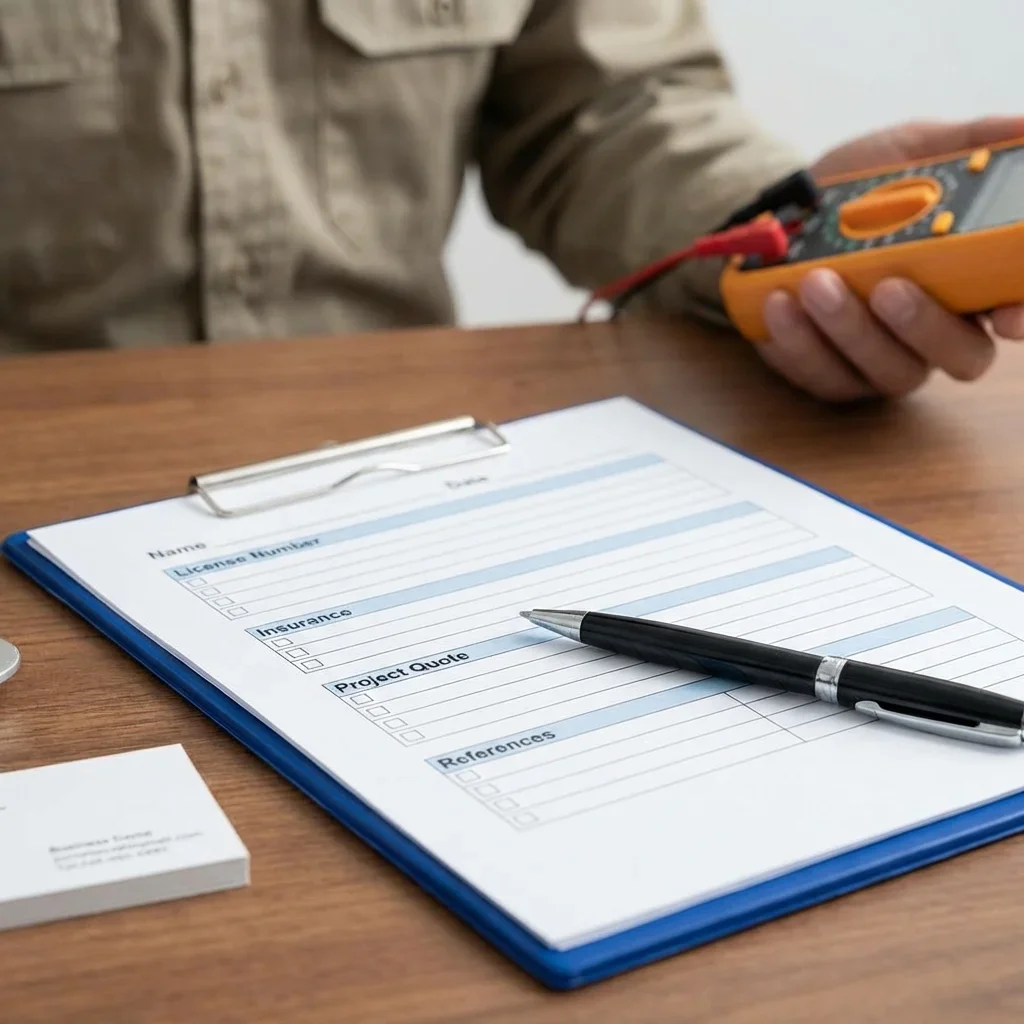
A legitimate electrical estimate is a multi-page document, not a number scrawled on the back of a business card. It should start with your name, property address, and a detailed scope of work describing exactly what the electrician will do: "Install one 200-amp main service panel (brand and model number), replace six existing circuits with AFCI-protected circuits per 2023 NEC 210.12, install one 2-pole 40-amp breaker for electric range, coordinate utility disconnect and reconnect with APS."
The estimate should list materials by line item: panel make and model, number and type of circuit breakers, wire gauge and footage, conduit type and length, boxes, connectors, and hardware. It should specify whether materials are included in the quoted price or billed at cost-plus.
You want to see manufacturer names and model numbers for major components, not generic descriptions like "new panel."
Labor should appear as either a fixed project price or an itemized breakdown by task (panel replacement: 8 hours at $125/hour; circuit installation: 4 hours at $100/hour). Fixed-price bids reduce uncertainty but can incentivize rushing. Hourly billing aligns the contractor's interests with quality work, but it requires trust that they won't pad hours.
Many Arizona electricians use a hybrid approach: fixed pricing for defined tasks with hourly rates for unforeseen complications.
Permit costs should appear as a separate line item with the actual city fee amount (verifiable on the city's website). Some contractors mark up permit fees as a "processing charge." Acceptable if disclosed, questionable if hidden. Inspection fees in most Arizona cities are included in the permit cost, but some municipalities charge separately for re-inspections if work fails the first time.
The estimate should include a project timeline with start date, expected completion date, and key milestones (permit approval, rough-in inspection, final inspection). It should state payment terms explicitly, including deposit amount, progress payment schedule, and final payment conditions (almost always "upon final inspection approval").
Finally, look for an expiration date.
Electrical material costs fluctuate with copper prices, and labor availability changes seasonally. A 30-day estimate validity is standard. Be suspicious of estimates with no expiration. It suggests the contractor hasn't thought through material sourcing or scheduling.
Find Pre-Screened, Licensed Electricians in Your Area
You've now got the framework for evaluating electricians, but finding qualified candidates still takes time. Start with Arizona's ROC database to confirm active licenses, then cross-reference with local references.
Emergency electrical services often come with inflated pricing, so building a relationship with a licensed electrician before you need urgent repairs saves money and stress.
For specialized work (whole house surge protection, electrical panel upgrades, EV charger installations), prioritize contractors who list that service explicitly and can provide recent project photos. Generic "we do everything" electricians might handle your project competently, but specialists complete niche work faster and with fewer surprises.
Arizona's seasonal demand patterns mean availability varies dramatically.
May through August sees peak demand for panel upgrades driven by AC load failures and pool electrical repairs. Book summer projects in early spring or expect longer wait times. Winter offers better availability and sometimes negotiable pricing, though emergency calls for heating-related electrical issues spike during the state's brief cold snaps.
Our directory pre-screens electricians for active ROC licenses, insurance coverage, and complaint history. You'll find licensed professionals in Phoenix, Scottsdale, Tempe, Gilbert, and Chandler, all verified through the state's contractor database and backed by our quality standards.
Whether you need a routine electrical inspection before selling your home or a complete residential electrical services overhaul, you'll know the contractors listed meet Arizona's licensing requirements and carry the insurance to protect your property.
- LicensedElectrician.com. "Electrician Licensing Info by State." https://www.licensedelectrician.com/Electrician_License.htm. Accessed April 06, 2026.
- National Electrical Contractors Association (NECA). "State Regulations and Licensing." https://www.necanet.org/topics/codesandstandards/the-nec/state-regulations-and-licensing. Accessed April 06, 2026.
- Indeed.com. "The Ultimate Guide to Electrician Requirements by State." https://www.indeed.com/career-advice/finding-a-job/electrician-requirements-by-state. Accessed April 06, 2026.
- Nevada Department of Administration, Division of Human Resource Management. "STATE OF NEVADA CLASS SPECIFICATION - ELECTRICIAN." https://hr.nv.gov/uploadedfiles/hrnvgov/content/resources/classspecs/09/09-448spc.pdf. Accessed April 06, 2026.