What Causes Lights to Flicker in Your Home?
Flickering happens when the voltage reaching your light changes, even briefly. That voltage drop can originate from something as simple as a loose bulb or as dangerous as arcing connections in your electrical panel.
The key is isolating where the problem starts.
Most homeowners notice flickering in one of three patterns: a single fixture that flickers constantly, lights that dim when certain appliances turn on, or multiple rooms flickering at once. Each pattern points to a different layer of your electrical system and a different urgency level.
Common Flickering Patterns and What They Mean:
- Single fixture flickering — Usually a bulb, socket, or fixture wiring issue (low urgency)
- Lights dim when appliances start — Shared circuit overload or undersized service (moderate urgency)
- Multiple rooms flickering simultaneously — Panel connection problem or utility issue (high urgency)
- Flickering + burning smell/warmth — Active arcing hazard (emergency - cut power immediately)
Simple Causes: Bulbs, Dimmers, and Fixture Issues
Start with the obvious.
LED bulbs flicker when they're incompatible with older dimmer switches designed for incandescent loads. Household LEDs typically exhibit 120 Hz flicker similar to incandescent bulbs, but some cheaper models (especially holiday LED strings) have 60 Hz flicker with extended off periods that make the effect more visible.[2] If you recently switched to LEDs and installed them on a dimmer, that's likely your culprit.
Loose bulbs cause intermittent contact between the base and socket, creating visible flicker. Screw the bulb in firmly when it's cool and power is off. If that fixes it, you're done. Same goes for fixtures with loose internal wiring. Older ceiling fans and track lighting are common offenders. You'll feel warmth at the fixture base if connections are arcing.
Fluorescent lights flicker differently. Older magnetic ballasts cycle at 120 Hz, creating a flicker most people can perceive. Modern electronic ballasts operate at frequencies above 20,000 Hz, which eliminates visible flicker entirely.[1]
If your fluorescent fixture flickers, the ballast is likely failing or you're dealing with a loose connection at the tombstones (bulb holders).
Serious Causes: Wiring, Connections, and Circuit Problems
Flickering stops being simple when it involves wiring behind walls or inside your panel.
Loose wire connections create resistance, which generates heat and voltage drops. In Arizona homes built before 1980, this risk is compounded by aluminum wiring that oxidizes over time, forming a powdery coating that interrupts current flow. The connection looks fine from the outside, but internally it's degraded to the point of intermittent contact.
Shared neutral circuits (common in older homes where two circuits share a single neutral wire) create voltage imbalances that show up as flickering. When one circuit draws heavy current, it affects the voltage on the shared neutral, dimming lights on the second circuit. This violates current National Electrical Code (NEC) standards but persists in homes wired before the 1980s.
Undersized wire gauge for the load causes voltage drop under demand. If a 15-amp circuit is feeding multiple high-wattage fixtures, you'll see flicker when everything's on at once. The wire heats up, resistance increases, and voltage sags.
This doesn't trip the breaker (which only responds to overcurrent), so it silently degrades until someone notices the lights.
Pro Tip: Breakers protect wiring from overcurrent fires, not voltage drop. A circuit can be grossly undersized for its load and still never trip a breaker—you'll just experience chronic flickering and premature equipment failure from low voltage.
Flickering When Appliances Turn On: What It Means
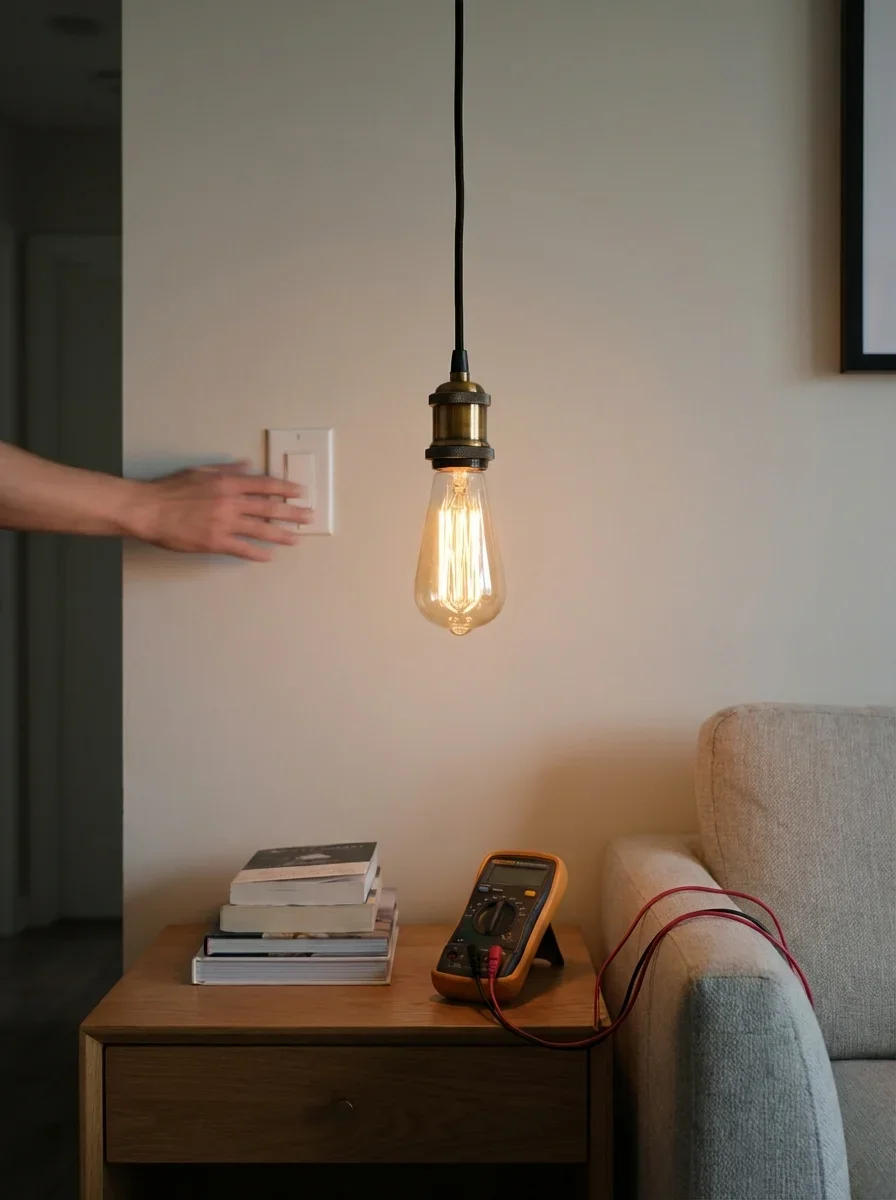
Lights dimming the moment your AC compressor starts is one of the most common complaints among Arizona homeowners.
It usually means the appliance and lighting circuits share a connection point that can't handle the startup surge.
Large motors (air conditioners, pool pumps, well pumps) draw several times their running current for 1-2 seconds during startup. If those appliances share a bus bar in your panel with lighting circuits, that momentary demand drops voltage across the entire bus. You'll see every light on that bus dim briefly, then recover.
This is normal to a very minor degree. A barely perceptible dimming when a 3-ton AC starts isn't a crisis. But if lights noticeably dim or flicker for multiple seconds, your panel is struggling to deliver adequate power. In homes built in the 1960s-1970s with 100-amp service, adding modern AC loads often exceeds what the service was designed to handle.
The solution isn't always a full panel upgrade. Sometimes a dedicated circuit for the appliance isolates the load and eliminates shared voltage drop. Other times, especially in homes where the main service wire from the utility is undersized, you need a service upgrade to 200 amps.
Pool pumps are a specific issue in Arizona, where pool ownership is near 40% in metro Phoenix. Pumps running on shared circuits with patio lighting create visible flicker every time the pump cycles. Electricians route pool electrical on isolated circuits to prevent exactly this problem, but older installations were less careful about separation.
Flickering Throughout the House vs One Room
Flickering isolated to one room almost always points to a problem in that room's circuit. A loose connection at a switch, outlet, or junction box.
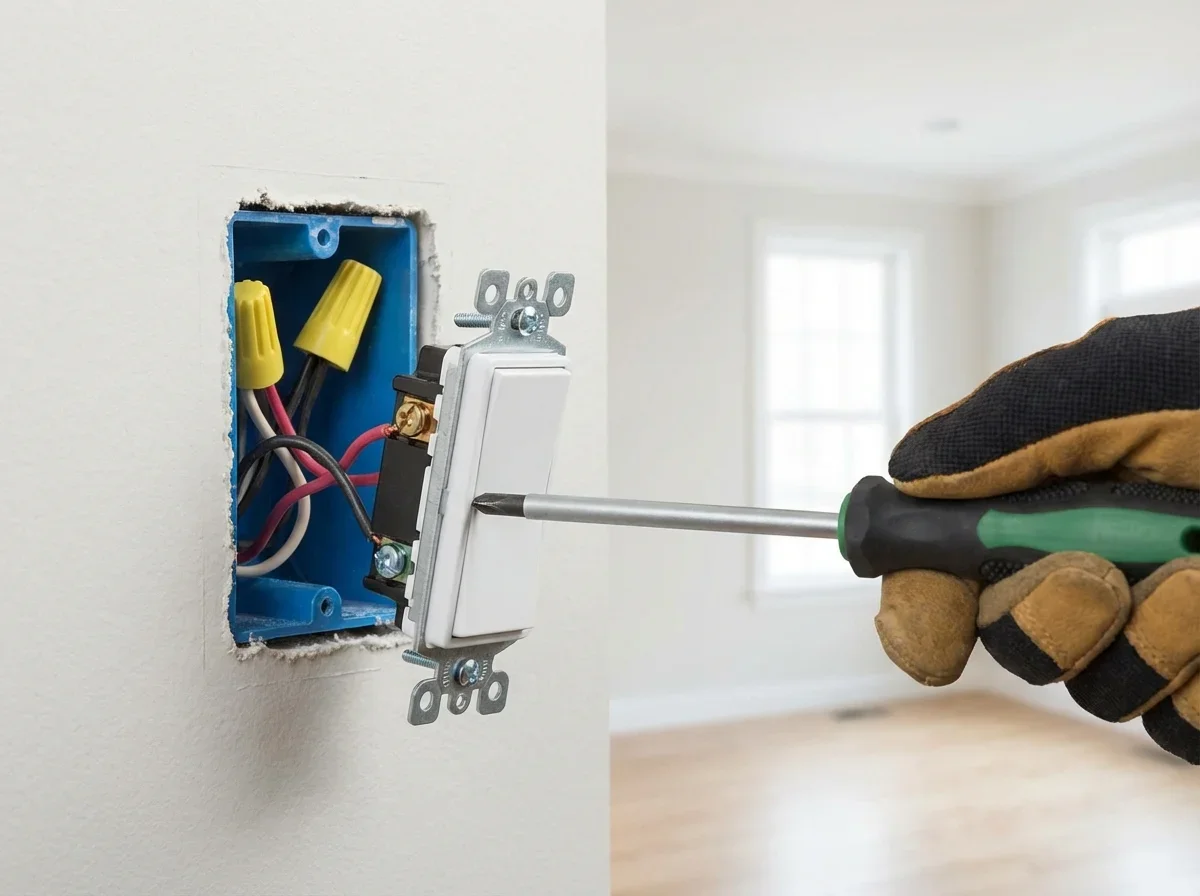
Open the switch plate and look for blackened terminals or scorch marks on the wires. Those are signs of arcing, where poor contact creates heat and intermittent connection.
Whole-house flickering is different. When every light in your home flickers simultaneously, the problem is upstream from your branch circuits. Either at the main panel, the meter base, or the utility service drop. Loose connections at the main breaker or where the service wires terminate in your panel create resistance that affects every circuit downstream.
In Arizona's older block construction homes, service wires often run through conduit buried in caliche soil. Ground shifting from seasonal moisture changes (monsoon rains soaking into dry caliche) can stress those conduit connections over time. A wire that was tight in 1975 may have worked loose by 2026, especially if the lug was aluminum-to-copper without the proper anti-oxidant compound.
Utility-side problems show up as whole-house flicker too. A loose connection at the weather head (where the utility lines attach to your home) or at the transformer serving your neighborhood will flicker every light you own.
You can't fix this yourself. Call your utility provider first to rule out their equipment before paying an electrician to diagnose your side.
Voltage fluctuations from the utility are more common in Arizona's older neighborhoods with undersized transformers. A 25 kVA transformer serving eight homes was adequate in 1970 when homes had one AC unit and fewer electronics. Today, with dual AC systems, EV chargers, and pool equipment, that same transformer is overloaded during peak summer afternoons. Voltage sags below 114V (normal is 120V), and every light on the grid flickers.
| Flicker Location | Likely Cause | DIY Check | Professional Fix |
|---|---|---|---|
| Single fixture only | Loose bulb, bad socket, fixture wiring | Tighten bulb, inspect for warmth at base | Replace fixture or repair internal connections |
| One room/circuit | Loose switch/outlet connection, backstabbed wiring | Check for scorch marks at switch plates | Trace circuit, replace faulty connections |
| Whole house | Panel connections, meter base, utility service drop | Check if neighbors have same issue (utility problem) | Tighten panel lugs, repair service entrance, coordinate with utility |
| When appliances start | Shared circuits, undersized service, startup surge | Note which appliance triggers it | Install dedicated circuit or upgrade panel to 200A |
When Is Flickering an Electrical Emergency?
Some flickering requires an immediate electrician visit, not a "call next week" approach.
Burning smells, warm switch plates, or sparking visible at outlets or fixtures mean you have active arcing that could ignite surrounding materials. Cut power at the main breaker to that circuit (or the whole house if you're unsure) and call an emergency electrician.
Flickering accompanied by buzzing or humming at the panel indicates a serious connection problem, likely a loose main breaker or bus bar connection. These connections carry 100-200 amps, and when they arc, they generate enough heat to melt buss bars and start panel fires. Arizona's summer heat makes this worse because ambient temperatures in attics and garages (where panels are often located) reach 130°F, reducing the ampacity of connections already stressed by poor contact.
Lights flickering only in one area, combined with outlets that don't work intermittently, suggests a lost neutral connection. This is particularly dangerous because it allows voltage to float above 120V on some circuits (damaging electronics) and drop below 120V on others (causing motors to overheat).
Lost neutrals happen at the panel, at the meter base, or at the utility connection. They require immediate professional diagnosis.
If you've recently had a whole house surge during a monsoon storm and flickering started afterward, lightning may have damaged wiring or panel components. Even if your surge protector saved your electronics, the strike can arc-weld connections inside your panel, creating intermittent contact that flickers under load. An electrical wiring inspection will reveal hidden damage before it fails completely.
Flickering in Arizona homes with aluminum wiring (common in 1960s-1970s construction) always deserves professional attention. Aluminum connections degrade predictably. The oxide layer builds up, resistance increases, heat accelerates oxidation, and eventually the connection fails or arcs. What starts as minor flickering becomes a fire hazard within months.
How Electricians Diagnose and Fix Flickering Lights
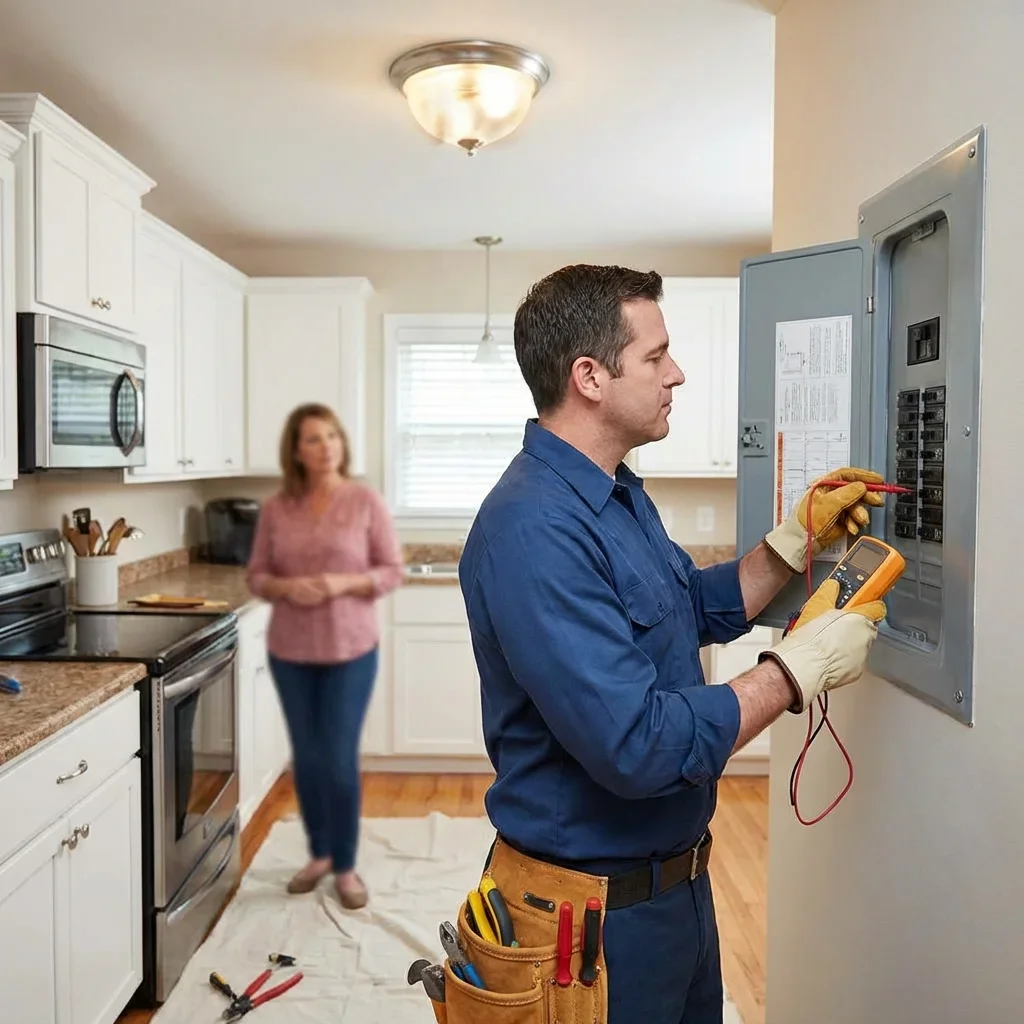
A licensed electrician's first step is measuring voltage at your panel under load.
They'll check voltage at the main breaker while running appliances that trigger flickering. If voltage drops below 114V or fluctuates more than 3-4V, the problem is either your main panel connections or the utility service.
Next, they inspect connections at the panel: tightness of breaker terminals, condition of bus bars, and torque on the main lugs. Arizona's ROC-licensed electricians know that aluminum-to-copper connections (common where aluminum service wires meet copper panel bus bars) require anti-oxidant paste and specific torque specs. A connection that looks tight but wasn't torqued to manufacturer specs will arc intermittently.
For flickering isolated to one circuit, electricians trace that circuit from the panel to each outlet, switch, and fixture. They're looking for backstabbed connections (wires pushed into the back of outlets rather than screwed to terminals), wire nuts with insufficient twist, or junction boxes with loose splices.
Backstabs are notorious for loosening over time, especially in Arizona where thermal cycling from extreme attic heat stresses connections.
Infrared cameras reveal hot spots invisible to the naked eye. An arcing connection generates heat long before it fails completely. An electrician scanning your panel with a thermal camera can identify a 20°F temperature rise at a specific breaker. That's a failing connection waiting to flicker or trip.
If the problem is voltage drop under load, solutions range from adding a dedicated circuit for high-draw appliances to upgrading wire gauge on undersized circuits. Homes that need broader fixes often benefit from whole house rewiring, particularly if insulation is brittle (common in pre-1980 Arizona homes where heat has degraded wire jackets).
For whole-house flickering tied to undersized service, a panel upgrade to 200-amp service is the permanent fix. In Phoenix metro homes where the median build year is 1985, many still have 100-amp panels installed when homes were smaller and AC loads lighter.
Modern electrical demands (dual AC zones, EV chargers, pool equipment) exceed what 100-amp service was designed to deliver.
Electricians also check the utility connection point. If voltage is inconsistent at the weather head or meter base, they'll coordinate with your utility (APS or SRP in most of Arizona) to repair their equipment. Homeowners can't touch utility equipment, but electricians know the process for requesting service inspections.
Connect with Licensed Electricians for Flickering Light Issues
Flickering lights sit at the intersection of simple fixes and hidden hazards.
You can replace a bulb or tighten a fixture yourself, but anything involving panel connections, circuit-level voltage drop, or whole-house symptoms requires a licensed professional.
In Arizona, all electricians must hold an active ROC license to perform work over $1,000. Verify their license at roc.az.gov before hiring. Residential electrical contractors hold an R-classification; commercial work requires a B-classification. The ROC bond is only $4,000-$15,000 depending on license type, so confirm the electrician carries adequate general liability and workers compensation insurance independently.
For flickering that's escalated to burning smells, sparking, or warm fixtures, emergency electrical service is available 24/7. Don't wait until morning if you're cutting power to circuits to prevent arcing.
That's an active fire risk that demands immediate attention.
For non-emergency flickering (the kind that happens occasionally when your AC runs but doesn't involve smoke or heat), schedule a diagnostic service call. Expect electricians to spend 1-2 hours tracing circuits, testing voltage, and inspecting connections. Diagnostic fees typically run $100-$200 in the Phoenix metro area and apply toward repair costs if you proceed with the work.
Frequently Asked Questions
- U.S. Department of Energy. "Flicker Basics." https://www.energy.gov/eere/ssl/flicker-basics. Accessed April 06, 2026.
- Flicker Sense (DOE-supported flicker research initiative). "Public Health Risks." https://www.flickersense.org/public-health-risks. Accessed April 06, 2026.