Why Electrical Panels Get Hot
Your electrical panel distributes power throughout your home. Every circuit, every appliance, and every outlet pulls electricity through that metal box. When everything works correctly, the panel manages this load without building up excess heat.
When something goes wrong, the panel becomes the first place heat accumulates.
Loose connections inside the panel create resistance. When wire terminals aren't tightened properly, electricity struggles to flow through the connection point. That resistance converts electrical energy into heat, the same way a space heater warms a room. A single loose wire can heat an entire breaker or bus bar enough to damage surrounding components.
Overloaded Circuits Generate Constant Heat
Phoenix homes built before 1990 typically came with 100-amp panels designed for a different era. You didn't have central AC running 24/7 from May through September, pool pumps cycling constantly, or EV chargers drawing 40 amps overnight.
Modern electrical demands on old infrastructure create sustained overload conditions that generate heat faster than the panel can dissipate it.
An overloaded circuit forces the breaker to carry more current than it's rated for. The breaker doesn't trip immediately because it's designed with thermal tolerance, but that tolerance assumes brief surges, not continuous overloading. Over time, the sustained heat degrades the breaker's internal components until it either fails to trip when needed or welds itself in the "on" position.
Corroded Connections Worsen Over Time
Arizona's temperature swings cause metal components inside your panel to expand and contract daily. 106°F days dropping to 75°F nights. This thermal cycling gradually loosens connections that were tight during installation. Add desert dust infiltrating through panel vents, and you get a layer of contamination at connection points that increases resistance further.
Aluminum bus bars in older panels corrode faster than copper when exposed to moisture. During monsoon season (July through September), humidity spikes from 10% to 50% in hours. If your panel isn't properly sealed, that moisture accelerates oxidation on aluminum surfaces, creating a rough, resistant surface where smooth metal should be.
How to Tell If Your Panel Is Too Hot
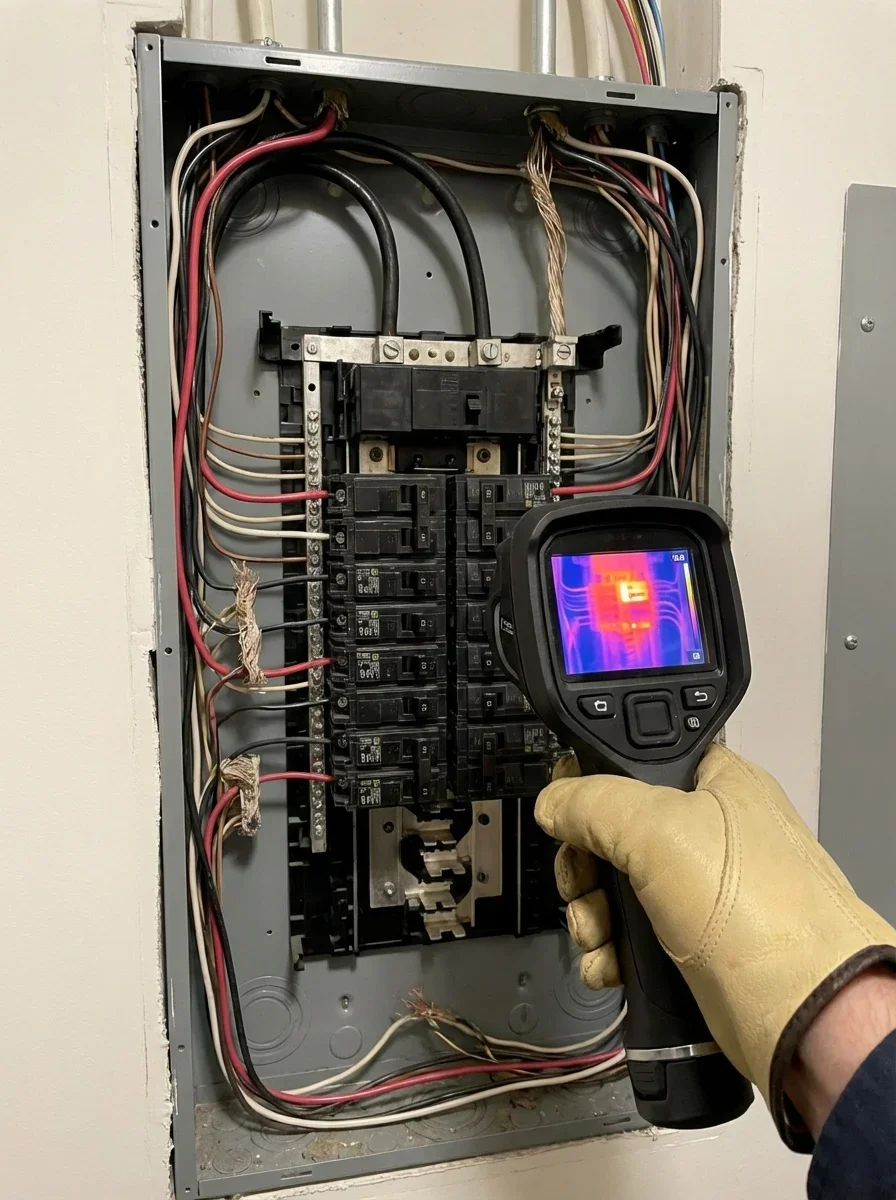
Normal operational warmth feels like holding your hand near a laptop that's been running for a few hours. Concerning heat feels like touching the hood of a car that's been sitting in a Phoenix parking lot.
If you pull your hand back instinctively, your panel is too hot.
Check the panel surface at different times of day. A panel that's cool in the morning but hot by 6 PM is telling you it can't handle peak load. That pattern often coincides with AC runtime, pool equipment, and cooking appliances all pulling power simultaneously. The panel isn't designed for that combined draw, and the heat buildup proves it.
Specific Warning Signs Beyond General Warmth
Look for discoloration around breakers. Tan or brown marks on the panel's white interior indicate overheating at that specific location. Black scorch marks mean the problem has progressed from "get this checked" to "shut off the main breaker and call an emergency electrician."
These marks don't appear from normal use. They're carbon deposits from electrical arcing or sustained overheating that's degrading insulation.
Listen to your panel. Buzzing, humming, or crackling sounds indicate arcing inside the box. Arcing happens when electricity jumps across a gap it shouldn't, generating thousands of degrees of heat at the arc point. You might hear it more clearly at night when ambient noise drops. A panel should be completely silent except for the occasional click when a breaker trips.
Check for a burning smell near the panel. Overheated wire insulation produces a distinct odor (not quite like burning plastic, more like hot electrical components with a chemical edge). If you smell this, you're already past the "monitoring" stage. The insulation is degrading, and exposed conductors inside the panel create immediate fire risk.
Key Warning Signs Your Panel Is Overheating:
- Panel surface too hot to touch comfortably (hotter than a running laptop)
- Tan, brown, or black discoloration around breakers
- Buzzing, humming, or crackling sounds from inside the panel
- Burning electrical smell near the panel box
- Panel stays cool in morning but becomes hot by evening
- Visible melting or warping of plastic components
What Causes Electrical Panels to Overheat in Phoenix Homes
Arizona's residential electrical code (based on IRC 2021 with state amendments) requires panels to be rated for the home's total load plus 25% capacity for future expansion.[5] Homes built in the 1980s rarely have that margin now.
Your 100-amp panel might have been adequate for a 1,200-square-foot block home with evaporative cooling, but add modern AC, a pool, and electric vehicle charging, and you're routinely pulling 95+ amps during peak hours.
Phoenix's sustained summer heat makes everything worse. When your panel is mounted on an interior wall near the garage or in a closet without ventilation, ambient temperatures inside that space hit 95°F even with AC running. The panel's ability to dissipate heat depends on temperature differential. If the surrounding air is already hot, heat transfer slows dramatically. Electricians regularly find panels in Phoenix attics or garages where enclosure temperature exceeds 110°F, making it impossible for the panel to stay cool regardless of electrical load.
Federal Pacific and Zinsco Panels Have Known Defects
If your home was built between 1950 and 1990, check your panel brand. Federal Pacific Electric (FPE) panels have documented failure rates where breakers don't trip during overload conditions, allowing conductors to overheat without protection.[2]
Zinsco panels have similar issues. The breakers fuse to the bus bar after repeated heating cycles, creating a permanent connection that can't be interrupted even when the breaker appears off.
These panels weren't illegal when installed, but current electrical safety standards recognize them as hazards. ROC-licensed electricians in Arizona routinely recommend replacement regardless of whether the panel shows visible problems. The risk isn't worth monitoring.
Backstabbed Wires Create Hidden Hot Spots
Walk into any electrical supply store and ask about backstabbing, and you'll hear stories. This installation method pushes wires into spring-loaded terminals on the back of breakers instead of securing them under screw terminals. It saves installation time but creates unreliable connections that loosen over years of thermal cycling.
Arizona's extreme temperature swings accelerate this loosening. A backstabbed connection that worked fine for five years suddenly develops enough resistance to heat the breaker to 140°F. You won't see this without opening the panel, but you'll feel the heat radiating from that section of the box.
Licensed electricians pull and re-terminate backstabbed connections as standard practice during panel inspections. Homes that haven't had an electrical wiring inspection since original construction still have these time bombs.
Immediate Steps When You Find a Hot Panel
Don't open the panel cover yourself. The dead front cover protects you from energized bus bars carrying 100-200 amps.
If the panel is hot enough to concern you, there's likely a fault inside that could arc when you disturb it. Opening the cover without proper tools and training adds injury risk to fire risk.
Reduce electrical load immediately. Turn off AC units, pool pumps, electric water heaters, and any other high-draw appliances you can live without temporarily. This drops the current flowing through the hot connection and slows heat accumulation. You're buying time, not fixing the problem, but time matters when components inside the panel are degrading.
Call an ROC-licensed electrician. Arizona requires anyone performing electrical work over $1,000 to hold an active Registrar of Contractors license (verify at roc.az.gov before anyone touches your panel).[1] An emergency call for a hot panel typically gets same-day or next-day response. The electrician will use thermal imaging to identify hot spots, test connections with a torque screwdriver to verify tightness, and measure voltage drop across circuits to find high-resistance faults.
What the Electrician Will Check First
Expect them to pull the meter and kill power to the entire panel before opening it. OSHA regulations require this de-energization whenever possible to protect workers from arc flash hazards that can exceed 35,000°F.[2]
Once inside, they'll check main breaker connections, bus bar integrity, and individual circuit breaker terminals.
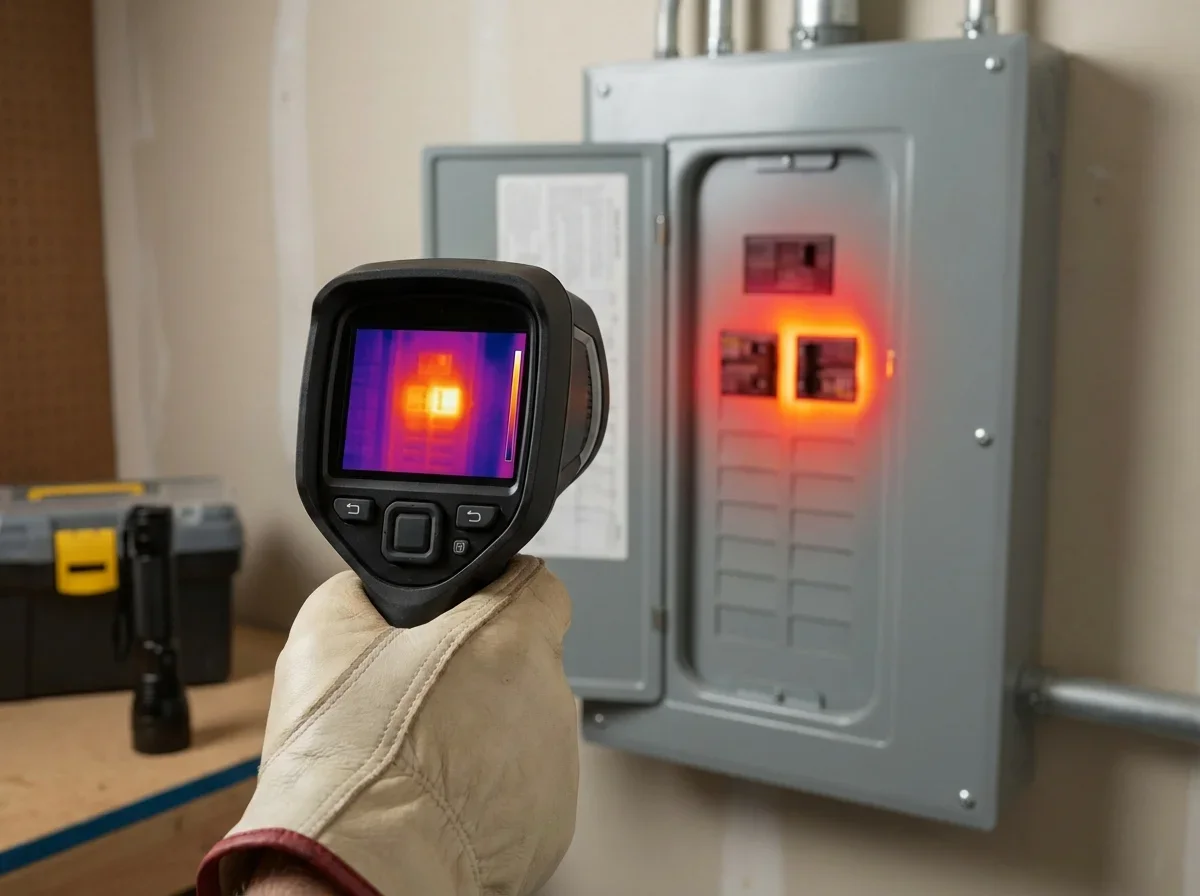
Thermal imaging cameras show temperature differentials invisible to touch. A breaker running 40°F hotter than adjacent breakers indicates a problem at that specific location. Electricians photograph these readings for documentation and use them to prioritize repairs. If multiple breakers show elevated temperatures, the problem is usually at the bus bar connection or the main breaker itself.
They'll measure resistance across connections with a milliohm meter. Proper wire terminations show resistance under 1 milliohm. Connections reading 5+ milliohms generate measurable heat under load. A reading over 20 milliohms means the connection is failing and needs immediate repair.
Pro Tip: Never attempt to tighten connections or swap breakers in a hot panel yourself. Even with the main breaker off, improper tools or technique can create arc flash that causes severe burns. Licensed electricians use calibrated torque drivers, insulated tools, and proper PPE to work safely on energized or recently energized equipment.
Panel Replacement vs Repair
Minor issues like a single loose connection or a failed breaker get repaired on the spot. The electrician de-energizes the circuit, removes the faulty component, cleans the connection point, and re-terminates with proper torque specs. Total repair time runs 30-60 minutes depending on panel accessibility.
Cost typically runs $200-400 for straightforward connection repairs.
Panel replacement becomes necessary when problems are systemic. If the bus bar shows corrosion across multiple connection points, if the main breaker itself is overheating, or if you have a Federal Pacific or Zinsco panel, replacement is the only viable solution. Trying to repair a fundamentally flawed panel is like patching a tire with sidewall damage.
What Full Panel Replacement Involves
A typical electrical panel upgrade in Phoenix costs $2,000-4,500 depending on amperage (100A, 150A, or 200A) and whether the service entrance needs replacement. The electrician pulls a permit with the city, coordinates a power shutdown with your utility (APS or SRP), and installs a new panel with proper torque on every connection, labeled circuits, and adequate surge protection.
Modern panels include arc-fault circuit interrupters (AFCIs) and ground-fault circuit interrupters (GFCIs) as required by current code. These devices add protection that older panels lack entirely. AFCIs detect arcing conditions and shut down the circuit before fire starts. GFCIs prevent electrocution in wet locations like bathrooms and kitchens.
Both technologies have reduced residential electrical fires and injuries measurably since becoming code requirements in the early 2000s.
The upgrade process takes 4-8 hours depending on complexity. Your power will be off during installation, so plan accordingly (refrigerated food, medical equipment, and work-from-home setups all need contingency plans). Most electricians schedule panel work for early morning to minimize disruption and avoid working in peak heat.
When a Sub Panel Makes More Sense
If your main panel is sound but you're adding significant load (like a hot tub or EV charger), a sub panel installation might solve your capacity problem without replacing the main. The electrician runs a large feeder circuit (typically 60-100 amps) from your main panel to a secondary panel located closer to the new load.
This approach works when your main service has adequate capacity but the main panel lacks physical space for additional breakers. Phoenix homes with 200-amp service can typically support a 100-amp sub panel without service upgrades.
The sub panel dedicates capacity to specific circuits without overloading the main panel's bus bars.
| Solution | Best For | Typical Cost | Timeline |
|---|---|---|---|
| Connection Repair | Single loose wire or failed breaker | $200-400 | 30-60 minutes |
| Full Panel Replacement | Systemic corrosion, FPE/Zinsco panels, insufficient capacity | $2,000-4,500 | 4-8 hours |
| Sub Panel Addition | Adequate main service but need more circuits or dedicated capacity | $800-2,000 | 2-4 hours |
| Service Upgrade | Insufficient amperage from utility (upgrading from 100A to 200A service) | $3,000-6,000 | 1-2 days |
Long-Term Prevention and Monitoring
Schedule an electrical inspection every 3-5 years if your home was built before 2000. Arizona doesn't require periodic inspections, but the equipment doesn't last forever.
Breakers wear out, connections loosen, and bus bars corrode.
Finding these problems during routine inspection costs hundreds. Finding them during an electrical fire costs everything.
Watch your panel during monsoon season. Humidity infiltration accelerates corrosion inside the box. If you see moisture inside the panel after a storm, call an electrician to identify the entry point and seal it properly. Water and electricity create immediate hazard, but even after the water dries, the corrosion damage continues.
Thermal Monitoring Technology
Some electricians install thermal monitoring systems that alert you when panel temperature exceeds safe thresholds. These systems use thermistors attached to critical connection points, feeding data to a monitoring panel or smartphone app. When temperature rises 20°F above baseline, you get an alert.
It's like a smoke detector for electrical faults. Early warning before visible damage occurs.
Cost runs $400-800 for basic monitoring on residential panels. It's not standard practice, but homeowners with high-value homes, extensive solar installations, or previous panel problems find value in continuous monitoring. The system pays for itself the first time it catches a developing fault before it damages expensive equipment.
Upgrading to a larger panel eliminates the root cause of overheating in most Phoenix homes. Going from 100-amp to 200-amp service gives your electrical system room to handle modern loads without sustained stress. The panel runs cooler, breakers last longer, and you eliminate the constant monitoring and concern that comes with an undersized system.
Understanding Heat Tolerance in Electrical Components
Breakers are rated for specific operating temperatures, typically 104°F (40°C) ambient. When panel temperature exceeds this due to poor ventilation or external heat, the breaker's thermal trip mechanism becomes less accurate.
A breaker designed to trip at 20% overload might not trip until 40% overload when it's already running hot from environmental conditions.
This temperature sensitivity explains why panels in Phoenix garages fail more often than panels in climate-controlled interior spaces. That garage hits 115°F on summer afternoons, meaning your breaker is starting 11°F above its rated ambient before any electrical load heats it further. The cumulative effect degrades breaker performance and shortens component life measurably.
Wire insulation has temperature ratings too. Standard NM cable (Romex) is rated for 60°C or 90°C depending on conductor size and insulation type. When panel connections run hot enough to discolor the dead front, they're likely exceeding wire insulation ratings at the connection point. The insulation becomes brittle, cracks, and exposes bare conductor.
Once that happens, you're one vibration or thermal cycle away from a short circuit or ground fault.
Heat Dissipation Design Matters
Modern panels include ventilation features that older designs lack. Vent slots at top and bottom of the enclosure allow convection cooling (hot air rises out the top while cooler air enters the bottom). Panels installed in tight closets or covered with paint lose this airflow, trapping heat inside the enclosure.
OSHA requires minimum clearances around electrical equipment: three feet in front of the panel and 2.5 feet of width or the panel width, whichever is greater.[1] These aren't just access requirements for electricians. They're heat management specifications.
Blocking airflow around the panel with storage boxes or shelving increases operating temperature and accelerates component degradation.
Check your panel's mounting location. Panels mounted on exterior walls in direct sun can see enclosure temperatures 20°F higher than shaded panels. If the wall gets afternoon sun in Phoenix, the panel inside that wall cavity operates in significantly elevated ambient conditions. Moving the panel during renovation or installing sunshade over the exterior wall both help reduce this heat load.
When Hot Panels Indicate Larger System Problems
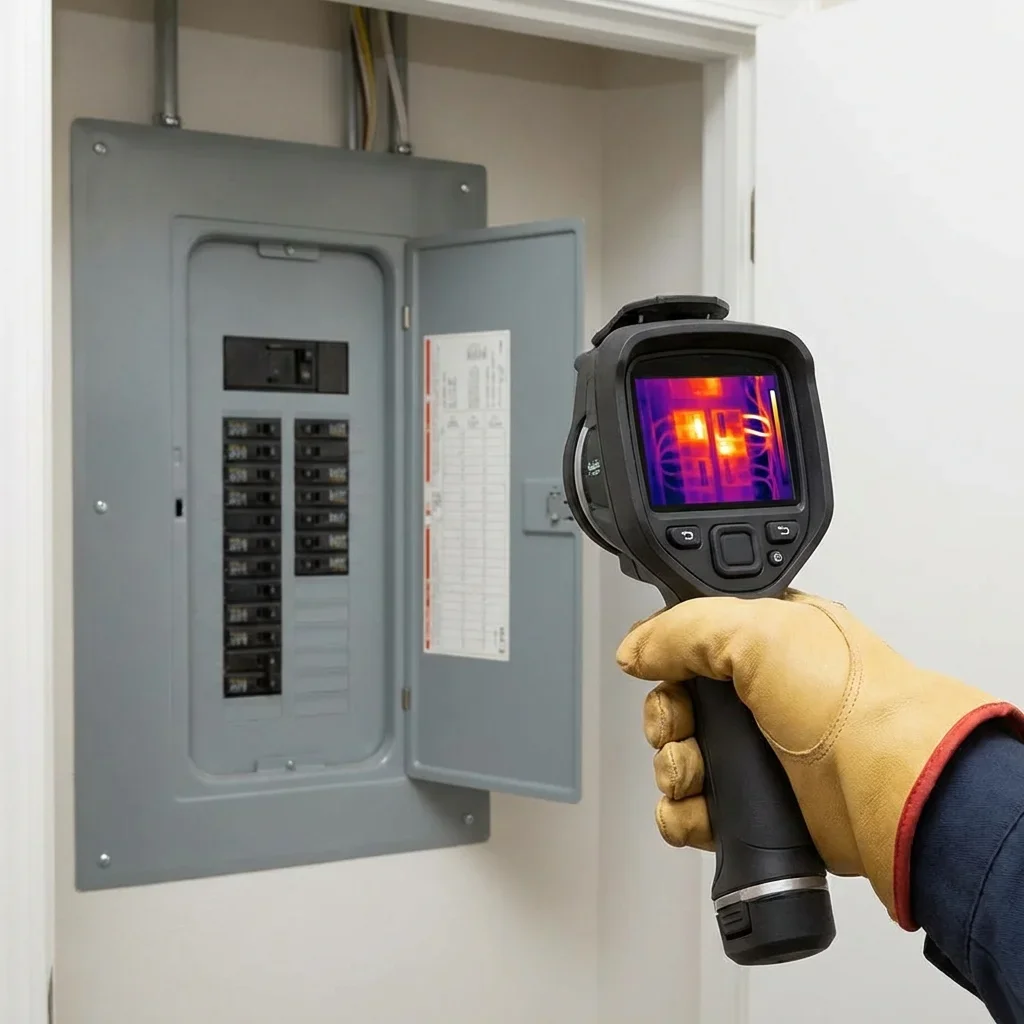
Sometimes a hot panel is just the symptom, not the problem. If your main service conductors from the utility are undersized for your home's current load, the voltage drop across those conductors generates heat that radiates into your panel.
You'll need an electrician to measure voltage at the meter during peak load and compare it to voltage inside the panel. A drop exceeding 3% indicates service conductor issues that panel replacement won't fix.
Utility connection problems cause this too. The connection between utility lines and your meter, or between the meter and your service entrance, can develop resistance over time. This is technically the utility's responsibility up to the meter, but homeowners often notice the problem first when the meter base or service entrance conductors run hot. Calling your utility (APS: 602-371-7171, SRP: 602-236-8888) gets a service check scheduled, usually within 24-48 hours.
Identifying Service Entrance Failures
Look at the meter base itself. If the metal enclosure is hot to touch or you see discoloration around the connection lugs visible through the meter glass, the problem is upstream of your panel.
These connections carry the full house load (100+ amps continuously during Phoenix summers), and any resistance generates significant heat.
Licensed electricians can't work on utility-owned equipment, but they can identify the problem and coordinate with the utility on your behalf. Expect the utility to de-energize your service, pull the meter, inspect connections, and re-terminate if they find problems. This service is typically free because it's infrastructure maintenance on utility-owned equipment.
If the problem is on your side of the meter (the service entrance conductors running from meter to panel), replacement falls to you. Service entrance conductor replacement costs $800-2,000 depending on run length and whether the conduit needs replacement too. It's expensive, but it fixes the heat problem permanently rather than masking it with panel repairs that don't address root cause.
Code Compliance and Panel Safety Standards
Arizona adopts the National Electrical Code (NEC) as its baseline standard, with state amendments published by the Arizona Registrar of Contractors. Current code requires AFCI protection on most 15A and 20A circuits, GFCI protection in wet locations, and proper labeling of all circuits.[3]
Older panels lack these protections entirely, creating safety gaps that modern code considers unacceptable.
When you upgrade a panel, the work must meet current code regardless of what was acceptable during original construction. This means adding protection devices that weren't required in 1985 but are mandatory now. Some homeowners resist this as unnecessary expense, but the code changes are based on decades of incident data showing measurable safety improvements from these technologies.
Permit Requirements for Panel Work
Any panel replacement or substantial modification requires a permit in Phoenix, Scottsdale, Tempe, and other valley cities. The permit costs $100-300 depending on jurisdiction and triggers an inspection after work completes. That inspection verifies proper installation, correct breaker sizing, adequate clearances, and code-compliant protection devices.[4]
Electricians pull permits as part of standard service. If someone offers to "save you money" by skipping the permit, walk away.
Unpermitted electrical work creates liability during home sales, may void your homeowner's insurance, and leaves you with no verification that the work meets safety standards. The permit and inspection cost a few hundred dollars. The consequences of unpermitted work cost thousands.
ROC requires contractors to specify license numbers on all permits and contracts. If you're reviewing an estimate for panel work, verify the contractor's C-11 (residential electrical) license at roc.az.gov before signing anything. Active licenses show no recent violations or disciplinary actions. Suspended or expired licenses mean the contractor can't legally perform the work regardless of their experience or pricing.
Regional Factors That Accelerate Panel Degradation in Arizona
Phoenix's extreme UV exposure affects panels mounted on exterior walls or in outdoor enclosures. UV degrades plastic components in breakers and melts adhesive on circuit labels. Panels installed outdoors need UV-resistant enclosures rated for direct sun exposure, not standard interior-rated boxes.
Using the wrong enclosure type accelerates component failure measurably.
Desert dust infiltration is another Phoenix-specific problem. Fine particulate dust enters panel enclosures through vent slots and settles on bus bars, creating an insulating layer that traps heat. Over time, this dust absorbs moisture during monsoon season, becoming slightly conductive and creating paths for current leakage. Annual cleaning with compressed air during electrical troubleshooting visits removes this buildup before it causes problems.
Thermal expansion from daily temperature swings loosens wire terminations faster in Arizona than moderate climates. A connection properly torqued in January might be loose by August after hundreds of heating/cooling cycles.
This is why re-torquing connections during routine inspections matters. It's preventive maintenance against a problem that develops predictably in this climate.
- Office of the Colorado State Water Engineer (OCWR.gov). "Electrical Panel Safety." https://www.ocwr.gov/publications/fast-facts/electrical-panels/. Accessed April 07, 2026.
- Occupational Safety and Health Administration (OSHA). "1926.403 - General requirements.." http://www.osha.gov/laws-regs/regulations/standardnumber/1926/1926.403. Accessed April 07, 2026.
- Occupational Safety and Health Administration (OSHA). "29 CFR Part 1910 Subpart S -- Electrical." https://www.ecfr.gov/current/title-29/subtitle-B/chapter-XVII/part-1910/subpart-S. Accessed April 07, 2026.
- Occupational Safety and Health Administration (OSHA). "29 CFR Part 1926 Subpart K -- Electrical." https://www.ecfr.gov/current/title-29/subtitle-B/chapter-XVII/part-1926/subpart-K. Accessed April 07, 2026.
- National Institute of Standards and Technology (NIST). "A Guide to United States Electrical and Electronic Equipment Compliance Requirements." https://nvlpubs.nist.gov/nistpubs/ir/2017/nist.ir.8118r1.pdf. Accessed April 07, 2026.