Why Only Part of Your House Lost Power
Your home's electrical system divides power across multiple circuits, each protected by its own breaker. When one circuit fails, everything on that circuit goes dark while the rest of your house runs normally.
Think of it like a tree. The main panel is the trunk, and each circuit is a branch. Damage to one branch doesn't kill the whole tree.
Most partial outages trace back to a tripped breaker, a blown fuse (if you still have a fuse box), or a fault somewhere along that circuit. Less often, the problem sits upstream — at a loose connection in your panel, a failing main breaker, or even utility equipment outside your house.
In Arizona's slab-on-grade homes, wiring runs under concrete or through attic spaces where summer heat routinely hits 140°F. That thermal stress, combined with Phoenix's hard water causing corrosion in metal junction boxes, accelerates wear on connections and insulation. Homes built in the 1970s and 1980s with aluminum branch wiring or outdated panels are especially vulnerable.
Check Your Electrical Panel First
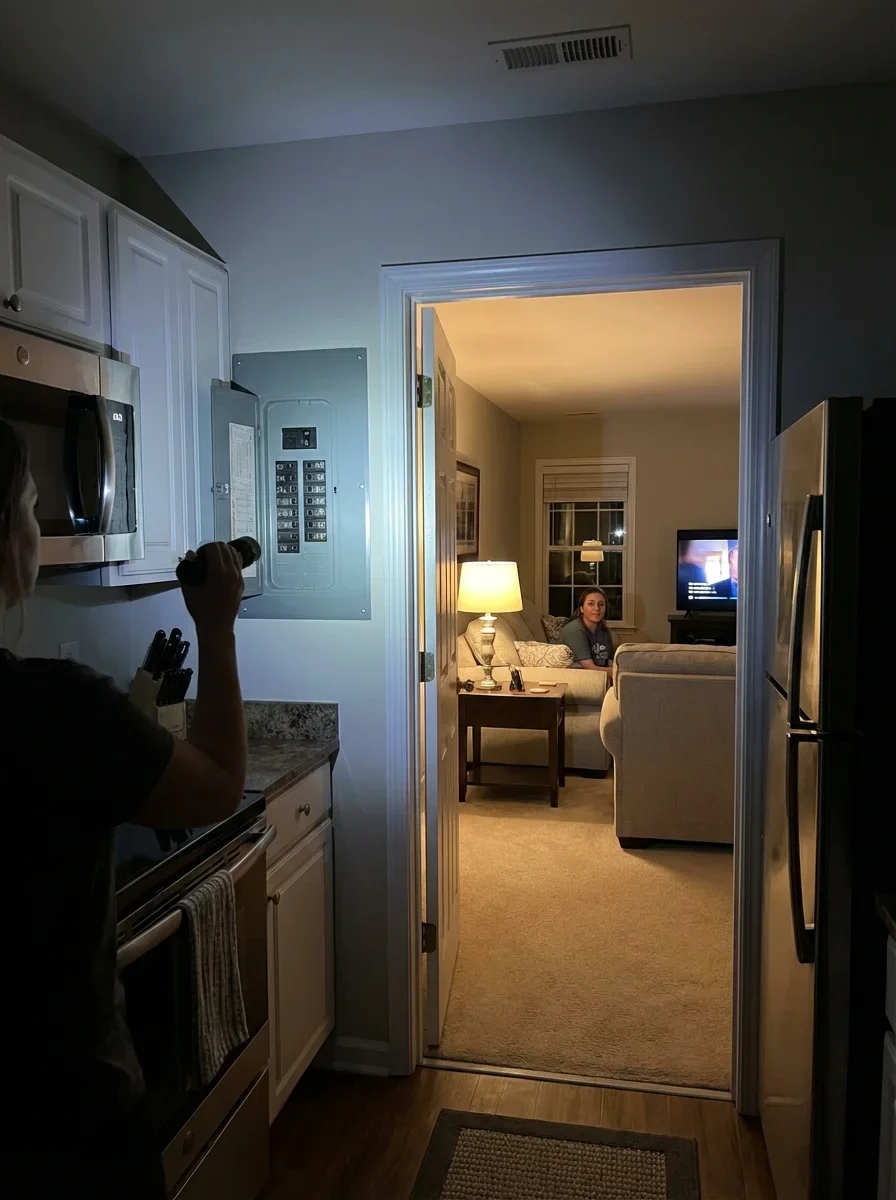
Walk to your main electrical panel and open the door. Look for a breaker in the "off" position or sitting halfway between on and off.
A tripped breaker is the single most common cause of partial power loss.
If you find one, don't just flip it back on yet. A breaker trips for a reason — overload, short circuit, or ground fault. Resetting it without understanding why might trip it again immediately, or worse, mask a dangerous fault that's heating up wiring inside your walls.
Before resetting, unplug everything on that circuit. If the breaker holds when you flip it back on, you've likely got an overload. Add devices back one at a time to identify the culprit.
If the breaker trips again immediately with nothing plugged in, you've got a short circuit or ground fault somewhere in the wiring. Stop. This is electrical troubleshooting work for a licensed electrician.
What a Tripped Breaker Actually Means
Breakers are protective devices, not switches. When current exceeds the breaker's rating — say, 20 amps on a 15-amp circuit — the internal mechanism trips to prevent wire overheating.
Modern breakers also trip on ground faults (current leaking to ground) and arc faults (sparking inside connections).
In Phoenix, June through August sees a spike in nuisance tripping. Your AC, pool pump, and refrigerator all cycle harder in 110°F heat, and aging breakers lose their calibration. If a breaker trips repeatedly without obvious overload, the breaker itself may be worn out.
Breakers don't last forever. 25 to 30 years is typical, and many Phoenix homes are still running original 1980s panels.
When the Breaker Looks Fine But Power's Still Out
No tripped breakers? Check if the breaker is actually making contact. Gently press it fully to the "on" position — sometimes they sit loose without fully engaging the bus bar.
If that doesn't restore power, you might have a failed breaker. They can fail internally without visibly tripping, especially in older Federal Pacific or Zinsco panels that Arizona electricians flag during electrical inspections as fire hazards.
Another possibility: the problem isn't in your panel at all. A lost phase from the utility, a blown transformer fuse, or a bad connection at your meter can cause half your house to go dark. If your panel shows 120V on some breakers and zero on others (requires a multimeter to check), the issue is upstream.
Call your utility first, then an electrician if they clear their equipment.
Common Causes Behind Partial Power Loss
Overloaded Circuit
You're running a space heater, a hair dryer, and a vacuum on the same circuit. Total draw: 26 amps on a 15-amp breaker. The breaker trips, and everything on that circuit dies.
This is the electrical equivalent of trying to pour a gallon of water through a funnel sized for a pint.
Phoenix homes built before 1990 typically have fewer circuits than modern code requires. Kitchens might have one 20-amp circuit serving countertop outlets, the refrigerator, and the microwave. That's below current National Electrical Code (NEC) standards, which mandate at least two 20-amp small appliance circuits in kitchens.
If you're constantly tripping breakers in one room, you likely need a dedicated circuit installation.
Short Circuit or Ground Fault
A short circuit happens when hot and neutral wires touch, creating a sudden surge of current. A ground fault occurs when current leaks to the grounding system, usually through damaged insulation.
Both trip breakers instantly.
In Arizona, rodents are a frequent cause. Roof rats chew through wire insulation in attics, especially near entry points around HVAC ducting. UV exposure through unshaded windows degrades insulation on exposed wiring. Water intrusion during monsoon season (July through September) creates ground faults in outdoor junction boxes and buried conduit.
If your partial outage started during or after a storm, check GFCI outlets and exterior boxes first.
Loose or Corroded Connection
Electrical connections expand and contract with temperature. In Phoenix attics where summer temps exceed 140°F, this cycle repeats thousands of times. Over 20 to 30 years, wire nuts loosen, screw terminals back out, and aluminum wire connections oxidize.
A loose connection creates resistance, resistance creates heat, and heat accelerates oxidation. Eventually the connection fails entirely or arcs intermittently.
You might notice lights flickering before they go out completely, or power that comes and goes when you bump a switch. This is one of the most dangerous electrical faults because it generates heat inside your walls without tripping a breaker. If you smell burning plastic or see discolored outlets, shut off the circuit and call an electrician immediately.
Phoenix's hard water (300+ ppm calcium carbonate) accelerates corrosion in metal junction boxes, especially in pre-2000 homes where boxes are grounded through direct contact with metal conduit. Mineral-rich moisture from seasonal humidity combines with desert dust to create conductive sludge inside outdoor boxes.
Top-rated contractors in Mesa and Chandler report loose outdoor connections as the #2 cause of service calls during monsoon season, right behind lightning strikes.
Warning Sign: Flickering lights, power that comes and goes when you touch a switch, or outlets that feel warm to the touch indicate a loose connection generating heat inside your walls. This is a fire hazard that won't trip a breaker. Shut off the circuit immediately and call an electrician — don't wait for the problem to "get worse."
GFCI or AFCI Tripped
Ground Fault Circuit Interrupter (GFCI) outlets protect against shock in wet locations like bathrooms, kitchens, and outdoor areas. Arc Fault Circuit Interrupter (AFCI) breakers protect against sparking faults in bedrooms and living areas. Both are code-required in Arizona new construction and are more sensitive than standard breakers.
A GFCI outlet has "Test" and "Reset" buttons on its face. If tripped, the reset button pops out and power stops at that outlet and every outlet downstream on the same circuit.
You might lose power in three rooms because one GFCI in the garage tripped. Check all GFCI outlets in your house, not just the room with dead power.
AFCI breakers in your panel look like regular breakers but have a small test button. They trip on arc faults (loose connections, damaged cords, deteriorating insulation) and sometimes on normal motor startup from vacuums or drills. Nuisance tripping is common with older AFCI models.
If an AFCI breaker trips repeatedly with no obvious fault, the breaker may need replacement or the protected circuit may have a hidden arc fault requiring professional diagnosis.
Failed Breaker or Panel Issue
Breakers wear out. The bi-metal strip or magnetic coil that senses overcurrent degrades over decades.
A failed breaker won't trip when it should, or trips at random, or fails to conduct power even in the "on" position.
Certain panel brands sold in the 1970s and 1980s — Federal Pacific Electric (FPE) Stab-Lok and Zinsco — are documented fire hazards. Their breakers fail to trip under fault conditions, allowing wires to overheat. Arizona's ROC doesn't mandate replacement, but insurers often require it before issuing or renewing policies.
During a home sale, an inspector will flag these panels and buyers typically demand replacement as a condition of closing. Replacement costs $2,000 to $4,500 depending on panel size and whether you need a sub panel installation to redistribute circuits.
Lost Phase from Utility
Your house receives power as two 120V legs from the utility transformer. If one leg drops — failed transformer fuse, broken wire at the weatherhead, loose lug at the meter — half your panel goes dark.
You'll lose power to roughly every other breaker, and 240V appliances (AC, dryer, oven) won't run at all.
This is a utility problem, not a homeowner problem. Call your power company first. They'll check the transformer and service drop. If their equipment is fine, the fault is between the meter and your panel — that's your responsibility. An electrician will check the meter base, service conductors, and main breaker.
Arizona Public Service (APS) and Salt River Project (SRP) both offer 24-hour outage lines. Lost phase is more common in older neighborhoods with aging overhead lines, especially after high winds or monsoon microbursts.
| Cause | Typical Symptoms | DIY Check | Professional Fix |
|---|---|---|---|
| Tripped Breaker | One or more rooms dark, breaker in off/middle position | Reset breaker with devices unplugged | If trips repeatedly: diagnose overload or fault |
| Overloaded Circuit | Breaker trips when multiple devices run | Reduce load, test one device at a time | Install dedicated circuit ($300-800) |
| GFCI Tripped | Multiple rooms dark, GFCI reset button popped | Press reset on all GFCI outlets | Replace failed GFCI ($150-250) |
| Lost Phase | Half the house dark, 240V appliances won't run | Call utility company first | Utility repairs service drop; electrician fixes meter base to panel ($400-1,200) |
What You Can Safely Check Yourself
Before calling an electrician, you can eliminate simple causes. Start at the panel. Identify which rooms or outlets are dead, then find the corresponding breaker.
Reset any tripped breakers with nothing plugged in on that circuit.
Check GFCI outlets in bathrooms, kitchen, garage, and outdoor areas. Press "Reset" on each one. In Phoenix homes, outdoor GFCIs protect patio outlets, pool equipment outlets, and sometimes landscape lighting. A tripped GFCI near your pool pump might kill power to the far side of your yard.
Look for obvious damage: burn marks on outlets, charred wire insulation visible in ceiling boxes, discolored switch plates. If you see or smell evidence of overheating, don't touch it.
Shut off the breaker if you can identify it safely, then call an electrician.
Test outlets with a plug-in circuit tester ($8 at any hardware store). It'll tell you if the outlet is wired correctly, has an open ground, reversed polarity, or open neutral. An open neutral — where the neutral wire is disconnected somewhere upstream — causes weird symptoms like partial power and voltage fluctuations.
That's the extent of safe DIY diagnostics. Anything past that requires tools, training, and an ROC C-11 electrical license.
When to Call an Electrician
Call immediately if you see sparks, smell burning plastic, hear buzzing from the panel, or feel heat on outlets or switch plates. These are symptoms of active electrical faults generating heat.
Every hour you wait increases fire risk.
Call same-day if a breaker trips repeatedly, even with nothing plugged in. That's not a nuisance trip, it's a fault condition. The breaker is doing its job by cutting power to a dangerous circuit.
Call within 24 hours if you've ruled out tripped breakers and GFCI outlets but still have dead circuits. The problem is inside your walls or panel, and finding it requires testing you can't safely do yourself.
For non-emergency diagnostics — like investigating why a bedroom circuit trips occasionally or upgrading an overloaded kitchen — schedule within a week. Electrical problems don't heal themselves, and small issues become expensive ones if ignored.
Arizona law requires all electrical work beyond simple device replacement (outlets, switches, light fixtures) to be performed by ROC-licensed contractors. Verify any electrician's C-11 license at https://roc.az.gov/ before they start work.
Phoenix-area contractors should carry general liability and workers comp insurance, though Arizona doesn't mandate workers comp. Ask for proof. The ROC bond ($4,000 to $15,000 depending on license class) won't cover much if something goes wrong.
When to Call Immediately (Safety Risk):
- Sparks from outlets, switches, or panel
- Burning plastic smell near electrical components
- Buzzing, crackling, or sizzling sounds from panel
- Outlets or switch plates hot to the touch
- Visible char marks or melted plastic
- Breaker trips repeatedly with nothing plugged in
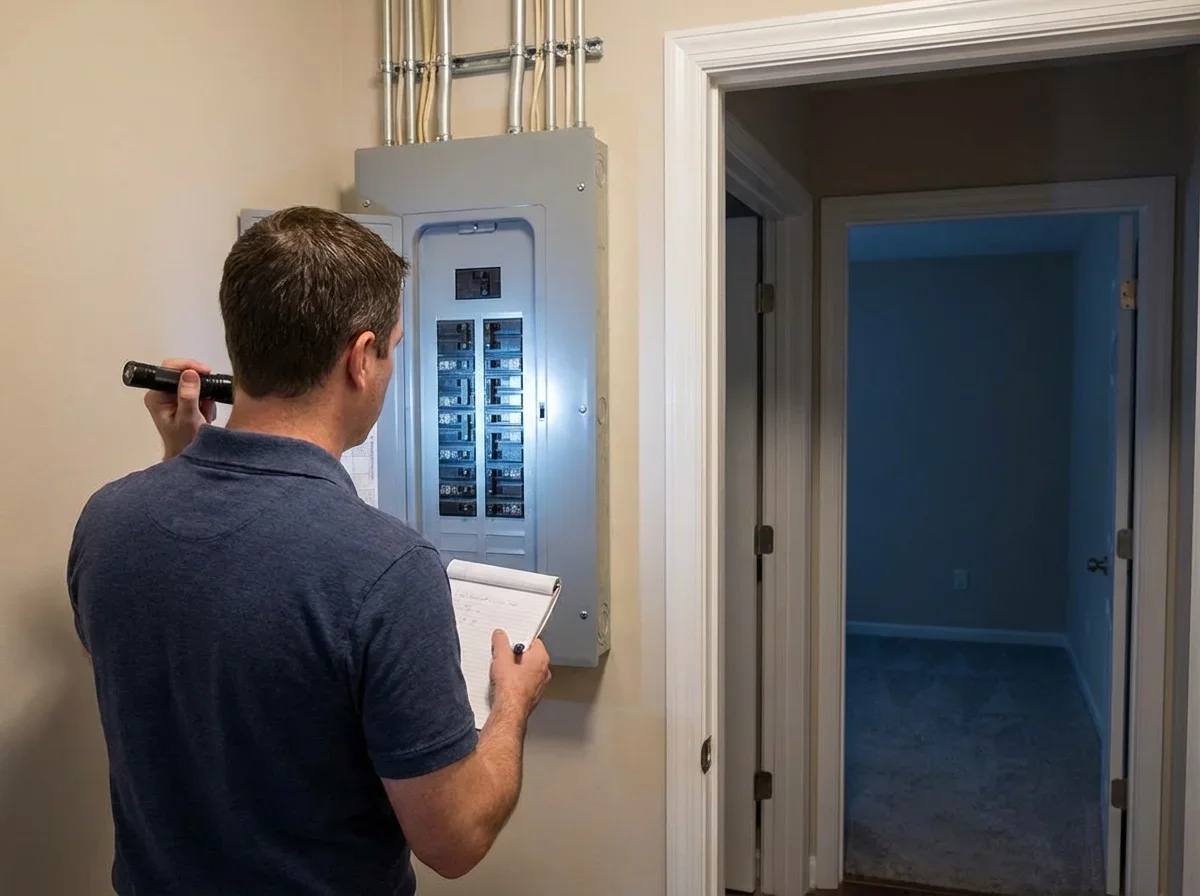
What an Electrician Will Do
A licensed electrician starts with questions: When did the power go out? Did anything trip or make noise? Have you added new appliances or space heaters? Were there storms, high winds, or recent construction nearby?
This history narrows the diagnostic path.
Next comes testing. Using a multimeter, they'll check voltage at the panel, confirm which breakers are live, and identify dead circuits. If a breaker shows 120V but outlets downstream read zero, the fault is between the panel and the first dead outlet — usually a junction box or switch.
They'll trace the circuit, opening boxes to inspect connections. In Phoenix, attic junction boxes are common failure points due to heat and rodent damage. Outdoor boxes fail from corrosion. Switches fail from mechanical wear.
Each step involves shutting off power, testing to confirm it's off, then visually inspecting and testing continuity.
If the problem is a failed breaker, they'll replace it. If it's a loose connection, they'll clean and re-torque terminals or replace damaged wire nuts. If it's a short circuit buried in the wall, they may need to run new wire or install a junction box to bypass the damaged section.
For older panels with multiple failing breakers or signs of overheating (rust, corrosion, melted bus bars), they'll likely recommend a panel upgrade. A full 200-amp panel replacement in Phoenix runs $2,500 to $4,500 including permit and inspection.
If your main service is undersized (100-amp service feeding a house with central AC, pool, and modern appliances), you're looking at $5,000 to $8,000 for a service upgrade including new meter base and utility coordination.
Preventing Partial Power Outages
Most electrical failures don't happen suddenly. They develop over months. Regular maintenance catches them early.
Have a licensed electrician inspect your panel every five years if your home was built before 1990, every ten years for newer construction.
During an inspection, the electrician will thermal-scan the panel for hot spots, tighten bus connections, test GFCI and AFCI devices, and check for signs of overload (discolored breakers, worn contact points). Phoenix electricians also check outdoor boxes and attic junction boxes, which deteriorate faster than indoor components.
Don't overload circuits. If you're running multiple high-draw devices (space heaters, power tools, kitchen appliances) on one circuit and tripping breakers regularly, install dedicated circuits.
Kitchens should have at least two 20-amp small appliance circuits plus separate circuits for the dishwasher, disposal, and microwave. A 200-amp panel has room for 40 to 50 circuits — don't try to run a modern home on 1970s-era 100-amp service with 12 circuits.
Replace outdated panels. If you have Federal Pacific, Zinsco, or a fuse box, budget for replacement. These aren't just inconvenient, they're fire hazards.
Insurance companies know it and will non-renew policies or refuse coverage on homes with known-hazardous panels.
Consider whole house surge protection if you live in an area with frequent lightning or power fluctuations. Phoenix's monsoon season brings 20,000+ cloud-to-ground lightning strikes annually. A direct or nearby strike can blow multiple breakers, fry electronics, and damage arc fault breakers.
Whole-house suppressors install at the panel and cost $400 to $900 including labor.
Keep your electrical load balanced. If half your house routinely dims when the AC kicks on, your panel may be unbalanced (too many heavy loads on one leg). An electrician can redistribute circuits across both legs to even out the load.
DIY Electrical Work vs Licensed Pros
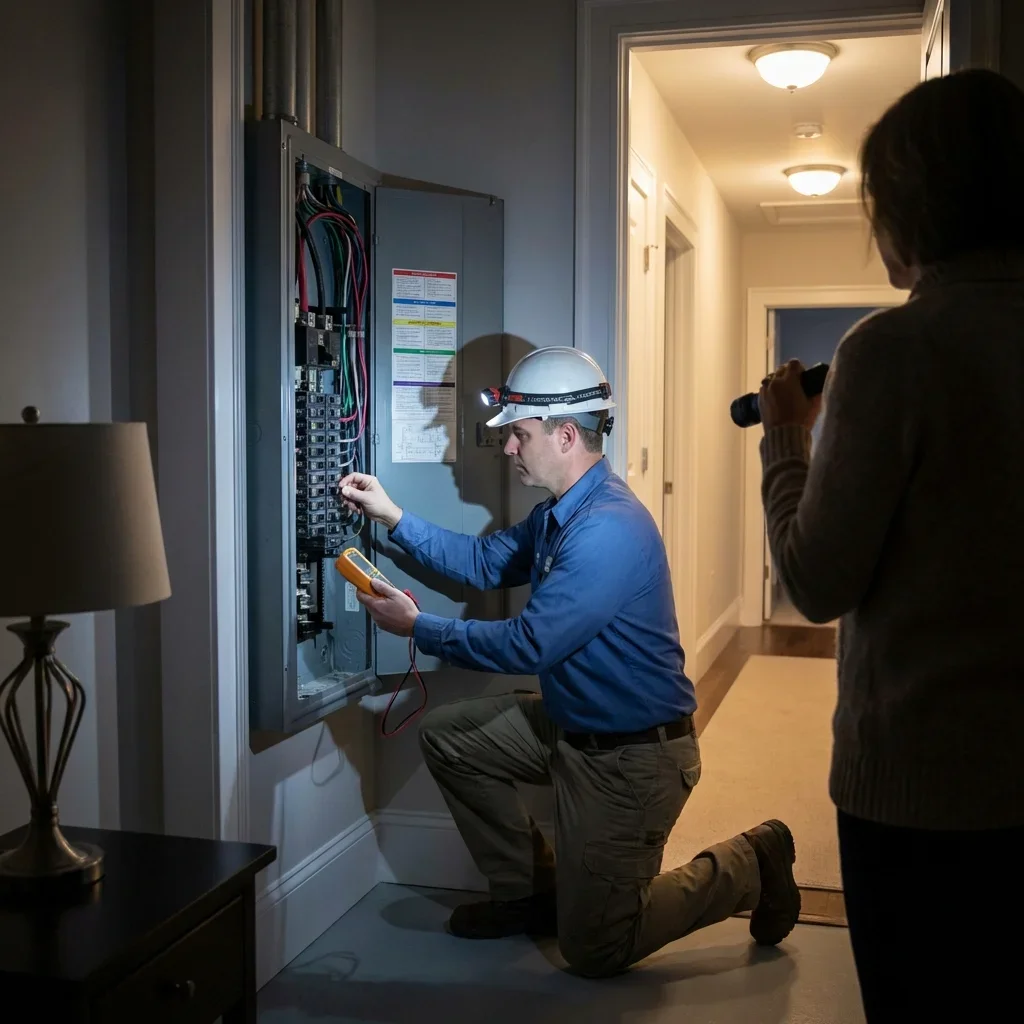
Arizona law is clear: any electrical work beyond replacing a device (outlet, switch, light fixture) in an existing box requires a licensed contractor. Running new wire, installing circuits, replacing breakers, upgrading panels — all require an ROC C-11 or C-61 (limited electrical) license.
Unlicensed work voids permits, complicates home sales, and can void your homeowner's insurance if a fire starts from faulty wiring.
During a sale, an inspector will note unpermitted electrical work, and buyers will demand correction or price reduction. Correcting DIY work often costs more than doing it right the first time because the electrician has to demo the faulty work, bring it to code, then pass inspection.
Even if you have electrical experience, working without a license is illegal in Arizona. "Homeowner exemption" doesn't exist for electrical like it does for some plumbing work. If you pull a permit as a homeowner for electrical work, you're certifying you'll do it to code and pass inspection.
Most municipalities won't issue electrical permits to non-licensed individuals.
For a detailed breakdown of when to tackle a project yourself versus hiring a licensed pro, see our comparison guide: DIY Electrical Work vs Hiring a Licensed Electrician.
What to Ask When You Call
When you call an electrician for a partial power outage, ask:
- Are you ROC-licensed? (Verify the license number yourself at roc.az.gov)
- Do you carry liability and workers comp insurance?
- What's your diagnostic fee? (Expect $100 to $200 for a service call and initial diagnosis)
- Can you provide a written estimate before starting repairs?
- Will the work require a permit? (Most panel work and circuit additions do)
- What's your warranty on parts and labor?
Be specific about your symptoms: "Power is out in two bedrooms and the hallway, but the bathroom between them works fine. I checked the panel and don't see any tripped breakers. This started this morning with no storms or obvious cause."
That level of detail lets the electrician bring the right tools and parts, saving you time and repeat visits.
For more detailed guidance on evaluating contractors, see How to Find a Good Electrician: Licensing, Red Flags & Questions to Ask.