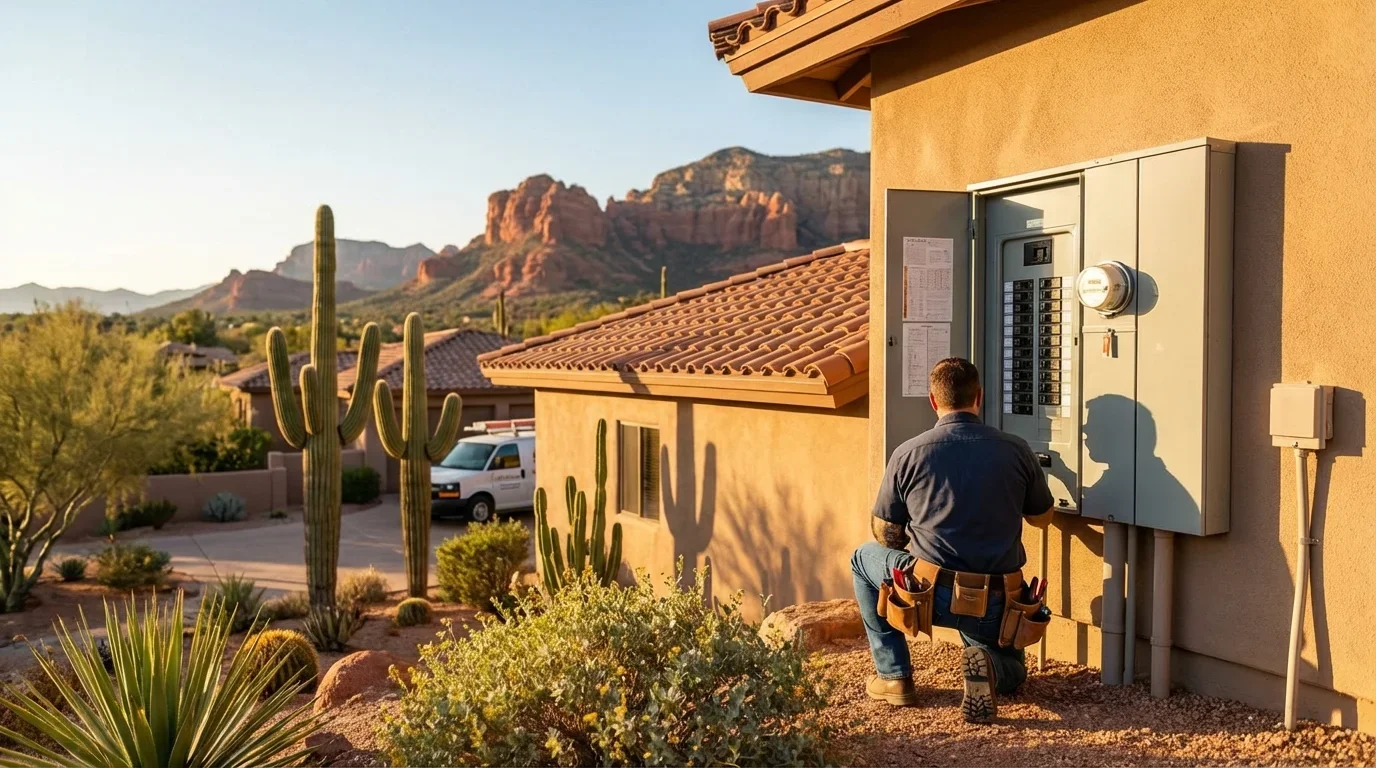
Keep Your Power On When Arizona Needs It Most
Breakers that trip constantly aren't just annoying—they're warning signs. Our licensed electricians diagnose the real problem and fix it right the first time.
- Stop resetting breakers multiple times a day
- Prevent electrical fires from overloaded circuits
- Get same-day service across the Valley
⚠ Common Issues
When Do You Need Circuit Breaker Repair?
Your breaker trips. You flip it back. It holds for a week, then trips again. You flip it again. It trips the same day.
That cycle is your electrical system screaming for help.
Signs Your Breaker Is Failing
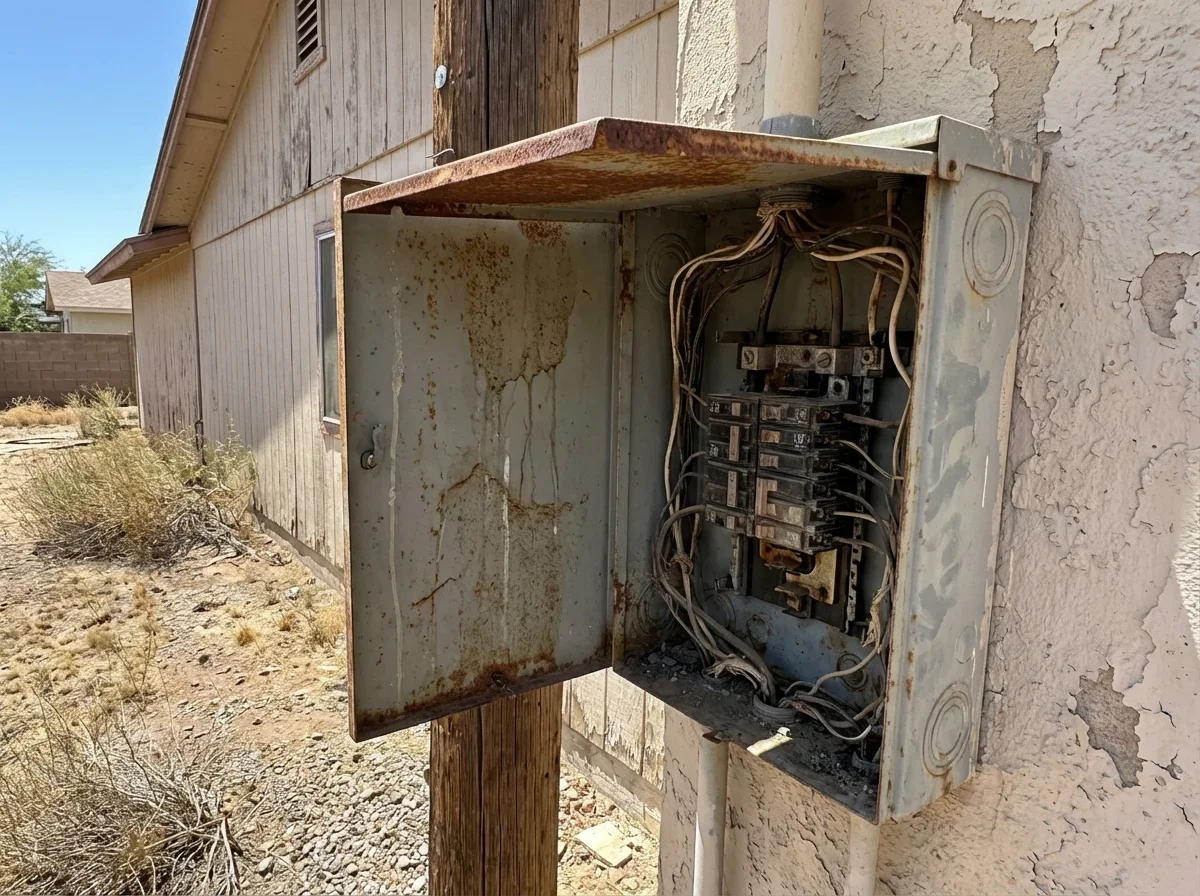
A circuit breaker that trips occasionally might just be doing its job — protecting an overloaded circuit. A breaker that won't reset, feels hot to the touch, or emits a buzzing sound is failing. That's when you stop flipping and start calling.
Common warning signs in Phoenix and Scottsdale homes:
- Breaker won't stay in the "on" position — trips immediately or won't reset at all
- Hot breaker or burning plastic smell — the breaker itself is overheating
- Scorch marks around the breaker or on the panel cover
- Buzzing or crackling sounds from the panel
- Flickering lights when the AC kicks on or appliances run
Arizona's extreme heat makes garage and attic panels particularly vulnerable. A panel sitting in a 140°F garage all summer experiences thermal stress that accelerates breaker wear. Dust accumulation in desert homes compounds the problem — dust inside the panel acts as insulation, trapping heat around breakers and bus bars.
Tripping vs Non-Resetting Breakers
A breaker that trips and resets successfully might not need replacement — you might have an overloaded circuit, a short circuit, or a ground fault somewhere downstream. A Mesa homeowner running a space heater, hair dryer, and curling iron on the same bathroom circuit will trip a 20-amp breaker every time. That's not a breaker problem; that's a dedicated circuit problem.
A breaker that won't reset at all has typically failed internally. The trip mechanism is damaged, the contacts are welded shut from arcing, or the breaker has reached end-of-life. Standard circuit breakers last 30-40 years under normal conditions, but Arizona heat can cut that lifespan in half for panels in unconditioned spaces.
Sound familiar? Your bedroom circuit trips every time you run the vacuum. You flip the breaker. It works for three days. Then it trips while you're at work, and now it won't reset at all. The fridge on that circuit has been warming for six hours.
Non-resetting breakers also indicate more serious panel issues: corrosion on the bus bar, loose connections causing arcing, or a main breaker beginning to fail. In Chandler and Gilbert homes built in the 1980s-90s with original Federal Pacific or Zinsco panels, a single failing breaker often signals it's time for a full panel upgrade.
What happens if you ignore it? A failing breaker stops protecting the circuit. You lose arc-fault and overload protection — the two things preventing electrical fires. Nationwide data shows faulty breakers and electrical distribution equipment cause 10% of residential fires.[1] In Arizona's dry climate, those fires spread faster.
The cost of ignoring a $200 breaker replacement: potential fire damage ($20,000-$80,000 average), insurance claims, displacement, and risk to your family. The decision isn't whether you can afford the repair — it's whether you can afford not to make it.
$ Cost Guide
What Does Circuit Breaker Repair Cost in Arizona?
Most circuit breaker repairs in Phoenix metro fall between $150-$400 for a single breaker replacement, including the service call, diagnosis, breaker cost, and labor. That assumes your panel is accessible, the breaker type is standard, and no code upgrades are required.
Single Breaker Replacement
The price depends on breaker type, amperage, and Arizona code requirements:
| Breaker Type | Cost Range | Common Applications |
|---|---|---|
| Standard 15-20A single-pole | $150-$250 | Lighting, general outlets |
| GFCI 15-20A | $200-$300 | Garage, outdoor, bathroom circuits |
| AFCI 15-20A | $200-$325 | Bedrooms, living areas (required by code) |
| Dual-function AFCI/GFCI | $250-$400 | Kitchens, laundry rooms |
| 30-50A double-pole | $250-$450 | Dryer, range, EV charger circuits |
Arizona adopted the 2020 NEC, which requires AFCI protection in most living spaces and GFCI protection in wet locations.[1][2] If you're replacing a breaker in a bedroom, family room, or kitchen, code requires upgrading to AFCI or dual-function — you can't just swap in a standard breaker. That's non-negotiable for permitted work.
Tempe and Mesa electricians typically charge $125-$175 for the service call and first hour, then $75-$125/hour for additional labor. A straightforward breaker swap takes 30-45 minutes. Diagnosis time adds to that if the electrician needs to test circuits, trace wiring, or identify the root cause of tripping.
Full Panel Service or Upgrade
If the electrician opens your panel and finds multiple failing breakers, corrosion, or an outdated panel (Federal Pacific, Zinsco, split-bus), the conversation shifts from repair to replacement.
Panel service and upgrade costs in Arizona:
- Panel replacement (same location, 100-200A): $1,800-$3,500
- Panel upgrade (service increase to 200A): $2,500-$5,000
- Main breaker replacement: $400-$800
- Bus bar repair/replacement: $600-$1,500
Glendale and Peoria homes with aluminum wiring face an additional decision: upgrading breakers often requires addressing aluminum wiring connections, adding $500-$1,200 to the project.
You might also discover your panel is full and needs a sub-panel installation to add circuits for new appliances or EV charger installation. Sub-panels run $800-$2,000 depending on capacity and wire run distance.
The math is simple: if three or more breakers need replacement and your panel is 20+ years old, replacement often makes more financial sense than piecemeal repairs. You get a modern panel with full AFCI/GFCI protection, warranty coverage, and capacity for future electrical needs.
→ What to Expect
The Circuit Breaker Repair Process
A licensed electrician doesn't just swap breakers. They diagnose the system, identify the root cause, verify code compliance, and ensure safe operation.
Diagnosis and Testing
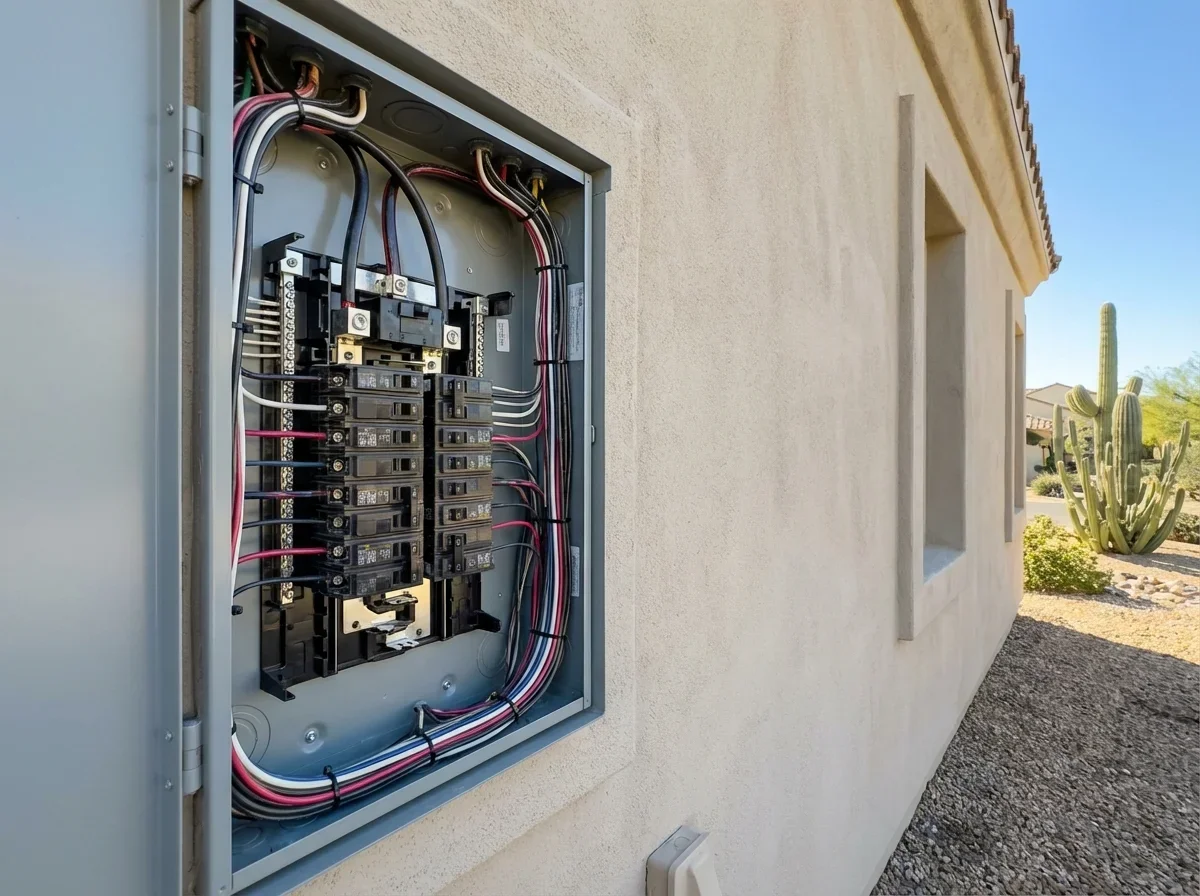
Step 1: Visual inspection. The electrician examines the panel with the cover removed, looking for scorch marks, corrosion, loose connections, signs of arcing, and moisture damage. In Surprise and Buckeye homes, dust buildup inside panels is common — that gets cleaned during service.
Step 2: Voltage and continuity testing. Using a multimeter, the electrician tests voltage at the breaker, verifies the breaker is actually tripping (vs. a loose connection), and measures load on the circuit. If the circuit is pulling 23 amps on a 20-amp breaker, the problem isn't the breaker — it's an overloaded circuit that needs load balancing or a new dedicated circuit.
Step 3: Insulation and ground fault testing. The electrician may use a megohmmeter to test wire insulation or a GFCI tester to verify ground fault protection is working. This identifies downstream wiring issues that cause nuisance tripping.
Timeline: Diagnosis takes 30-60 minutes for a single circuit. If multiple circuits are affected or the electrician suspects panel-level issues, diagnostic time extends to 1-2 hours.
Repair vs Replacement Decision
After testing, the electrician presents options:
- Replace the breaker — the breaker itself has failed
- Repair the circuit — the breaker is fine, but there's a short, ground fault, or bad connection downstream
- Upgrade the panel — multiple issues indicate panel-level failure or code non-compliance
For Scottsdale homes with older panels, electricians often recommend replacement even if the current breaker can be repaired. Breakers for discontinued panel brands (Federal Pacific, Zinsco) are increasingly unavailable or unreliable. Installing a used or "compatible" breaker in these panels creates liability issues and won't pass inspection for permitted work.
Arizona requires permits for panel replacements but typically not for like-for-like breaker swaps — unless the swap involves a code upgrade (standard to AFCI). Your electrician should clarify permit requirements before starting work.
Installation and Code Compliance
Step 4: Power shutdown. The electrician shuts off the main breaker and verifies power is off. Working inside a live panel is how electricians get killed — no shortcuts here.
Step 5: Breaker installation. Remove the old breaker, inspect the bus bar connection point, install the new breaker, torque the terminal screws to manufacturer specs, and verify secure mounting.
Step 6: Testing and labeling. Restore power, test the new breaker under load, verify AFCI/GFCI function (if applicable), and update panel labeling. Arizona code requires accurate circuit labels — "bedroom outlets" isn't sufficient. It should specify which rooms and receptacles are on the circuit.
Step 7: Documentation. For permitted work, the electrician provides documentation for the building department inspection. For non-permitted repairs, you should still receive an invoice detailing work performed and materials used.
Total time: 1-2 hours for a single breaker replacement including diagnosis. Full panel service takes 4-8 hours depending on complexity.
Seasonal consideration: Summer in Phoenix means attic and garage panels can exceed 130°F. Electricians schedule these jobs for early morning when possible, but expect longer work times as technicians take heat-safety breaks. Indoor panels in conditioned spaces work year-round without seasonal constraints.
✓ Choosing a Contractor
How to Choose a Circuit Breaker Repair Electrician
You're trusting this person to work inside your electrical panel — the most dangerous component in your home. Licensing, insurance, and experience aren't optional criteria. They're the baseline.
Licensing Requirements in Arizona
Arizona requires electrical contractors to hold a Residential Contractor (CR-11) or General Commercial Contractor (KB-1) license through the Arizona Registrar of Contractors. Journeyman and master electricians work under a licensed contractor's supervision.[1]
Before hiring, verify:
- Active contractor license (check azroc.gov)
- Current liability insurance ($1M minimum recommended)
- Workers' compensation coverage (protects you if a technician is injured on your property)
- No disciplinary actions or unresolved complaints
Gilbert and Chandler homeowners should confirm the electrician is familiar with HOA requirements and city permitting processes. Some HOAs require advance notice for electrical panel work, and certain cities have specific inspection requirements for panel replacements.
What to Ask Before Hiring
Smart questions separate qualified electricians from parts-changers:
"Will you diagnose before replacing the breaker?" — The answer should be yes. A good electrician doesn't assume the breaker is bad; they test to confirm.
"Do you pull permits for panel work?" — Panel replacements require permits. If they say permits are optional or offer a discount to skip permitting, walk away. Unpermitted electrical work creates liability for you and makes selling your home difficult.
"What brand breakers do you install, and why?" — Name-brand breakers (Square D, Eaton, Siemens, GE) have better quality control and wider availability than off-brand options. If your electrician stocks only the cheapest breakers available, that tells you something about their quality standards.
"How do you handle code upgrades?" — If your 1995 bedroom circuit needs a new breaker, code requires AFCI protection. The electrician should explain this upfront, not surprise you with an upgraded breaker cost during the visit.
"What's included in your diagnostic fee?" — Some electricians charge a trip fee that applies to the repair cost. Others charge a flat diagnostic fee regardless of whether you hire them. Clarify this before they arrive.
Red flags to avoid:
- Unwilling to provide a written estimate or scope of work
- Suggests reusing breakers from another panel or installing "compatible" breakers in obsolete panels
- No permit for panel replacement work
- Asks for full payment upfront (deposit is reasonable; 100% prepayment is not)
- Can't explain why a breaker is tripping beyond "it's old"
Phoenix metro has hundreds of licensed electricians. You're not limited to the first one who answers the phone. Compare at least three quotes for panel replacement work. For emergency breaker issues — sparking, smoke, burning smell — prioritize licensed emergency electrical service providers who can respond within hours, even if the rate is higher.
The goal isn't finding the cheapest breaker replacement. It's finding an electrician who diagnoses accurately, works safely, follows code, and stands behind their work. When you're dealing with electrical panel repairs, "good enough" isn't good enough.
Top Contractors for Circuit Breaker Repair
View all →



Frequently Asked Questions
- Arizona Legislature (Arizona Revised Statutes). "Arizona Electrical Code." https://www.azleg.gov/ars/41/02101.htm. Accessed April 06, 2026.
- Arizona Department of Housing. "Residential Electrical Code Requirements | The Arizona Experience." https://housing.az.gov/general-public-information/residential-electrical-code-requirements. Accessed April 06, 2026.
Estimate Your Circuit Breaker Repair Cost
Get an instant price range based on your home and project details.