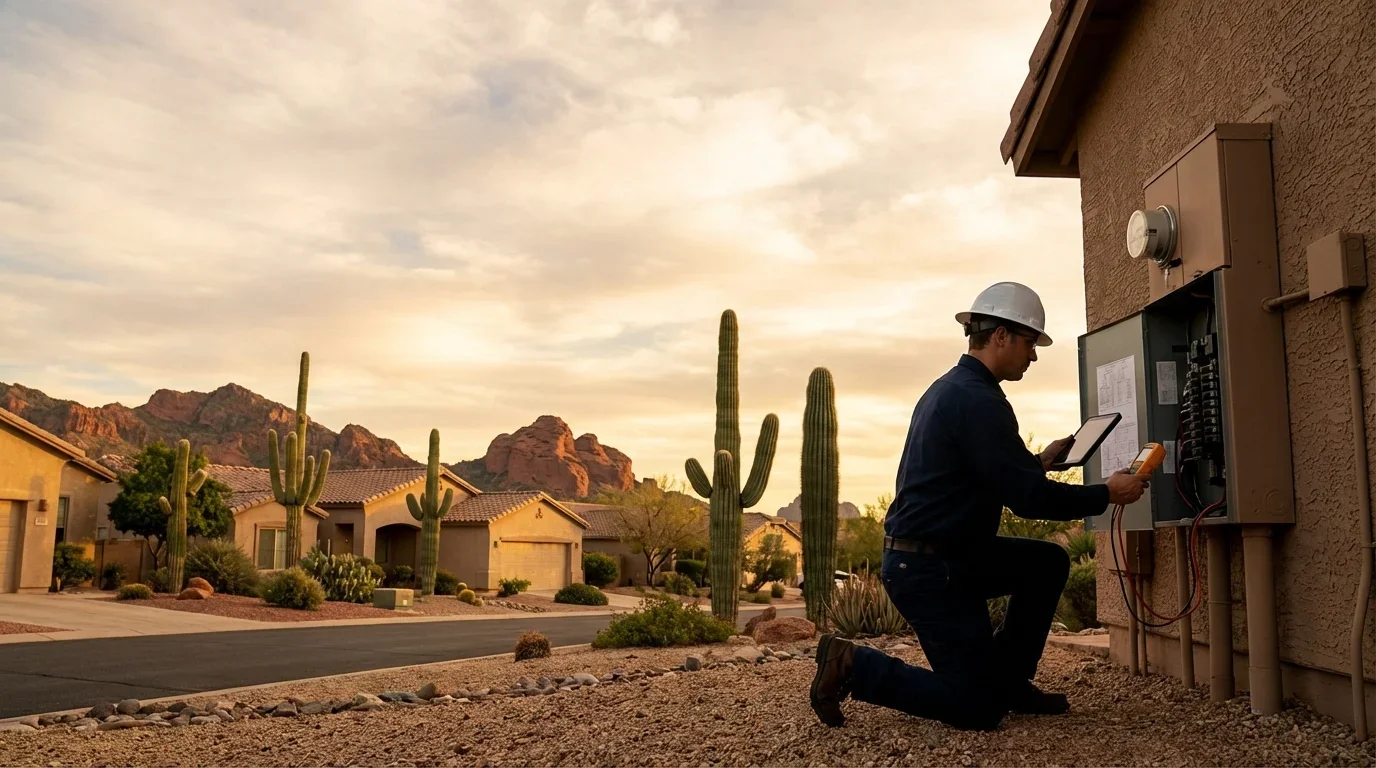
Your Electrical System Isn't Passing Inspection on Hope
Outdated wiring, code violations, and hidden hazards put your property—and people—at risk. Arizona buyers, sellers, and property owners need certified peace of mind.
- Licensed inspections that satisfy lenders and insurance
- Catch fire hazards before they catch you
- Fast certification turnaround for closings and permits
⚠ Common Issues
When Do You Need an Electrical Inspection in Arizona?
You're not getting certified just for fun. Something triggered this search.
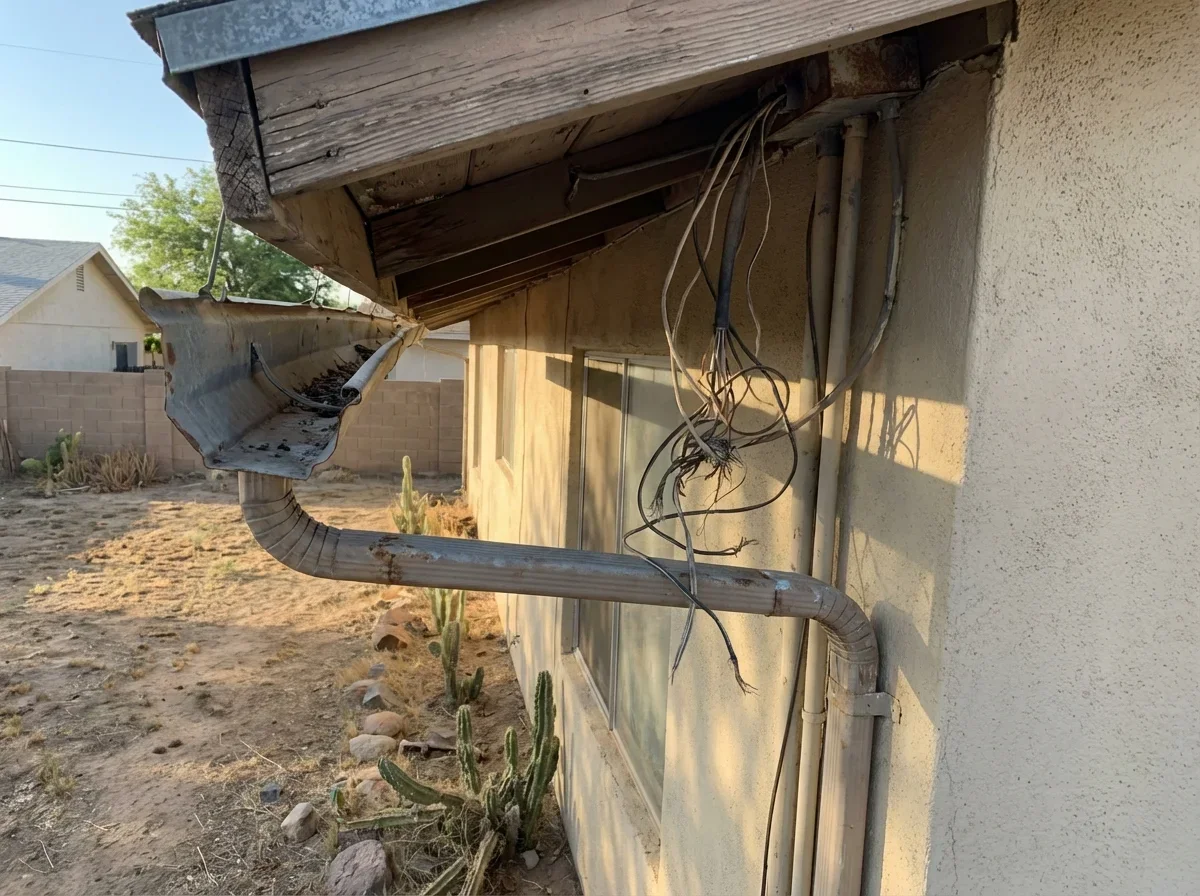
Maybe you're selling your Phoenix home and the buyer's lender requires electrical certification before closing. Or you finished a kitchen remodel in Gilbert and the city inspector wants a sign-off on the new circuits. Maybe your insurance company flagged your panel during renewal, or you're buying a 1970s house in Tempe and want to know what you're inheriting before you sign.
The stakes are real. A failed inspection can delay a home closing by weeks. An unsigned permit can prevent you from selling — or trigger insurance non-renewal. One undetected hazard can void your coverage after a fire.
Real Estate Transactions
Arizona doesn't mandate electrical inspections for every home sale, but most lenders and insurers require certification when red flags appear: homes built before 1980, evidence of DIY work, Federal Pacific or Zinsco panels, visible wiring damage, or aluminum branch circuits.[1] Buyers routinely request inspections during due diligence, and sellers in Scottsdale and Chandler increasingly get pre-listing certifications to avoid deal-killing surprises.
Remodels and Additions
Any project that adds circuits, moves panels, or alters service capacity requires permit close-out. The city inspector checks rough-in work, but final certification from an ROC-licensed electrical contractor confirms code compliance before issuing occupancy permits.[2] In Mesa and Glendale, municipalities won't close permits without proper documentation — and open permits follow properties into MLS listings, scaring off buyers.
Insurance and Code Compliance
Carriers increasingly require electrical certifications for homes over 40 years old or properties with known hazards. You'll also need inspection documentation for adding pool & spa electrical, installing whole house generators, or upgrading service to support EV chargers. Some HOAs in Peoria and Surprise require certification before approving exterior electrical modifications.
If you're buying a flip or a foreclosure, assume nothing was inspected. Certification protects you from inheriting code violations that become your liability the moment you close.
$ Cost Guide
What Does Electrical Wiring Inspection & Certification Cost in Arizona?
Inspection pricing depends on property size, system complexity, and how fast you need results.
Residential Inspection Pricing
| Property Type | Typical Cost | Timeline |
|---|---|---|
| Single-family home (under 2,000 sq ft) | $150-$250 | 24-48 hours |
| Single-family home (2,000-4,000 sq ft) | $250-$350 | 24-48 hours |
| Home with sub-panels or detached structures | $300-$500 | 2-3 days |
| Older home requiring detailed aluminum wiring evaluation | $350-$600 | 3-5 days |
Rush service (same-day or next-day reports) typically adds $100-$200. If you're closing on a house in Chandler next week and need certification fast, expect premium pricing.
Pre-listing inspections for sellers often cost slightly more because the report needs to be comprehensive enough to satisfy any buyer's lender or insurer. Budget $300-$400 for a detailed certification package in Phoenix metro markets.
Commercial Inspection Pricing
Commercial certifications scale with building size and system complexity:
| Property Type | Typical Cost | Timeline |
|---|---|---|
| Small retail or office (under 5,000 sq ft) | $400-$700 | 2-3 days |
| Mid-size commercial (5,000-20,000 sq ft) | $700-$1,200 | 3-5 days |
| Large facilities or multi-phase inspections | $1,200-$3,000+ | 5-10 days |
Properties with three-phase power, backup generators, or specialized equipment (commercial kitchens, data centers, medical facilities) require more detailed evaluation. Tenant improvement inspections for lease compliance typically fall in the $500-$900 range for Scottsdale and Tempe office spaces.
Factors That Affect Cost
System age and condition matter. A well-maintained 10-year-old panel takes less time to evaluate than a 1968 Zinsco panel with aluminum wiring and missing ground connections. Inspectors charge more when they expect to find problems requiring detailed documentation.
Accessibility impacts pricing. Inspectors need full access to panels, sub-panels, junction boxes, and attic/crawlspace wiring. If your panel is blocked by storage or requires landscaping removal to access exterior disconnects, expect additional charges.
Report complexity varies. A basic pass/fail certification costs less than a detailed narrative report with photos, repair recommendations, and code references suitable for insurance underwriters or commercial lease negotiations.
Re-inspections after repairs typically cost $100-$150 for residential, $200-$400 for commercial — but you'll pay this only if initial findings require corrections before certification.
→ What to Expect
The Electrical Inspection Process
You schedule the inspection, provide access, and the inspector evaluates your entire system against current Arizona electrical code and NEC standards.
Pre-Inspection Preparation
Clear access to all electrical components. The inspector needs to open every panel, check every sub-panel, and visually trace circuits. Move storage away from panels, unlock attic/crawlspace access, and notify tenants if you own rental property.
Gather any documentation you have: previous inspection reports, permit records for additions or remodels, receipts from recent electrical work. This helps inspectors understand system history and verify that permitted work was completed correctly.
For commercial properties in Gilbert or Mesa, provide building plans if available. Inspectors use blueprints to verify that installed systems match approved designs and identify any undocumented modifications.
What Inspectors Evaluate
Inspectors check service capacity — does your 100-amp panel actually support the load you're running? They verify proper grounding and bonding, test GFCI protection in kitchens, bathrooms, and outdoor circuits (critical in Arizona where pools and monsoon moisture create shock hazards), and confirm arc-fault protection in bedrooms meets 2020 NEC requirements.[1]
They identify hazardous components: Federal Pacific and Zinsco panels (both known for breaker failures), aluminum branch wiring without proper terminations, ungrounded outlets, double-tapped breakers, missing panel covers, and improper wire sizes for circuit breakers.
Common Arizona-specific issues: insufficient surge protection (monsoon lightning strikes), outdoor circuits lacking weatherproof enclosures, pool equipment bonding failures, and HVAC disconnects that don't meet clearance requirements. Inspectors also flag dedicated circuit deficiencies for appliances that legally require them — refrigerators, microwaves, garbage disposals.
The inspector tests a representative sample of outlets and switches, verifies correct polarity, checks for proper junction box covers, and inspects exposed wiring in garages, attics, and crawlspaces. Thermal imaging often reveals overheating connections before they fail.
Receiving Your Certification
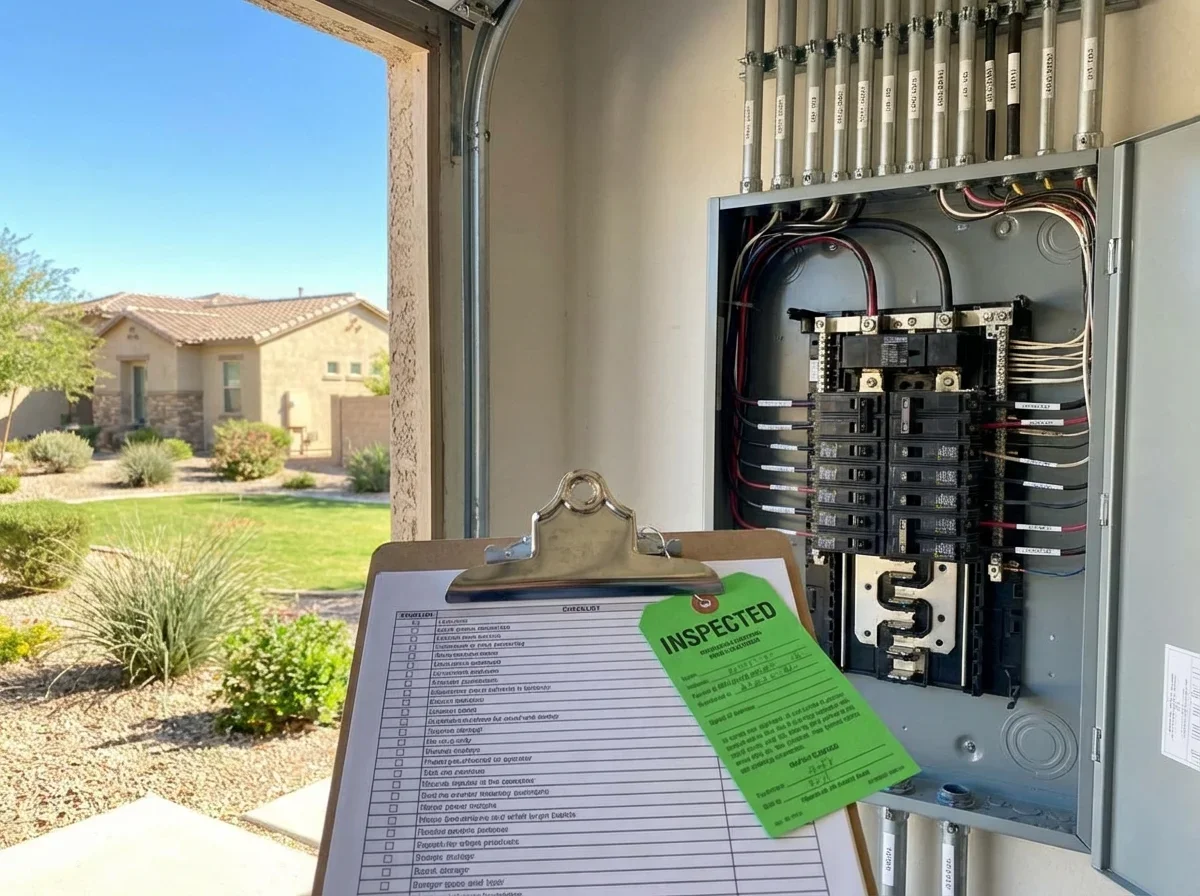
Standard turnaround is 24-48 hours for residential properties without major defects. You receive a written report listing findings, code references for any violations, and recommendations for repairs. If the system passes, you get signed certification documents suitable for real estate closings, insurance submissions, or permit close-outs.
If defects are found, the report details required corrections. You hire a licensed electrician (the inspector cannot perform repairs — conflict of interest), complete the work, and schedule re-inspection. Most properties in Peoria and Surprise that fail initial inspection need $500-$2,000 in repairs — typically panel upgrades, GFCI installations, or correcting improper splices.
For commercial properties, expect detailed narrative reports with photos, section-by-section analysis, and prioritized repair recommendations. Complex buildings may require phased inspections if electrical systems are still under construction or renovation.
The final certification document includes the inspector's ROC license number, inspection date, property address, and confirmation of code compliance — everything lenders, insurers, and municipalities require.[2]
✓ Choosing a Contractor
How to Choose an Electrical Inspector in Arizona
Not every electrician can issue legal certification. You need someone with the right credentials, report quality, and turnaround time.
Licensing and Credentials
Arizona requires ROC licensing for electrical inspectors who issue certification documents for legal purposes.[2] Verify the inspector holds CR-11 (dual residential/commercial electrical), R-11 (residential electrical), or C-11 (commercial electrical) classification. You can look up any contractor's license status, complaint history, and bonding at roc.az.gov.
Home inspectors who aren't licensed electricians can evaluate electrical systems during buyer due diligence, but they cannot provide certification documents acceptable to lenders, insurers, or permit offices. If you need legal certification, hire an ROC-licensed electrical contractor who specializes in inspections.
Ask about additional credentials: ICC electrical inspector certification, NFPA membership, thermal imaging training. These indicate inspectors who stay current on code changes and use advanced diagnostic tools.
Report Quality and Turnaround
Request sample reports before hiring. Quality inspection reports include photos of every defect, specific code references (not just "does not meet code"), and clear repair recommendations with priority levels. You want documentation detailed enough to hand an electrician so they know exactly what to fix.
Verify turnaround time in writing. If you're closing on a Chandler home in five days, a two-week report timeline doesn't help. Most inspectors in Phoenix metro can deliver residential certifications within 48 hours, but confirm before scheduling.
Ask whether re-inspection fees are capped if multiple correction cycles are needed. Some inspectors include one free re-inspection if initial repairs don't fully resolve violations.
Arizona-Specific Experience
Choose inspectors familiar with regional hazards and common local code issues: monsoon surge damage patterns, pool bonding requirements that differ from other states, aluminum wiring retrofits in older Scottsdale and Tempe neighborhoods, and HVAC electrical issues specific to desert cooling loads.
Inspectors who regularly work with Phoenix-area municipalities understand local interpretation of NEC code and what Mesa, Glendale, or Buckeye inspectors will flag during permit inspections. This matters if you're getting pre-inspection certification before pulling permits for kitchen electrical upgrades or sub-panel installations.
Questions to ask prospective inspectors:
- What's your ROC license classification and number?
- How many inspections do you complete monthly in my city?
- What's included in your standard inspection fee?
- Do you provide thermal imaging as part of the evaluation?
- What's your typical turnaround for residential certifications?
- Do you offer rush service for real estate closings?
- What percentage of homes you inspect in this area fail initial certification?
Red flags: Inspectors who can't provide ROC credentials immediately, won't commit to written turnaround times, or suggest they can "pre-approve" systems over the phone without site visits. Legitimate inspectors don't guarantee pass/fail results until they evaluate the actual installation — code compliance isn't negotiable.
The right inspector gives you certification you can trust, documentation that satisfies lenders and insurers, and clear guidance if repairs are needed. That's worth paying for quality credentials and experience.
Top Contractors for Electrical Wiring Inspection & Certification
View all →



Frequently Asked Questions
- Arizona Secretary of State. "Arizona Administrative Code Title 4, Chapter 9, Article 4 Electrical Contractors." https://apps.azsos.gov/public_services/Title_04/4-09.pdf. Accessed April 06, 2026.
- Arizona Registrar of Contractors (ROC). "Electrical Board." https://roc.az.gov/electrical-board. Accessed April 06, 2026.
Estimate Your Electrical Wiring Inspection & Certification Cost
Get an instant price range based on your home and project details.