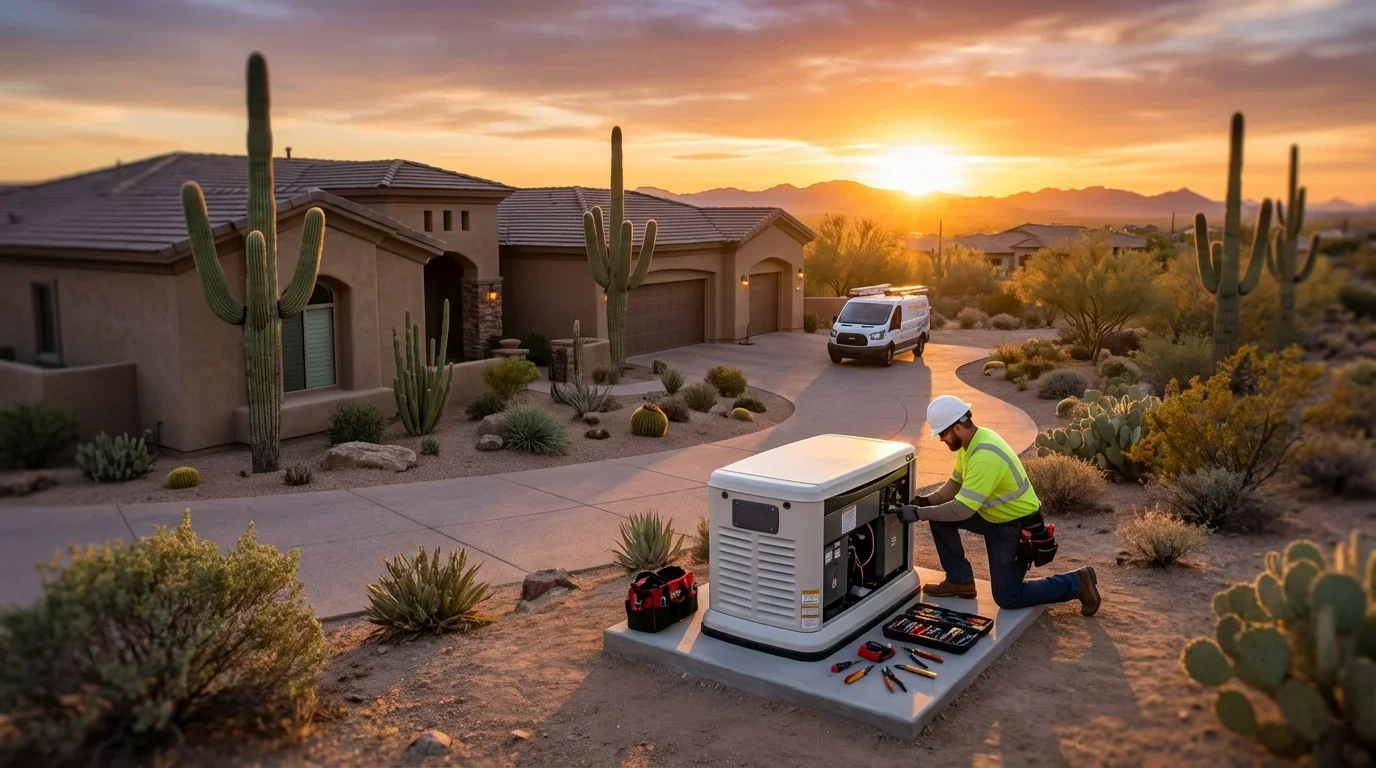
Power When You Need It Most.
Arizona summers don't forgive. When the grid fails at 115°F, you've got about 45 minutes before your home becomes uninhabitable. A whole house generator keeps your AC running, your food cold, and your family safe during monsoon outages.
- Automatic backup during monsoon season blackouts
- Powers critical AC loads in extreme Arizona heat
- Installed and operational in 2-4 weeks
⚠ Common Issues
Why Arizona Homeowners Install Whole House Generators
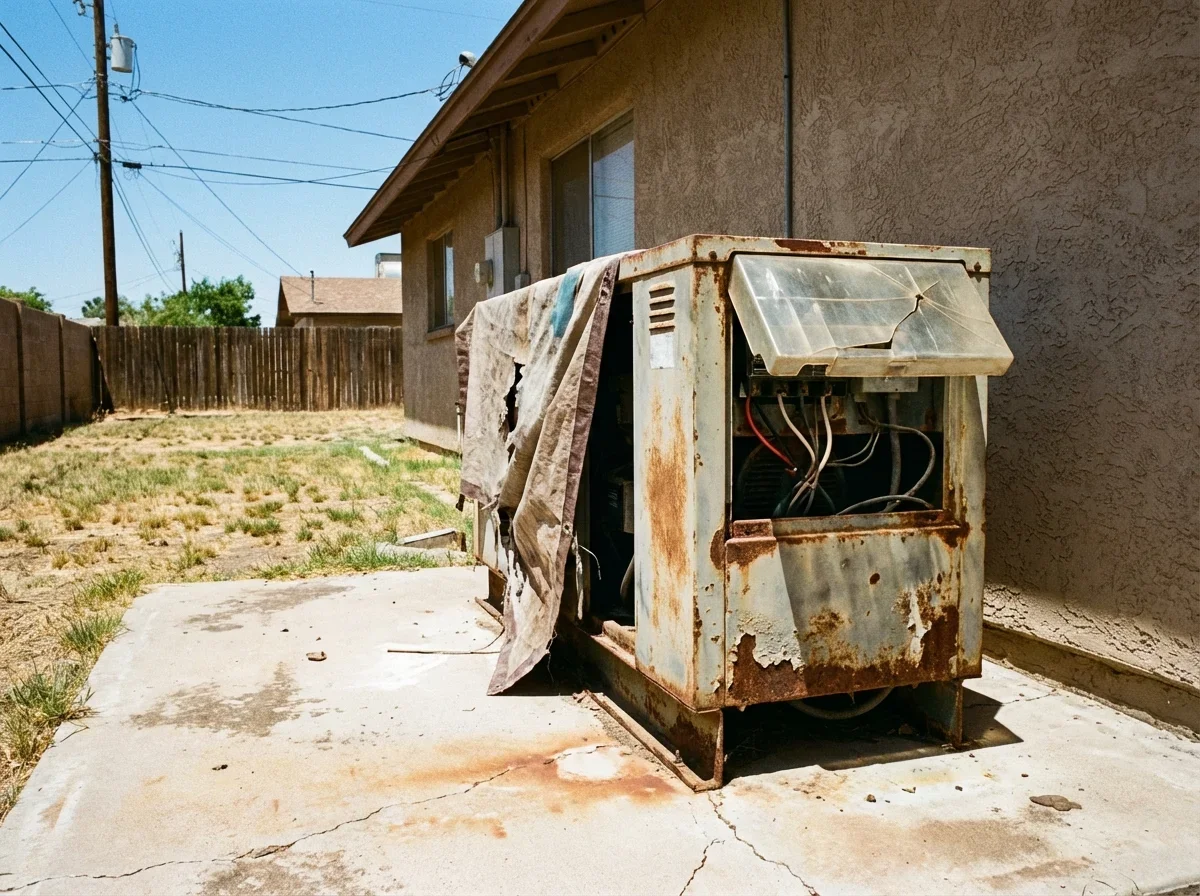
You've sat through enough summer outages to know the drill. The power drops. The AC dies. Within an hour, your home climbs past 90°F. By hour two, you're checking hotel rates while your freezer thaws and your elderly neighbor needs medical equipment that won't run on batteries.
Monsoon season brings 30+ outages annually across the Phoenix metro. Salt River Project and APS crews work fast, but even a three-hour outage in July can cost you thousands in spoiled food, damaged electronics from power surges when service returns, and the health risk of heat exposure.
The portable generator you bought after the last outage? It runs your fridge and a few lights. Maybe a window AC unit if you're lucky. It won't touch your central air—the single most critical load in a desert climate. And you're out there in 110°F heat, hauling gas cans and running extension cords through windows while your neighbors' whole-house systems kicked on automatically before they even noticed the outage.
The stakes are higher here. Phoenix breaks 110°F more than 30 days per year. Mesa and Chandler aren't far behind. An outage that's an inconvenience in Wisconsin becomes a safety crisis in Arizona.
Homeowners in Scottsdale planned communities face another layer: HOA architectural guidelines that prohibit visible portable generators or require specific enclosure standards for standby units. You need a permanent solution that meets community standards while delivering the power capacity Arizona homes actually need—typically 22kW minimum for homes with dual AC zones.
The question isn't whether you need backup power. It's whether you want to scramble for it during the next haboob or have it turn on automatically while you're still deciding if the outage is real.
$ Cost Guide
Transfer Switch Only
$500 – $1,500
- ✓ Manual transfer switch install
- ✓ 6–10 circuit coverage
- ✓ Use with portable generator
- ✓ Keeps A/C running in outage
Standby 10–16 kW
$5,000 – $9,000
- ✓ Automatic standby generator
- ✓ Automatic transfer switch
- ✓ Natural gas or propane
- ✓ Powers essential circuits
- ✓ Permit & concrete pad included
Standby 22 kW+
$10,000 – $18,000+
- ✓ Whole-house coverage
- ✓ 200A automatic transfer switch
- ✓ Runs A/C, pool pump & all circuits
- ✓ Gas line extension if needed
Installed pricing including generator, transfer switch, concrete pad, and permits. Gas line work may add $500–$2,000.
→ What to Expect
The Generator Installation Process
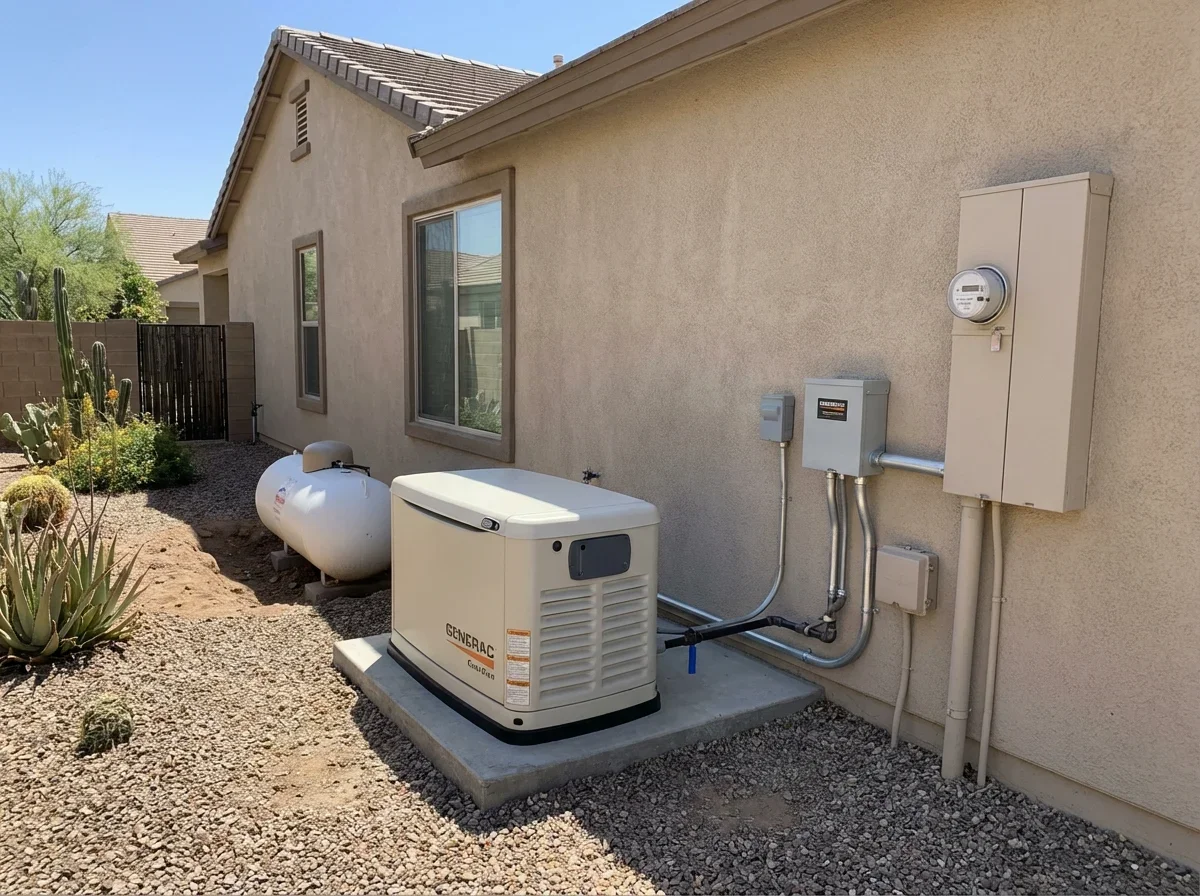
A whole-house generator isn't a same-day install. From quote to operational backup power, expect 2-4 weeks in the Phoenix metro—longer during peak monsoon prep season (May-June) when everyone remembers they need one.
Initial Assessment and Load Calculation
Your contractor conducts an on-site load calculation to size the generator correctly. They'll review your electrical panel, count AC tonnage (the biggest load by far in Arizona), note pool pumps, well pumps if you're in rural Buckeye, and any medical equipment that requires clean power delivery.
For a typical 2,500 sq ft Chandler home with dual 3-ton AC units, the math looks like:
- AC systems: 12,000W combined startup load
- Refrigerator, freezer: 1,800W
- Lights, outlets, fans: 2,500W
- Pool pump (if applicable): 2,400W
- Safety margin: 20%
Total calculated need: 22kW minimum. Undersizing is the most common mistake—your generator runs but can't start both AC compressors simultaneously, defeating the entire purpose during summer outages.
Permitting and Utility Coordination
Licensed contractors pull permits through your municipality—Phoenix, Scottsdale, Mesa, and Glendale require separate electrical and gas permits.[1] The city inspects the transfer switch installation, grounding, and emergency disconnect requirements. SRP or APS doesn't need to approve the generator itself, but they'll want notification if you're installing a system capable of grid-tie (rare for residential standby units).
HOA approval in Scottsdale or other planned communities can add a week. Most accept generators if they're side/rear-mounted, on matching pad color, and meet setback requirements (typically 5 feet from property lines, 18 inches from combustibles).
Installation and Testing
Installation day runs 6-10 hours for straightforward setups:
- Concrete pad pour (day 1, needs 48-72 hours to cure in Arizona heat)
- Generator placement and leveling (day 3-4)
- Natural gas or propane connection (licensed gas contractor, sometimes separate trade)
- Electrical connections and transfer switch integration
- Startup, programming, and load testing (contractor simulates outage, verifies automatic transfer)
The transfer switch is the brain of the system. When utility power drops, it signals the generator to start (typically 10-15 seconds), waits for stable voltage, then transfers your home's electrical loads. When grid power returns, it transfers back and runs the generator for a cooldown cycle before shutdown.
Final inspection occurs within 5-7 business days. Once signed off, your system is operational. Most contractors include a commissioning walkthrough showing you the control panel, manual override procedures, and maintenance intervals.
✓ Choosing a Contractor
How to Choose a Generator Installation Contractor
You're trusting someone to integrate a fuel-burning engine with your home's electrical system and natural gas supply. This is not a Craigslist hire. Arizona requires contractors to hold ROC electrical and potentially gas licensing for this work—verify both before signing anything.
Licensing Requirements in Arizona
Ask for:
- Arizona Registrar of Contractors (ROC) license number (CR-## or KB-## for electrical)
- Proof of liability insurance ($1M minimum for generator installations)
- Workers comp coverage (protects you if someone gets hurt on your property)
- City of Phoenix or applicable municipality business license
Red flag: contractors who say "permits aren't really necessary for generators" or offer to skip inspection to save money. You'll fail resale inspection when you sell, and your homeowner's insurance may deny claims if an unlicensed installation causes damage.
Warranty Support and Service Network
Generator manufacturers offer 5-10 year warranties, but they require annual maintenance to stay valid. Your contractor should be a factory-authorized dealer with access to parts inventory and technical support.
Questions to ask before signing:
- Are you a Generac/Kohler/Cummins authorized dealer?
- Do you stock common replacement parts locally?
- What's your average response time for service calls during outage season?
- Do you offer maintenance contracts? (Typical cost: $200-$350/year for annual service and quarterly test runs)
The cheapest installer often becomes the most expensive when you need service on a 115°F July afternoon and they're not returning calls. Mesa and Tempe homeowners consistently report better long-term satisfaction with contractors who offer post-installation support versus one-and-done installers.
Experience with Local Codes and Utilities
Phoenix-area municipalities adopted NEC 2020 with local amendments.[1] Transfer switches require specific grounding configurations. Natural gas connections need seismic shutoff valves. A contractor familiar with Scottsdale inspectors knows what passes and what gets red-tagged.
Ask to see examples of recent installations in your city. Gilbert permitting differs slightly from Glendale. An experienced contractor already knows the submittal requirements and has working relationships with local inspectors—that's the difference between a 2-week install and a 6-week permit delay.
Look for contractors who discuss surge protection for the generator itself (lightning strikes are common during monsoons) and who suggest electrical panel upgrades when your existing panel is undersized. That's someone thinking about your whole system, not just moving a generator box.
The best contractors ask about your specific needs—do you just want AC and refrigeration during outages, or do you want whole-home coverage including the pool, landscape lighting, and garage door openers? That conversation should happen before they quote a generator size, not after you've already signed a contract for a unit that won't meet your expectations.
Top Contractors for Whole House Generator Installation
View all →



Frequently Asked Questions
- City of Phoenix. "Phoenix Building Construction Code." https://up.codes/viewer/phoenix/2020PBC/chapter/27/electric#27. Accessed April 06, 2026.
- U.S. Department of Energy. "Standby Electrical Systems." https://www.energy.gov/energysaver/standby-electrical-systems. Accessed April 06, 2026.
Estimate Your Whole House Generator Installation Cost
Get an instant price range based on your home and project details.