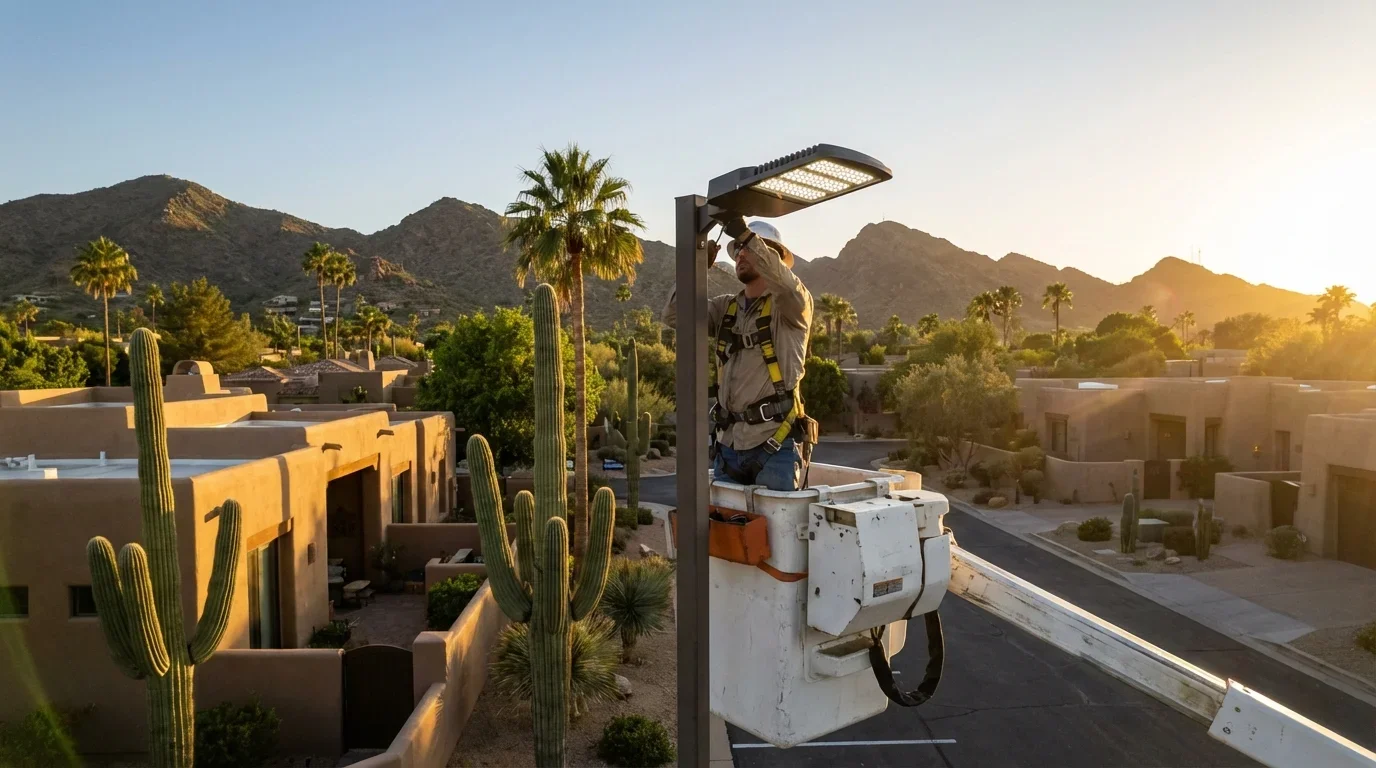
Bright Parking Lots Mean Safer Customers and Lower Liability
Dark parking lots drive customers away and invite liability issues. Modern LED lighting with smart controls cuts your energy costs while keeping properties secure 24/7.
- Eliminate dangerous dark zones and shadows
- Slash energy bills with LED retrofits
- Automated photocell controls require zero management
⚠ Common Issues
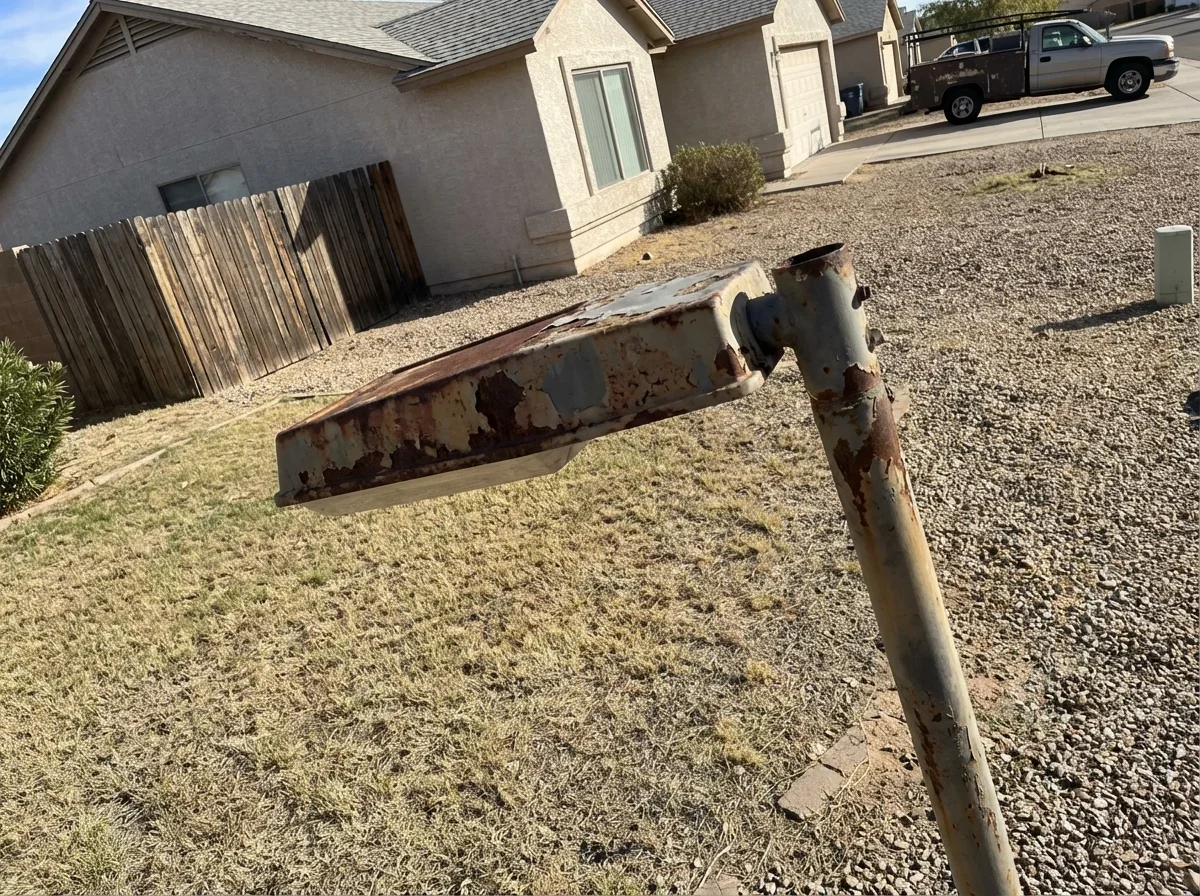
When Your Parking Lot Lighting Fails Your Business
You notice it during evening walk-throughs. Half your fixtures are out. The ones still working cast uneven pools of light with dark gaps where customers hesitate before walking to their cars. Your Scottsdale retail center looks closed by 7 PM, even though you're open until 9.
The calls start coming in. Property management wants to know why the electricity bill for lighting hasn't dropped despite "upgrading" three years ago. Security reports another incident in the northwest corner where the camera footage is too dark to identify anything. Your insurance carrier sends a letter about "inadequate lighting" after reviewing a premises liability claim.
Traditional metal halide and high-pressure sodium fixtures weren't built for Arizona. They fail faster in extreme heat. A 400-watt metal halide fixture that should last 15,000 hours often burns out at 8,000-10,000 hours when it's baking in 115-degree Phoenix summers. You're paying maintenance crews to come out monthly with bucket trucks.
The photocells stopped working reliably two years ago. Now lights stay on during the day or don't turn on at night, depending on which sensor failed this week. You've assigned someone to manually check every evening — a task that gets forgotten when they're busy.
The liability exposure is real. Premises liability attorneys in Mesa and Chandler specifically look for inadequate parking lot lighting in slip-and-fall cases. One case can cost more than replacing your entire lighting system.
Your tenants are complaining. The medical office wants better lighting near their entrance. The restaurant sees dinner reservations drop because customers don't feel safe walking from the back lot. Every lease renewal conversation includes "when are you fixing the lights?"
Meanwhile, you're spending $800-1,200 per month on electricity for lighting that barely works. The ROI calculation is obvious, but coordinating a full retrofit while businesses are operating feels overwhelming. So you keep replacing bulbs and paying the power bill.
Commercial property values in Gilbert and Tempe directly correlate with parking lot conditions. Buyers evaluate lighting systems during due diligence. Poor lighting knocks 2-4% off property valuations before you even get to negotiate.
$ Cost Guide
What Does Parking Lot Lighting Cost in Arizona?
Real numbers for Phoenix-area commercial properties, based on 2024 installation rates and verified contractor estimates.
Per-Pole Installation Costs
New pole installations with LED fixtures run $1,800-3,500 per pole depending on height, electrical runs, and site conditions:
| Pole Height | Fixture Type | Cost Per Pole | Typical Use Case |
|---|---|---|---|
| 15-20 feet | 150W LED | $1,800-2,400 | Small retail, office entries |
| 20-25 feet | 200-300W LED | $2,400-3,200 | Standard parking lots, strip malls |
| 30+ feet | 400W+ LED | $3,200-4,500 | Large lots, industrial facilities |
LED retrofits (replacing fixtures on existing poles) cost $450-900 per pole — often the smarter choice if your poles and wiring are sound. A 20,000 sq ft Chandler retail center with 12 poles typically spends $8,500-12,000 for a complete LED retrofit including photocell controls and a 5-year warranty.
LED Retrofit vs New Installation
| Approach | Upfront Cost | When It Makes Sense | Payback Period |
|---|---|---|---|
| LED Retrofit | $450-900/pole | Poles in good condition, adequate spacing | 2.5-4 years |
| New Installation | $1,800-3,500/pole | Poor coverage, rusted poles, redesign needed | 4-6 years |
| Hybrid (some new, some retrofit) | Mixed | Uneven existing conditions | 3-5 years |
A Mesa warehouse that spent $18,000 on LED retrofits now saves $425/month on electricity. They hit breakeven at 42 months. But more importantly, their after-hours theft incidents dropped 70% in the first year — a benefit no spreadsheet captures.
Factors That Impact Project Cost
Trench runs kill budgets. If you're adding poles or your existing underground conduit is compromised, expect $12-18 per linear foot for trenching, conduit, and wire. A 200-foot run to reach a dark corner adds $2,400-3,600 before you even install the pole.
Transformer upgrades: Older properties in Glendale and Peoria sometimes need transformer capacity increases when switching from scattered high-wattage fixtures to a comprehensive LED system. Budget $3,500-8,000 if your electrical service is maxed out.
Arizona's dark sky compliance adds minimal cost but requires expertise. Maricopa County requires shielded fixtures that direct light downward, not outward into the night sky.[2] Quality LED fixtures designed for commercial parking lots already meet these standards — it's about specifying the right products, not paying premiums.
Photocell and timer controls add $80-150 per fixture but eliminate the manual management nightmare. Astronomical timers (programmed for sunrise/sunset times) outperform standard photocells in dusty Arizona conditions where sensors get coated and fail.
Permit and inspection fees: $300-800 for most commercial lighting projects in Phoenix metro cities. Your commercial electrical contractor handles this as part of the installation process.
→ What to Expect
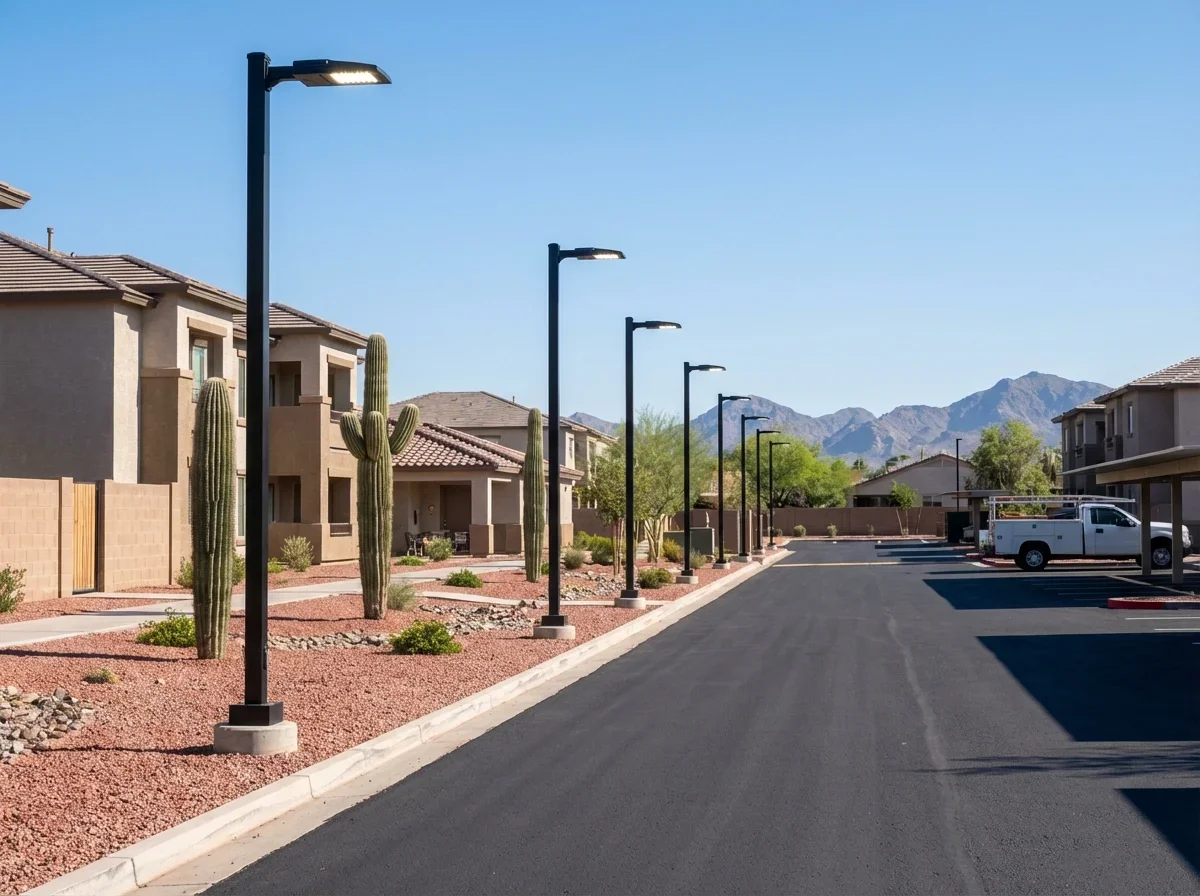
The Parking Lot Lighting Installation Process
Here's what happens from site assessment through final commissioning, based on how licensed commercial electricians actually execute these projects in Arizona.
Site Assessment and Photometric Planning
A qualified contractor starts with a photometric study — computer modeling that calculates light levels across your entire lot. They measure existing conditions, identify dark spots, and design a layout that meets IES (Illuminating Engineering Society) standards for parking lot safety.
For retail and office properties, the standard is 1-2 foot-candles minimum with 4:1 uniformity ratios. That means the brightest spot shouldn't be more than four times brighter than the dimmest. Most failed parking lot lighting systems have 10:1 or worse ratios — bright circles under fixtures with dark gaps between.
The photometric plan specifies pole locations, heights, fixture wattages, and beam angles. This becomes your permit application document and gives you an apples-to-apples basis for comparing contractor bids.
Trenching, Wiring, and Pole Installation
For new installations, trenching typically happens early morning before businesses open. Crews cut 18-24 inch deep trenches from your electrical service to each pole location, lay 2-inch PVC conduit, and pull 10 AWG or larger wire depending on circuit loads and run lengths.
Pole foundations require 36-48 inch deep concrete bases. A 25-foot pole needs a 3x3 foot base to handle wind loads during monsoon season. Buckeye and Surprise properties on exposed sites sometimes require engineered foundations reviewed by structural engineers.
Timing matters: Schedule concrete pours and installations October through April when temperatures allow proper curing. Summer concrete work in Tempe requires special mix designs and curing protocols that add 15-20% to costs.
Fixture Mounting and Control Integration
Once poles are set and wired, electricians mount LED fixtures and install photocell or astronomical timer controls. Quality installations include individual fixture disconnects — letting you service one light without killing the entire circuit.
The control integration step separates professional installations from mediocre ones. Properly configured astronomical timers account for daylight saving time changes and seasonal variations automatically. Cheap photocells stuck on top of fixtures fail within two years when dust and UV exposure degrade the sensors.
Testing and Commissioning
Final commissioning includes:
- Night-time light level verification with calibrated meters at grid points matching the photometric plan
- Control system testing through multiple cycles to verify reliable on/off operation
- Thermal imaging of connections to identify hot spots before they become failures
- As-built documentation showing actual pole locations, circuit routing, and panel schedules
Your contractor should deliver a commissioning report with light level measurements, warranty documentation, and maintenance schedules. This becomes essential for your property files and insurance compliance records.
The city inspector signs off after verifying code compliance, grounding systems, and proper shielding per Maricopa County requirements.[2] No final inspection approval means no certificate of occupancy for new construction, and potential liability issues for retrofits.
✓ Choosing a Contractor
How to Choose a Commercial Lighting Contractor
The electrician who wires residential ceiling fans isn't qualified to design parking lot lighting systems. Here's what separates contractors who deliver reliable installations from those who create expensive problems.
Licensing and Commercial Experience Requirements
Arizona requires contractors performing commercial electrical work over $1,000 to hold either a CR-11 (commercial) or CR-7 (residential/commercial) contractor license. Verify their license status at azroc.gov and check for complaints or violations.
Ask how many parking lot lighting projects they've completed in the past 12 months. You want a contractor who does commercial exterior lighting regularly, not someone trying it for the first time on your property. Request references from Gilbert or Mesa properties similar to yours — then actually call them and visit the sites at night.
Check if they carry commercial general liability insurance with limits of at least $2 million aggregate. Parking lot work involves trenching near buildings, working over vehicles, and substantial property damage exposure if something goes wrong.
Photometric Design Capabilities
Contractors who guess at fixture placement create problems you'll live with for 15 years. Ask to see sample photometric studies from previous projects. Quality contractors use AGi32 or Visual lighting software that models your specific fixtures, pole heights, and site conditions.
The photometric plan should show:
- Calculated light levels in foot-candles across a grid pattern
- Uniformity ratios proving even coverage without dark spots
- Compliance with IES recommendations for your property type
- Lighting zone classifications per Arizona outdoor lighting codes[1]
If a contractor can't produce this analysis before installation, keep looking. You're about to spend $15,000-50,000 based on their guesswork.
Warranty and Maintenance Agreements
LED fixtures should carry 5-10 year manufacturer warranties. The contractor's installation warranty should cover labor for at least 2 years. Get this in writing with specific language about what triggers warranty service.
Beware of contractors who subcontract the actual installation to unlicensed crews. Your warranty is only as good as the contractor's ability to stand behind it. Companies that use transient labor can't service what they install.
Ask about preventative maintenance agreements. A Scottsdale property management company pays $140/month for quarterly inspections, photocell cleaning, and priority service on their 40-fixture system. They haven't had an outage in three years — compared to monthly service calls before the agreement.
Red flags that signal trouble:
- Unwilling to provide photometric studies or detailed proposals
- Pressure to use specific fixture brands without explaining technical reasons
- No commercial references in Arizona
- Quotes significantly below market ($900/pole installed when competitors are $1,800-2,400)
- Can't explain compliance with dark sky requirements or local codes
The right contractor treats your parking lot lighting as a 15-year infrastructure investment, not a quick installation job. They'll coordinate with your commercial panel upgrade needs if your electrical service requires capacity increases, and they'll plan work schedules that minimize tenant disruption.
Your parking lot lighting affects property values, tenant retention, and liability exposure. Choose a contractor who understands those stakes and has the commercial experience to deliver systems that work reliably for decades.
Top Contractors for Parking Lot Lighting
View all →



Frequently Asked Questions
- City of Tucson/Pima County, Arizona. "2024 City of Tucson/Pima County Outdoor Lighting Code." https://www.tucsonaz.gov/files/sharedassets/public/v/1/pdsd/documents/boards-committees-commissions/olcc/022924/240229-draft-outdoor-lighting-code_clean.pdf. Accessed April 06, 2026.
- Maricopa County, AZ. "Light Fixtures - DD-3010-01." https://www.maricopa.gov/6461/Light-Fixtures---DD-3010-01. Accessed April 06, 2026.
Estimate Your Parking Lot Lighting Cost
Get an instant price range based on your home and project details.