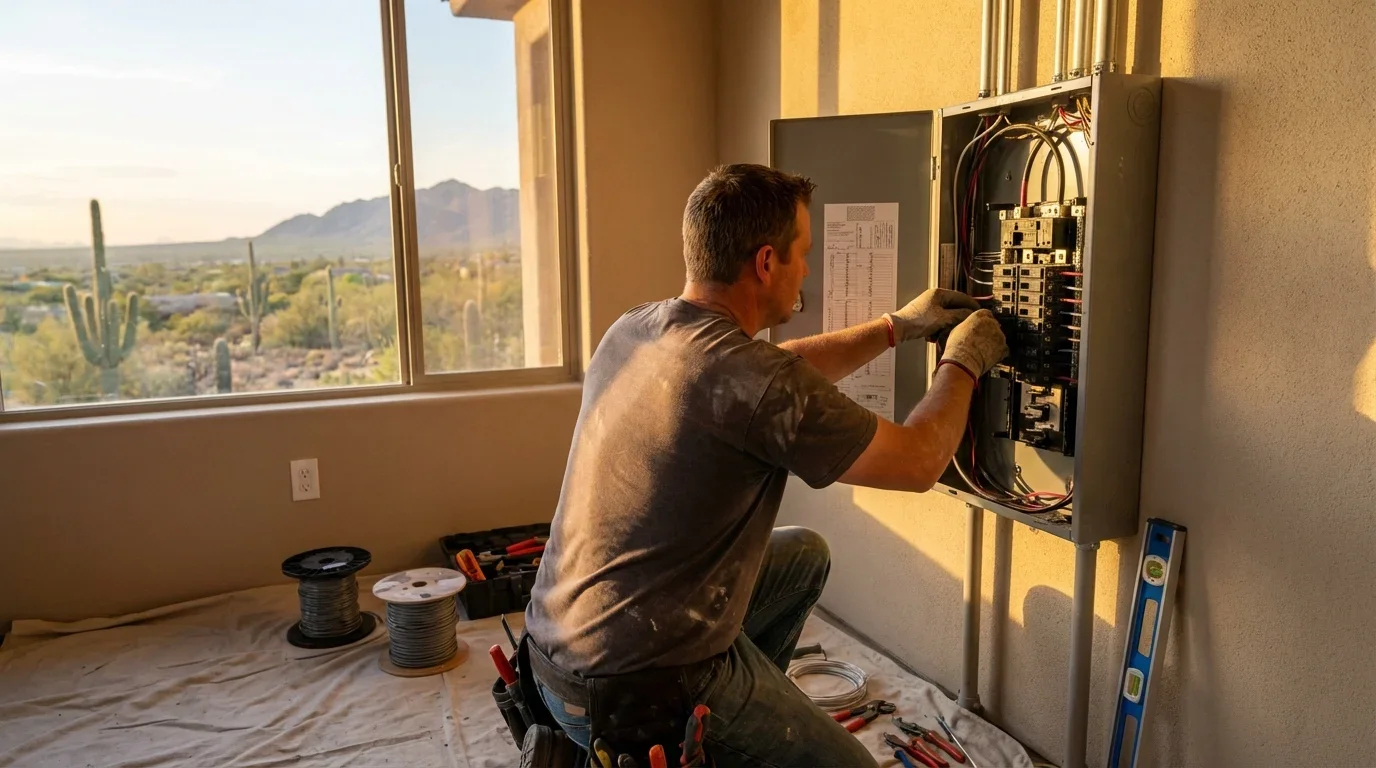
Power Where You Need It, When You Need It
Expanding your garage, workshop, or ADU? You need dedicated electrical capacity that doesn't overload your main panel. A sub panel delivers safe, code-compliant power distribution to any space on your property.
- Supports high-demand tools and equipment safely
- Prevents main breaker trips and power bottlenecks
- Adds capacity without full panel replacement
⚠ Common Issues
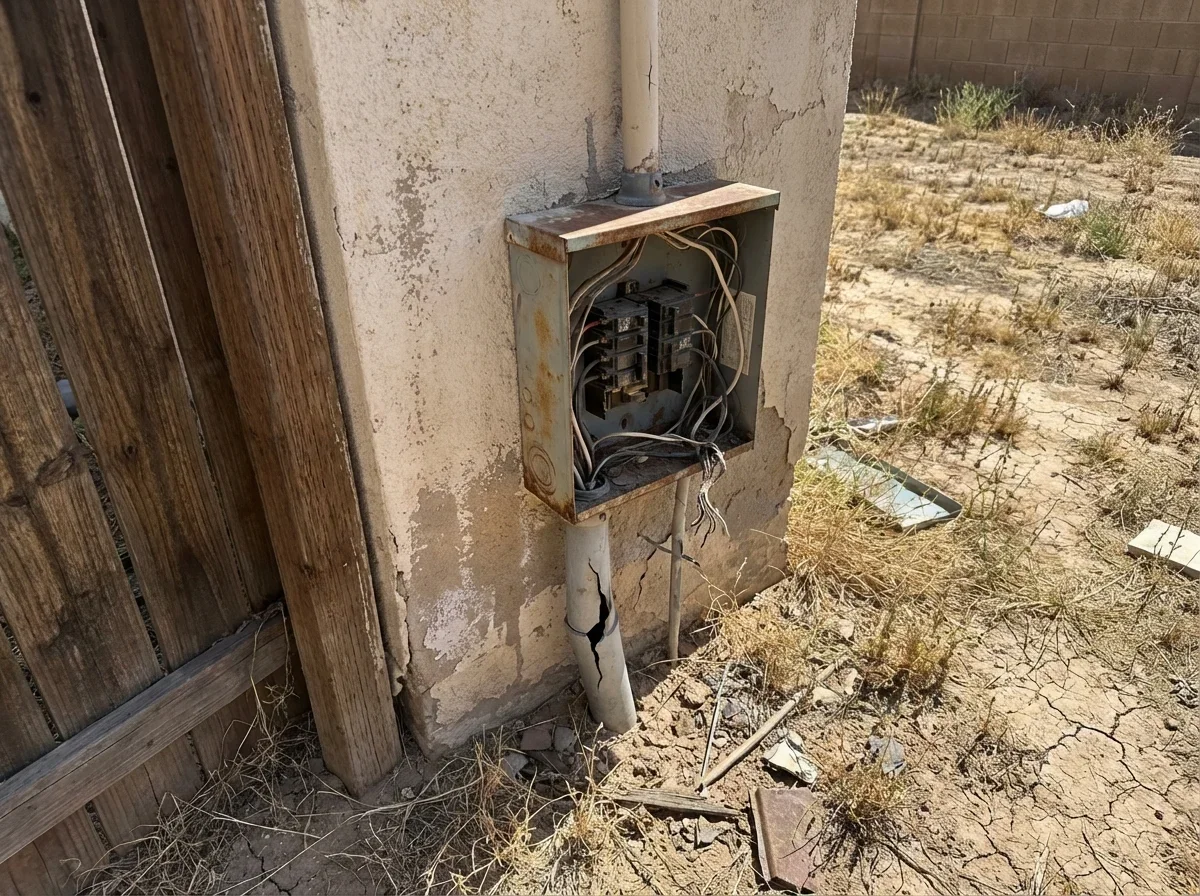
When Do You Need a Sub Panel?
You built the detached garage. Now you need power for tools, lights, an air compressor. You run extension cords from the house. The compressor runs, the lights dim, the breaker trips. Again.
Or you're finishing the guest house behind your Chandler home. It needs a full kitchen, AC, washer and dryer. Your electrician looks at the main panel and shakes his head — no room for more circuits.
A sub panel solves the "no more space" problem. It's a satellite electrical panel fed from your main, distributing power to a specific area without overloading the main service.
Common Applications in Arizona Homes
Detached garages and workshops are the #1 reason homeowners in Gilbert and Mesa add sub panels. You need 240V for welders or table saws. You want reliable lighting. You don't want to run four extension cords every time you work out there.
Home additions and ADUs (accessory dwelling units) require their own panels. The electrical load is too high to piggyback on existing circuits. A 100A or 200A sub panel gives the addition everything it needs — HVAC, kitchen, bathroom, lighting — without touching the main panel's capacity.
Pool houses, outdoor kitchens, and RV hookups also trigger sub panel installations. That heated pool in Scottsdale needs pumps, heaters, lighting. An outdoor kitchen needs outlets, refrigerator circuits, maybe a pizza oven. A sub panel keeps all that load separate and organized.
The alternative? Overloading existing circuits. Nuisance tripping. Breakers that won't reset. Eventually, melted wiring or a main panel upgrade that costs $3,000+ when a $1,200 sub panel would've handled it.
The key question: does your project add enough electrical load to justify a dedicated panel? If you're adding 30+ amps of continuous load or running power more than 50 feet from the main panel, the answer is usually yes.
$ Cost Guide
What Does Sub Panel Installation Cost in Arizona?
Expect to pay $800 to $2,500 for a sub panel installation in the Phoenix metro area. That's not a vague range — it's driven by three specific factors.
Factors That Affect Sub Panel Pricing
Amperage determines the panel size and feeder wire gauge. A 60A sub panel for a basic garage costs less than a 200A panel for a full guest house. The panel itself is only $150-$400, but the wire feeding it gets expensive fast.
Distance from the main panel drives labor and material costs. A 30-foot run to an attached garage is straightforward. A 150-foot run to a detached workshop in Peoria means trenching, conduit, heavier wire gauge to prevent voltage drop, and hours of additional labor.
Wire type matters in Arizona. Copper costs more than aluminum but handles heat better. In a state where attics hit 150°F and conduit bakes in the sun, some electricians won't use aluminum feeders for sub panels. Others will — at a lower price — but you'll need larger gauge wire to meet code.
Cost Breakdown by Amperage and Distance
| Amperage | Panel Cost | Typical Application | 50-Foot Run (Total) | 150-Foot Run (Total) |
|---|---|---|---|---|
| 30A | $100-$150 | Basic garage outlets/lights | $800-$1,200 | $1,200-$1,800 |
| 60A | $150-$250 | Workshop with 240V tools | $1,200-$1,800 | $1,800-$2,500 |
| 100A | $200-$350 | Guest house, full addition | $1,500-$2,200 | $2,200-$3,200 |
| 200A | $350-$500 | Large workshop, commercial space | $2,000-$3,000 | $3,000-$4,500 |
Add $200-$500 for trenching if the feeder runs underground. Arizona's caliche soil isn't easy to dig, and code requires conduit protection for any buried wire.[1]
Permit fees in Phoenix start at $50 for residential sub panel work, scaling up based on project valuation. Inspection is mandatory. Expect $100-$350 for permits and inspections combined, depending on jurisdiction.[2]
What Drives Costs Up
Running wire through finished walls. Long horizontal runs that need attic or crawlspace access. Main panels located on the opposite side of the house from the new sub panel. Upgrading the main panel's breaker to accommodate the sub panel feeder.
Grounding in Arizona's desert soil can be tricky. If your existing grounding system doesn't meet current code, the electrician may need to drive additional ground rods or install a grounding electrode system — add $200-$400.
The cheapest quote isn't always the best. A sub panel installed wrong creates a fire hazard. Undersized wire, incorrect breaker sizing, missing bonding jumpers — these aren't "good enough" situations. They're code violations that fail inspection and cost more to fix than doing it right the first time.
→ What to Expect
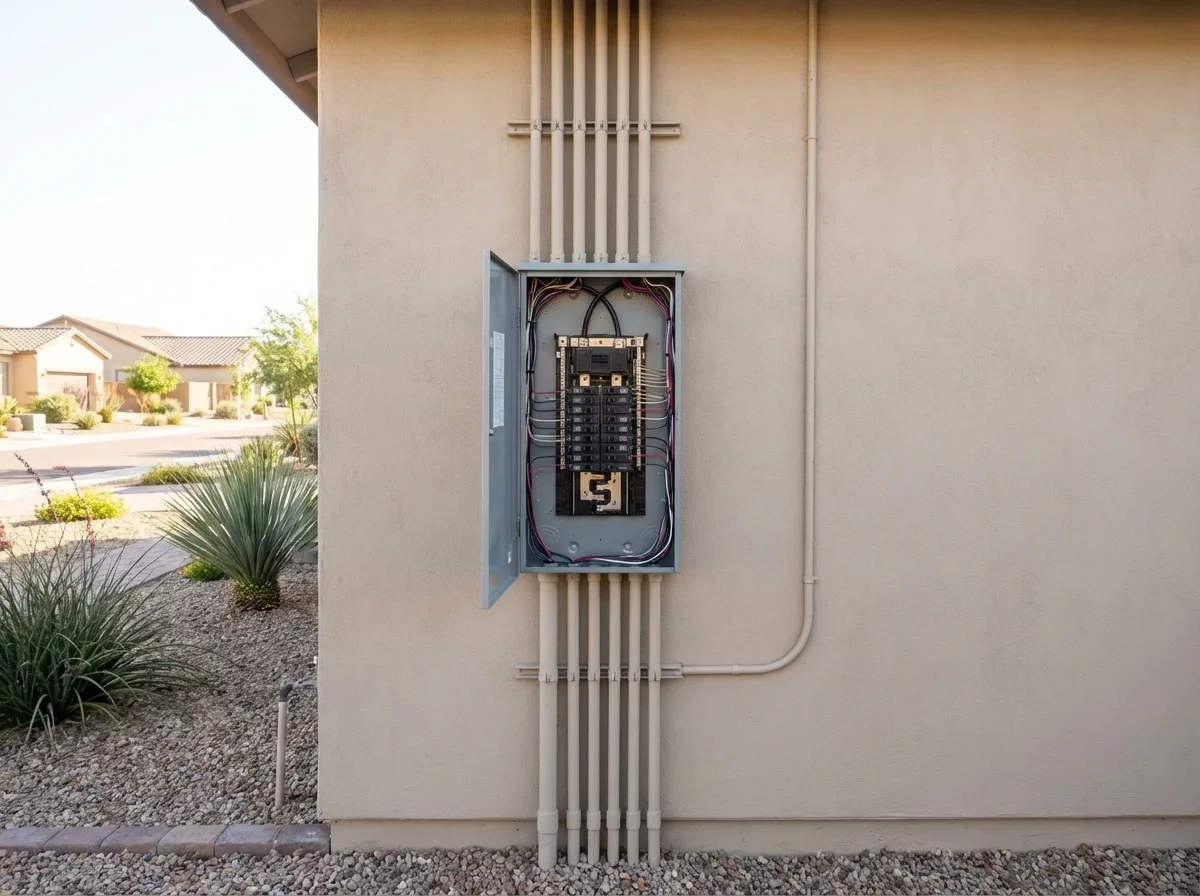
The Sub Panel Installation Process
A licensed electrician can typically complete a sub panel installation in 4-8 hours for straightforward runs, 1-2 days for complex projects. Here's what happens.
Site Assessment and Load Calculation
The electrician evaluates your main panel to confirm it has capacity for the sub panel feeder. If you're installing a 100A sub panel, your main panel needs a 100A breaker slot available — and your total service (usually 200A for modern homes) must support the added load.
They calculate the electrical load for the new space. How many outlets? What appliances? Any 240V equipment? This determines the sub panel amperage. Oversizing costs more upfront but prevents future headaches when you add that welder or EV charger.
Distance and wire route are mapped out. Shortest path isn't always cheapest if it means drilling through structural beams or running conduit across an exposed wall. The electrician identifies the most cost-effective route that meets code.
Permit and Planning
In Tempe, Chandler, and Phoenix, electrical permits are required for sub panel installations. The electrician pulls the permit, submits a plan showing wire size, conduit routing, panel location, and load calculations.
Arizona's extreme temperatures affect wire sizing. Ambient temperature derating means that wire running through a 140°F attic has lower ampacity than the same wire in a 70°F basement. Your electrician factors this into wire gauge selection to prevent overheating.[1]
Approval typically takes 1-3 business days for residential work.
Installation and Inspection
The electrician installs the sub panel at the designated location, mounts it securely, and runs the feeder wire from the main panel. For underground runs, they trench and install conduit before pulling wire.
Bonding and grounding are critical. The sub panel's neutral and ground buses must be separated — unlike the main panel where they're bonded together. This prevents ground loops and ensures safe fault current paths. It's a common DIY mistake that fails inspection every time.
The feeder breaker is installed in the main panel. The sub panel is energized. The electrician tests voltage, checks for proper grounding, verifies all connections are tight.
The city inspector arrives (usually within 2-5 days of scheduling). They verify wire sizing, bonding, grounding, breaker ratings, and conduit installation. If everything passes, you're done. If not, corrections are made and re-inspection scheduled.
✓ Choosing a Contractor
How to Choose a Sub Panel Electrician in Arizona
You need someone who knows Arizona electrical code, understands heat derating requirements, and won't cut corners on grounding in desert soil.
Licensing and Arizona-Specific Requirements
Verify the electrician holds an active Arizona Registrar of Contractors (ROC) license. Residential sub panel work requires a CR-11 (Residential Electrical) or CR-61 (Electrical) license. You can check license status and complaint history on the ROC website.
Arizona has specific code amendments for electrical installations in high-temperature environments. An electrician licensed in another state may not know these requirements. Local experience matters.
Ask about insurance. General liability covers property damage during installation. Workers' comp protects you if someone gets injured on your property. Don't skip this.
Questions to Ask Before Hiring
"What wire type and gauge do you recommend for my run distance?" The answer should reference voltage drop calculations and ambient temperature derating. If they just say "I always use 6-gauge," that's not a good sign.
"How do you handle grounding in desert soil?" Arizona's dry, rocky soil doesn't conduct electricity well. Proper grounding may require multiple ground rods, longer rods, or grounding electrode conductors. They should have a specific plan.
"Do you pull permits and handle inspections?" The right answer is yes. Unpermitted electrical work voids your homeowner's insurance and creates liability when you sell the house.
"What's included in your quote?" Material costs, labor, permit fees, trenching (if needed), inspection fees. Get it itemized. A $900 quote that doesn't include permits or wire isn't really $900.
Red Flags to Avoid
Electricians who suggest skipping the permit to save money. Quotes that seem 40%+ cheaper than others without clear explanation. "I can do it this weekend" from someone who doesn't ask about load requirements or distance.
Vague timelines. A professional electrician books jobs in advance and can give you a specific start date after permit approval.
The best sub panel installations in Surprise, Glendale, and Buckeye come from electricians who've done hundreds of them, know the local inspection requirements, and stand behind their work with warranties. You're comparing professionals in the directory who meet those criteria — focus on experience with your specific application, not just the lowest price.
For projects involving dedicated circuits or pool electrical alongside the sub panel, confirm the electrician has experience integrating multiple systems in the same installation.
Top Contractors for Sub Panel Installation
View all →


Frequently Asked Questions
- Arizona Registrar of Contractors. "Electrical Systems Requirements." https://up.codes/viewer/arizona/irc-2018/chapter/34/electrical-systems. Accessed April 06, 2026.
- City of Phoenix Planning & Development Department. "Electrical Permits." https://www.phoenix.gov/pdd/sites/pdd/files/electrical_permits.pdf. Accessed April 06, 2026.
Estimate Your Sub Panel Installation Cost
Get an instant price range based on your home and project details.