What a ROC C-11 License Actually Means
The Arizona Registrar of Contractors (ROC) issues the C-11 classification for residential electrical contractors. To qualify, the applicant must document four years of practical or management trade experience, with at least two of those years occurring within the last decade.[1]
That experience requirement isn't self-reported. It's verified through employer affidavits, tax records, and work history documentation.
Once the experience check clears, the applicant sits for two exams: the Business Management exam and the Trade exam specific to electrical work.[2] The Trade exam covers National Electrical Code (NEC) requirements, Arizona-specific code amendments, and practical problem-solving scenarios. Passing scores (70% minimum) demonstrate that the contractor knows both the technical side and the regulatory framework that governs residential electrical work in Arizona.
The C-11 license also requires a surety bond, typically $4,000 to $7,000 depending on the scope of work. That bond isn't insurance for the contractor. It's a limited recovery fund you can claim against if the contractor abandons your job, violates state law, or damages your property through negligence.
The bond amount is modest, so it won't cover a catastrophic loss. But it's a baseline protection no unlicensed handyman can offer.
C-11 vs A-11: Residential vs Commercial Classifications
The C-11 classification is residential-only. That means single-family homes, duplexes, and townhomes fall under this license. An A-11 license, by contrast, covers commercial electrical work: office buildings, retail centers, industrial facilities, and multi-family complexes with more than two units.
The distinction matters because commercial work involves different voltage requirements, load calculations, and code compliance standards.
| License Type | Work Scope | Experience Required | Typical Bond Amount |
|---|---|---|---|
| C-11 | Single-family homes, duplexes, townhomes | 4 years (2 recent) | $4,000 - $7,000 |
| A-11 | Commercial buildings, retail, industrial, multi-family (3+ units) | 4 years (2 recent) | $7,000 - $15,000 |
| A-17 | All electrical work (residential + commercial) | 6 years (3 recent) | $15,000+ |
If you're hiring someone for a commercial panel upgrade at your small business, verify they hold an A-11 (or broader A-17) license, not just a C-11. The inverse is also true: a contractor with only an A-11 license isn't licensed for residential work in your home. Verify the exact classification at roc.az.gov before signing any contract.
How to Verify a C-11 License in 60 Seconds
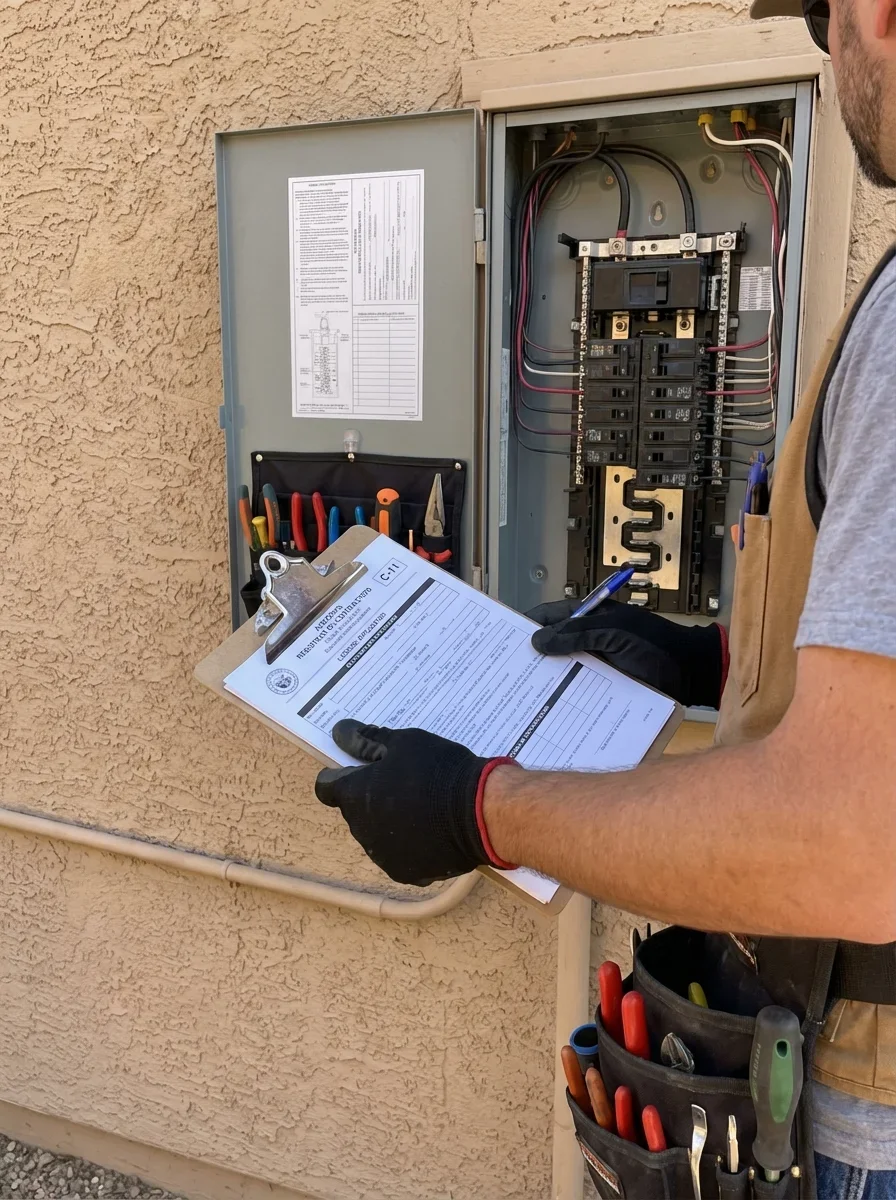
Arizona makes license verification public and instant. Go to roc.az.gov and click "License Lookup" on the homepage. Enter the contractor's business name or ROC number (it's a six-digit identifier, often formatted as ROC######).
The results page shows:
- Current license status (Active, Suspended, Revoked, Expired)
- Classification codes (C-11, A-11, etc.)
- Bond expiration date
- Complaint history and disciplinary actions
- Qualifying party name (the individual who passed the exams)
Check all three critical fields: active status, correct classification, and a valid bond. An expired bond means the contractor is operating illegally, even if the license itself shows "Active." If the bond expired more than 30 days ago, walk away.
You have zero recovery protection if the job goes sideways.
Also scan the complaint history. A single closed complaint from years ago isn't a red flag. Disputes happen. But multiple unresolved complaints, recent disciplinary actions, or a pattern of bond claims suggest chronic problems. Cross-reference that data with online reviews and references before hiring.
What the C-11 License Doesn't Cover
Arizona's ROC license is a floor, not a ceiling. It confirms minimum competency and regulatory compliance, but it doesn't guarantee technical skill, customer service, or fair pricing.
You still need to vet contractors on project-specific criteria. Have they installed EV chargers in homes with 100-amp panels before? Do they pull permits for sub-panel installations? Can they explain the load calculation for adding a hot tub circuit?
The C-11 license also doesn't require workers' compensation insurance. Arizona is one of the few states where contractors can legally operate without workers' comp coverage. That's a massive liability risk for you. If an unlicensed employee gets hurt on your property, you could be sued directly for medical costs and lost wages.
Always verify general liability insurance and ask for proof of workers' comp. Or get written confirmation that all workers on your job are covered under the contractor's policy or are properly classified as independent contractors with their own coverage.
Permits and Inspections Are Still Required
Holding a C-11 license doesn't exempt a contractor from permit requirements. Any electrical work beyond basic repairs requires a permit from your local building department. That includes panel upgrades, whole house rewiring, and pool electrical installations.
The contractor should pull that permit under their ROC number, schedule inspections, and close it out with a signed-off final inspection.
Unpermitted work creates two problems. First, it voids most homeowners insurance policies if a fire or injury occurs due to faulty electrical work. Second, it complicates home sales. Buyers' lenders and inspectors flag unpermitted electrical upgrades, and you'll pay to bring everything up to code retroactively, often at 2-3x the original cost.
If a contractor suggests skipping permits to "save time" or avoid fees, find someone else. Licensed contractors know permit compliance is non-negotiable.
Why Experience Requirements Matter in Arizona's Climate
Arizona's electrical challenges are different from Minnesota's or Florida's. Extreme heat (Phoenix regularly hits 115°F in July) accelerates insulation degradation on outdoor wiring, pool pump motors, and AC disconnect boxes. UV exposure breaks down wire jacketing faster than in humid climates.
Those four years of required experience should include hands-on work in desert conditions, not just classroom theory.
The caliche soil common across the Phoenix metro also affects electrical installations. When trenching for underground service to a detached garage or pool equipment, contractors hit caliche hardpan at 1-6 feet depth. Cutting through it requires specialized equipment and experience, something a newly licensed contractor from out of state might not anticipate.
An experienced Arizona electrician knows to factor caliche into bids and timelines for exterior outlet installations and landscape lighting runs.
Hard Water and Electrical Systems
Arizona's extremely hard water (300+ ppm calcium carbonate) doesn't directly damage wiring, but it correlates with plumbing corrosion that affects electrical work. When copper supply lines leak inside walls (common in pre-2000 Phoenix homes), water seeps into junction boxes, corrodes connections, and trips breakers.
A C-11 contractor who's worked in Arizona for years recognizes moisture intrusion patterns. They know to inspect nearby plumbing when diagnosing partial power outages or outlet sparking.
Similarly, evaporative coolers (still used in some older neighborhoods) require dedicated 120V circuits and annual maintenance. Contractors unfamiliar with swamp cooler electrical systems may misdiagnose pump failures or incorrectly wire replacement units.
Local experience matters.
Red Flags That Trump a Valid License
A current C-11 license is necessary but not sufficient. Watch for these warning signs that override an active ROC number:
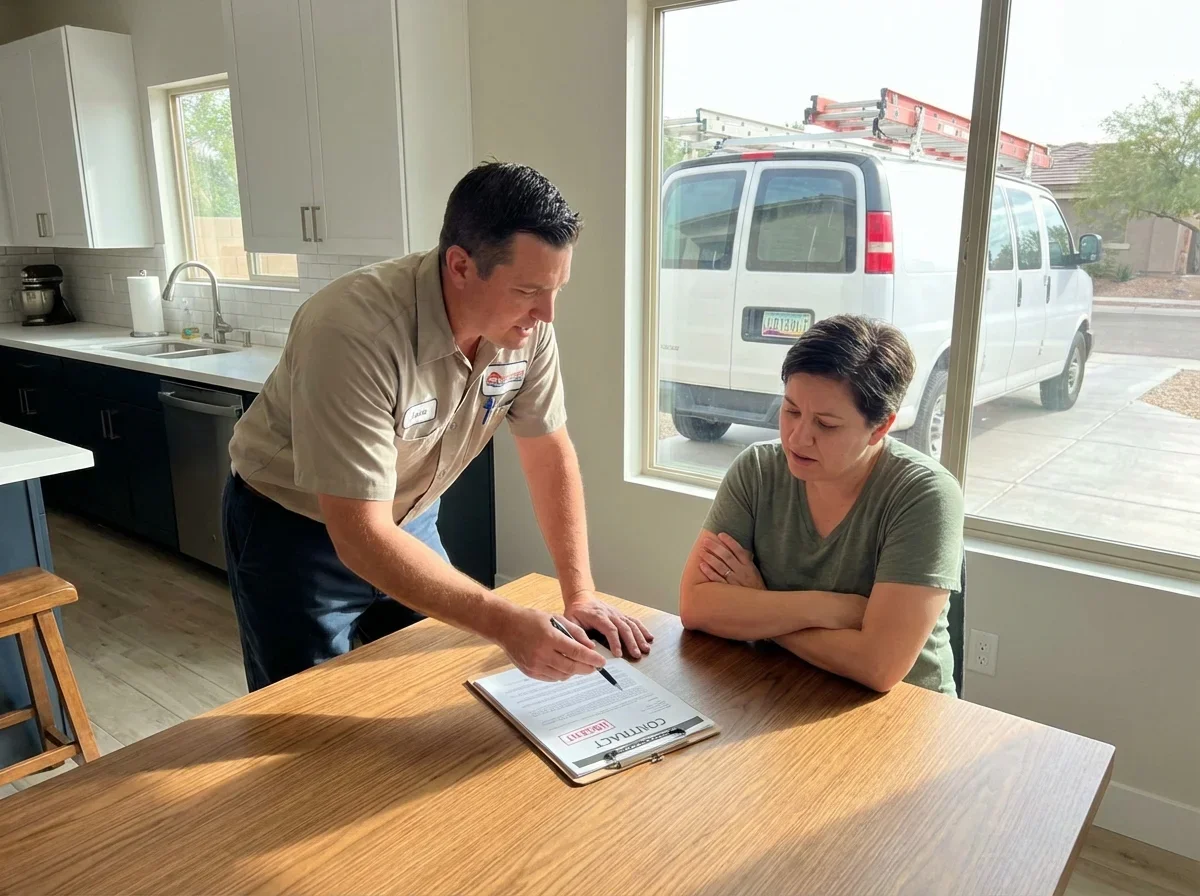
Pressure to sign same-day contracts. Legitimate contractors provide written estimates, allow time for review, and don't manufacture urgency. If someone shows up for a simple quote and pivots to "I can start today if you sign now," that's a sales tactic, not professionalism.
Requests for full payment upfront. Arizona law caps upfront deposits at one-third of the contract value or $1,000, whichever is less for home improvement contracts.[4] Anyone demanding 50% or 100% down is either cash-strapped or planning to ghost your job.
Pay in milestones: deposit, materials delivered, rough-in inspection passed, final completion.
No physical business address. Check the ROC record for the contractor's registered address. If it's a UPS Store mailbox or a residential address in another state, dig deeper. Arizona-based contractors should have a local business presence: an office, a warehouse, a shop. Post-COVID remote work is normal, but a contractor who can't provide a verifiable business location raises questions about permanence and accountability.
Unwillingness to provide references. Any contractor who's completed kitchen electrical remodels or whole house generator installations in the last year should have 3-5 happy clients willing to take a quick phone call.
If the contractor deflects, offers only online reviews, or provides references that feel staged, keep looking.
Pro Tip: Arizona law protects you with a deposit cap of one-third or $1,000 (whichever is less). Any contractor demanding more upfront is either financially unstable or planning to disappear. Payment milestones tied to inspection approvals protect both parties.
The Qualifying Party vs the Crew on Your Job
Every ROC license lists a qualifying party, the individual who passed the exams and whose experience qualified the license. That person's name appears on the public lookup.
Here's what most homeowners miss: the qualifying party doesn't have to be on your job site. Ever.
Arizona allows the qualifying party to supervise multiple jobs remotely. The electrician who shows up to install your recessed lighting might be a helper with six months of experience, not the master electrician whose name is on the truck. That's legal, but it's worth asking during the estimate: "Will you or someone from your team with a journeyman license be on-site, and how often will the qualifying party review the work?"
For simple jobs (replacing a dimmer switch or installing a bathroom exhaust fan), crew experience matters less. For complex projects (aluminum wiring replacement, sub-panel installations, or smart home wiring), you want someone with 10+ years in the trade, not a newly minted apprentice working off sketchy YouTube tutorials.
When You Need More Than a C-11 License
Certain electrical projects require additional credentials beyond the base C-11 classification:
Solar installations. If you're adding rooftop solar panels, verify the contractor holds a C-11 license and has documented solar installation experience. The interconnection between your solar inverter and the utility grid involves specialized equipment, utility approval, and net metering agreements.
A general residential electrician can legally do the work. But someone who's completed 50+ solar installs will navigate permitting and inspections more smoothly than someone doing their third project.
Commercial tenant improvements. If you own a small business in a strip mall and need electrical work, you need an A-11 or A-17 license, not a C-11. The voltage, load requirements, and code sections are different. Don't let a residential contractor talk you into "just handling it." If the work fails inspection, you'll pay twice.
Low-voltage systems. Data cabling, security cameras, and home theater wiring fall into a regulatory gray area. Some low-voltage work doesn't require an electrical license at all, but the contractor should still carry insurance and pull permits for in-wall runs that penetrate fire-rated assemblies.
Ask whether the contractor is familiar with NEC Article 800 (communications circuits) and local amendments for structured wiring.
How Arizona's Licensing Compares to Other States
Arizona's ROC system is more stringent than many states. Texas, for example, doesn't require state-level electrical licensing, only local permits. California has a more fragmented system with C-10 (general electrical) classifications but less centralized oversight.
Arizona's single state database, mandatory bonding, and public complaint history give you better transparency than most other jurisdictions.
That said, Arizona's $4,000-$7,000 bond cap is lower than neighboring states. Nevada requires $15,000 bonds for similar classifications. If a contractor damages your home or abandons a $20,000 panel upgrade, that bond won't make you whole.
This is why general liability insurance is critical. Verify coverage limits of at least $500,000 per occurrence, and ask for a current certificate of insurance naming you as an additional insured for the duration of the project.
Why "Licensed, Bonded, and Insured" Isn't Enough
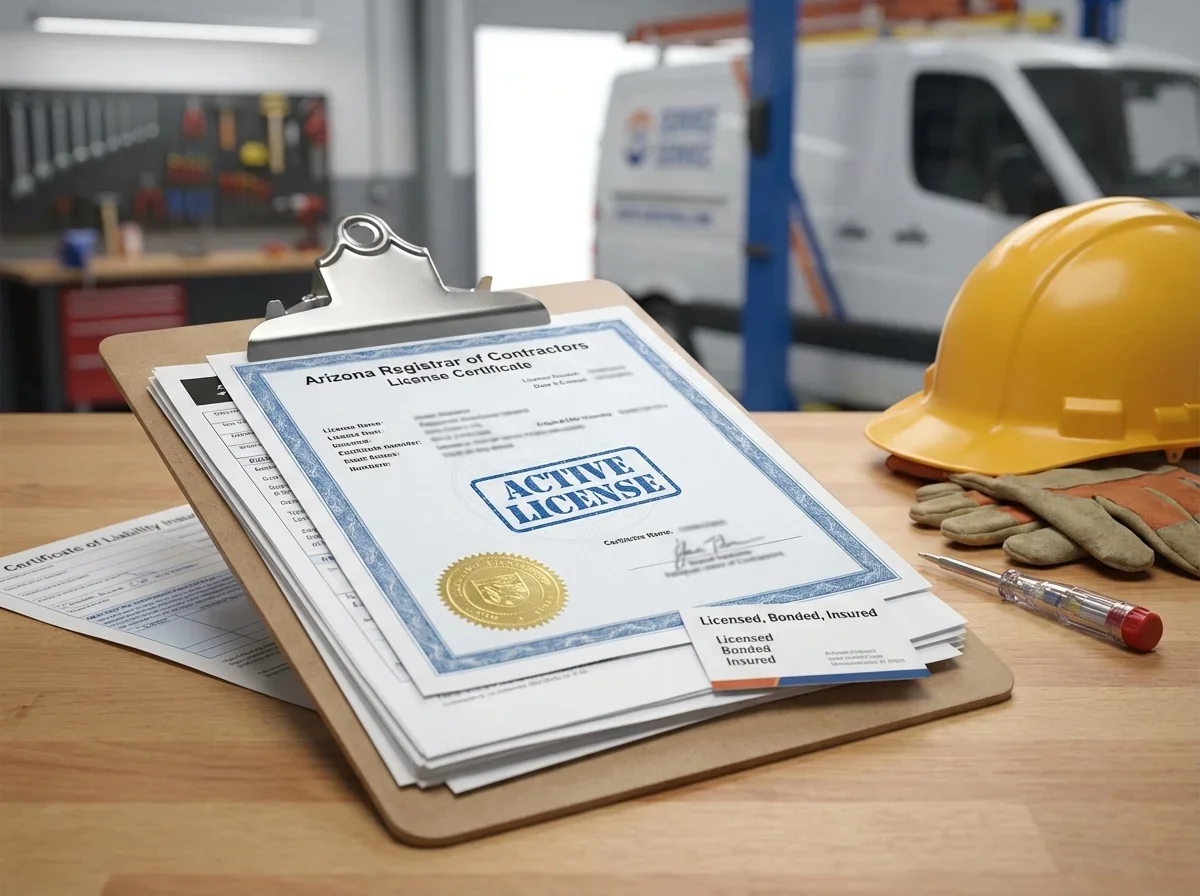
You'll see that phrase on every contractor website, truck wrap, and door hanger. It's table stakes, not a selling point.
Essential Verification Checklist:
- Active ROC license with correct classification (C-11 for residential)
- Current bond with expiration date at least 60 days out
- General liability insurance ($500,000+ per occurrence)
- Workers' compensation coverage or written exemption
- Permit-pulling history in your city (last 12 months)
- First-submission inspection pass rate
- Complaint history review on ROC database
Top-rated contractors like those listed in our Phoenix electrician directory will provide all this documentation upfront, usually in a welcome packet or attached to the written estimate.
If you have to chase down proof of insurance or bond status, that's a sign of disorganization that will likely show up in project execution too.
Using the ROC License as a Baseline, Not a Proxy for Quality
The C-11 license confirms the contractor can legally operate in Arizona. It doesn't confirm they're fast, communicative, or good at solving unusual problems.
Treat the license check as step one in a broader vetting process:
- Verify active C-11 license and bond at roc.az.gov
- Confirm insurance coverage and workers' comp status
- Check complaint history on the ROC database
- Read online reviews on Google, Yelp, and industry-specific sites
- Ask for references from recent projects similar to yours
- Get 2-3 written estimates and compare scope, timeline, and warranty terms
- Verify the contractor will pull permits and schedule inspections
For high-stakes projects (electrical panel upgrades in homes built before 1980, whole house rewiring in homes with aluminum wiring, or pool electrical installations in backyards with caliche soil), ask about project-specific experience.
How many similar jobs has this contractor completed? Can they walk you through the load calculation for adding a second AC unit? Do they have a preferred inspector relationship that speeds up permitting?
The ROC license is your foundation. Everything else is the structure you build on top of it.
What to Do If a Licensed Contractor Fails You
If a C-11 contractor abandons your job, performs substandard work, or violates contract terms, you have three recovery paths:
File a complaint with the ROC. Go to roc.az.gov and submit a formal complaint. The ROC investigates, and if they find violations, they can suspend the contractor's license, impose fines, or facilitate mediation.
Complaints are public record. They show up on future license lookups and warn other homeowners.
Claim against the bond. If the contractor's actions caused financial harm (you paid for work that wasn't completed, or you paid to fix code violations they created), you can file a claim against their surety bond. The process involves documentation (contracts, photos, repair invoices) and may take 60-90 days.
The bond amount caps your recovery, but it's a no-cost option.
Small claims or civil court. For damages exceeding the bond amount, you'll need to sue. Arizona small claims court handles disputes up to $3,500 with minimal legal fees. For larger claims, consult an attorney. If the contractor's general liability insurance applies, that's often a faster recovery path than litigation.
Start with the ROC complaint. Even if you pursue other remedies, documenting the issue with the state creates a paper trail and may pressure the contractor to settle rather than risk license suspension.
Practical Next Steps
Before you call any electrician for emergency electrical service, troubleshooting, or a planned upgrade:
- Verify their C-11 license at roc.az.gov. Takes 60 seconds, saves potential headaches.
- Ask for proof of insurance (general liability and workers' comp). Don't accept "we're insured" as an answer. Request a certificate.
- Confirm permit requirements for your specific project. If the contractor says "you don't need a permit," double-check with your city's building department.
- Get everything in writing (scope, timeline, payment schedule, warranty terms, and cleanup responsibilities).
- Check references from jobs completed in the last six months, ideally in homes similar to yours (age, size, electrical system type).
The ROC C-11 license is your proof that the contractor meets Arizona's minimum standards for residential electrical work. It's not a guarantee of quality, speed, or customer service, but it's the non-negotiable baseline that separates professionals from handymen working out of a pickup truck.
Start there, and build your vetting process on top of that foundation.
- Arizona Legislature. "32-1122 - Qualifications for license." https://www.azleg.gov/ars/32/01122.htm. Accessed April 06, 2026.
- Arizona Registrar of Contractors. "Arizona License Classification Requirements." https://contractorsexam.com/wp-content/uploads/2020/03/ArizonaLicenseClassificationRequirements2019.pdf. Accessed April 06, 2026.
- Arizona Registrar of Contractors. "ARIZONA REGISTRAR OF CONTRACTORS A-17 ELECTRICAL AND TRANSMISSION LINES (COMMERCIAL)." https://proctor2.psionline.com/media/programs/AZ%20CO/A-17.pdf. Accessed April 06, 2026.
- Arizona Registrar of Contractors. "Who needs an Arizona contractor license?." https://roc.az.gov/. Accessed April 06, 2026.