What the Arizona ROC C-11 Electrical License Actually Covers
The C-11 Electrical (Commercial) license allows contractors to install, alter, and repair wiring and electrical equipment used in generating, transmitting, or utilizing electrical energy under 600 volts.[1] That voltage threshold covers almost every residential and light commercial application you'll encounter — panel upgrades, circuit installations, EV chargers, pool and spa electrical, lighting systems, and whole-home rewiring.
The license also authorizes overhead wiring on public rights-of-way for signs and street decorations, plus underground electrical systems serving private properties.[1] If you're installing landscape lighting that runs underground from your panel to your backyard, or wiring an outdoor structure like a detached garage, the contractor needs a valid C-11 (or dual CR-11) license.
What it doesn't cover: work over 600 volts (industrial high-voltage systems) or certain specialized utility installations.
For residential projects, the C-11 scope is comprehensive.
C-11 vs R-11 vs CR-11: Why the Distinction Matters

Arizona separates electrical licenses into commercial (C-11), residential (R-11), and dual (CR-11). The C-11 covers commercial-grade electrical work, which includes most home electrical systems since the technical standards and voltage ranges overlap. The R-11 is restricted to residential properties only.
The CR-11 Dual Electrical license grants the full scope of both C-11 and R-11 classifications, making it the most versatile option for contractors who work across property types.[4] But even a dual license has limits. Certain utility work in public rights-of-way may require additional credentials or coordination with the local utility provider.
When you're hiring for a home project, a contractor with either a C-11 or CR-11 license is fully qualified. An R-11 license works too, but you lose the option to hire that same contractor for any future commercial property needs (rental units, small offices, mixed-use buildings).
If you're comparing bids, ask which classification each contractor holds and verify it at roc.az.gov.
| License Type | Scope | Best For | Limitations |
|---|---|---|---|
| C-11 (Commercial) | Commercial electrical work under 600V, includes residential | Contractors working across property types | Cannot perform residential-only specialized work requiring R-11 |
| R-11 (Residential) | Residential properties only | Dedicated home electricians | No commercial properties, rental units, or mixed-use buildings |
| CR-11 (Dual) | Full scope of both C-11 and R-11 | Maximum versatility across all project types | Higher qualification requirements |
Experience and Testing Requirements Behind the License
To qualify for a C-11 license, the applicant must document a minimum of four years of verifiable electrical experience and pass both the Business Management Exam (B) and the Trade Exam (T).[3] The trade exam is no formality. It consists of 110 questions with a 70% passing score and a 240-minute time limit.[2]
Applicants can choose between the NASCLA Accredited Trade Examination for Electrical Contractors or the AZ ROC Electrical (Commercial) exam.[2] Both test code knowledge, electrical theory, load calculations, and real-world installation scenarios. Passing requires fluency in the National Electrical Code (NEC), Arizona amendments, and local building authority requirements.
The four-year experience requirement is documented through affidavits from previous employers or supervising electricians.
This isn't college credit or general construction time. It's hands-on electrical work, and the ROC audits these claims during the application process.
Why the Qualifying Party Designation Matters
Every ROC license is tied to a "qualifying party" — the individual whose experience, exam scores, and credentials back the company's license. If that person leaves the company, the license becomes invalid until a new qualifier is approved.
This is why you should always check the Arizona Registrar of Contractors' public database before signing a contract. A license that was valid six months ago may not be valid today.[5]
The qualifying party is legally responsible for all work performed under that license. If the work doesn't meet code, causes a fire, or injures someone, the qualifier's credentials are on the line. Good contractors take this seriously. Fly-by-night operators rotate qualifying parties or operate under expired licenses and hope no one checks.
Bonding and Insurance Requirements (and Their Limits)
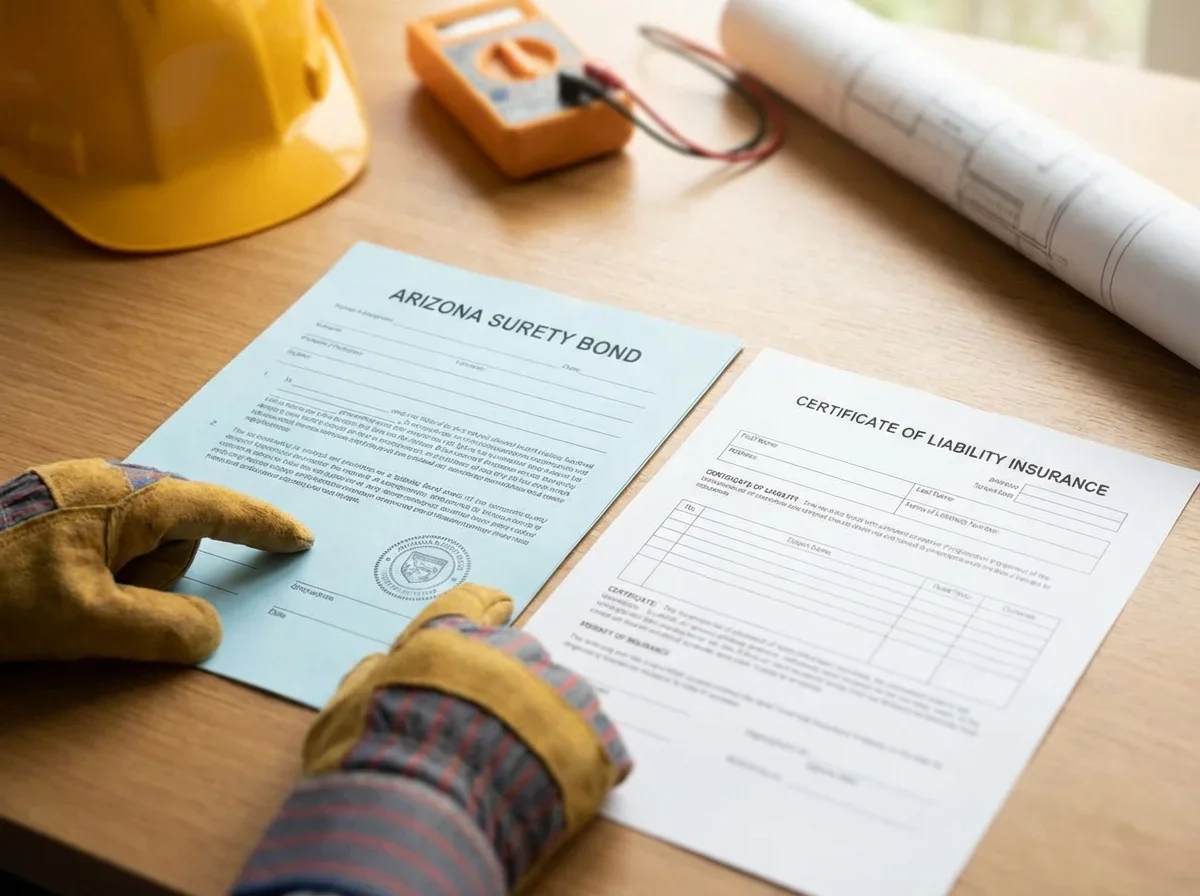
Arizona requires C-11 contractors to carry a surety bond, but the amounts are modest — typically between $4,000 and $15,000 depending on the license type and scope. That bond is not insurance. It's a financial guarantee that the contractor will comply with ROC regulations, pay subcontractors, and correct defective work.
But if your $30,000 panel upgrade burns your house down, a $7,500 bond won't come close to covering the damages.
This is why verifying general liability insurance independently is critical. Arizona doesn't require contractors to carry workers' compensation insurance unless they have employees, and even then enforcement is inconsistent. If an unlicensed worker gets hurt on your property and the contractor has no workers' comp, you could be liable for medical costs and lost wages.
Before hiring anyone for electrical panel upgrades, whole house rewiring, or EV charger installations, ask for a certificate of insurance showing general liability coverage of at least $1 million.
If the contractor balks, move on.
Pro Tip: The ROC bond ($4,000-$15,000) only covers regulatory compliance and contract disputes — not property damage or injuries. Always verify the contractor carries at least $1 million in general liability insurance before work begins. If they can't produce a certificate of insurance within 24 hours, that's your red flag.
How to Verify a C-11 License in 90 Seconds
The Arizona Registrar of Contractors maintains a public contractor search database where you can verify any C-11 license by company name, license number, or qualifying party.[5] The lookup shows license status (active, suspended, expired), qualifying party information, bond status, and any disciplinary actions or complaints.
Run this search before you sign anything.
Expired licenses, pending complaints, and bonding lapses all show up in real time. If the contractor gives you a license number that doesn't match the company name, or if the qualifying party listed isn't the person you've been talking to, ask why.
You can also verify that the license classification matches the scope of your project. If you're hiring for commercial electrical contracting or fire alarm wiring, confirm the contractor holds a C-11 (or CR-11) and not just an R-11 residential license.
Why Arizona's Licensing System Matters More Here Than Elsewhere
Arizona's construction environment creates unique risks that make licensing verification especially important. Slab-on-grade construction is standard across the Phoenix metro, which means electrical conduits and junction boxes are often embedded in concrete where mistakes are expensive to fix. Desert UV exposure degrades wire insulation and outdoor electrical components faster than in humid climates. And hard water (300+ ppm calcium carbonate) accelerates corrosion in copper grounding systems and metal conduit.
Pool and spa electrical is a major category in Arizona due to high pool ownership, and it requires specialized knowledge of wet-location wiring, GFCI protection, and bonding grids.
A contractor who's licensed but inexperienced with pool systems can create life-threatening electrical hazards. The C-11 license doesn't guarantee pool expertise — it guarantees baseline code knowledge and accountability. You still need to ask about specific experience with pool and spa electrical before hiring.
Caliche Soil and Grounding Challenges
Caliche — a hardpan layer of calcium carbonate common in Arizona soil — complicates grounding electrode installations. The NEC requires grounding rods to achieve a specific resistance to earth, but caliche's poor conductivity often means contractors need to drive multiple rods, use concrete-encased electrodes, or install ground rings.
Unlicensed workers routinely skip these steps or fake the installation because they don't understand the code or the geology.
A C-11 contractor knows how to test soil resistance and install compliant grounding systems in caliche conditions. That's not glamorous work, but it's the difference between a safe electrical system and one that won't protect you during a lightning strike or fault condition.
Red Flags That Mean "Don't Hire This Contractor"
No ROC license number on the estimate, business card, or truck. In Arizona, any contractor performing work over $1,000 must hold an active ROC license.
If they're advertising electrical services without a license, they're breaking the law.
Pressure to skip permits. Licensed contractors pull permits because they know inspectors will catch code violations. Unlicensed workers avoid permits because they can't pass inspection. If someone suggests you save money by skipping the permit for a sub panel installation or whole house generator, you're talking to someone who doesn't plan to meet code.
Cash-only pricing or requests for large upfront deposits. Arizona law caps deposits at one-third of the total contract price or $1,000, whichever is less, for contracts under $10,000.
If someone wants 50% down or insists on cash to "avoid taxes," you're looking at either an unlicensed operator or someone planning to disappear.
Vague answers about insurance. A licensed contractor will provide a certificate of insurance without hesitation. If you get runaround answers like "we're covered through the office" or "I'm bonded, that's the same thing," end the conversation.
Red Flags Checklist — Walk Away If You See:
- No ROC license number displayed on estimates, cards, or vehicle
- Pressure to skip permits "to save money"
- Deposit requests exceeding 1/3 of contract price or $1,000 (whichever is less)
- Cash-only payment demands or requests to "avoid taxes"
- Vague or evasive answers about insurance coverage
- Qualifying party name doesn't match the person you've been communicating with
- License lookup shows expired, suspended, or complaint history
What Happens When You Hire an Unlicensed Electrician
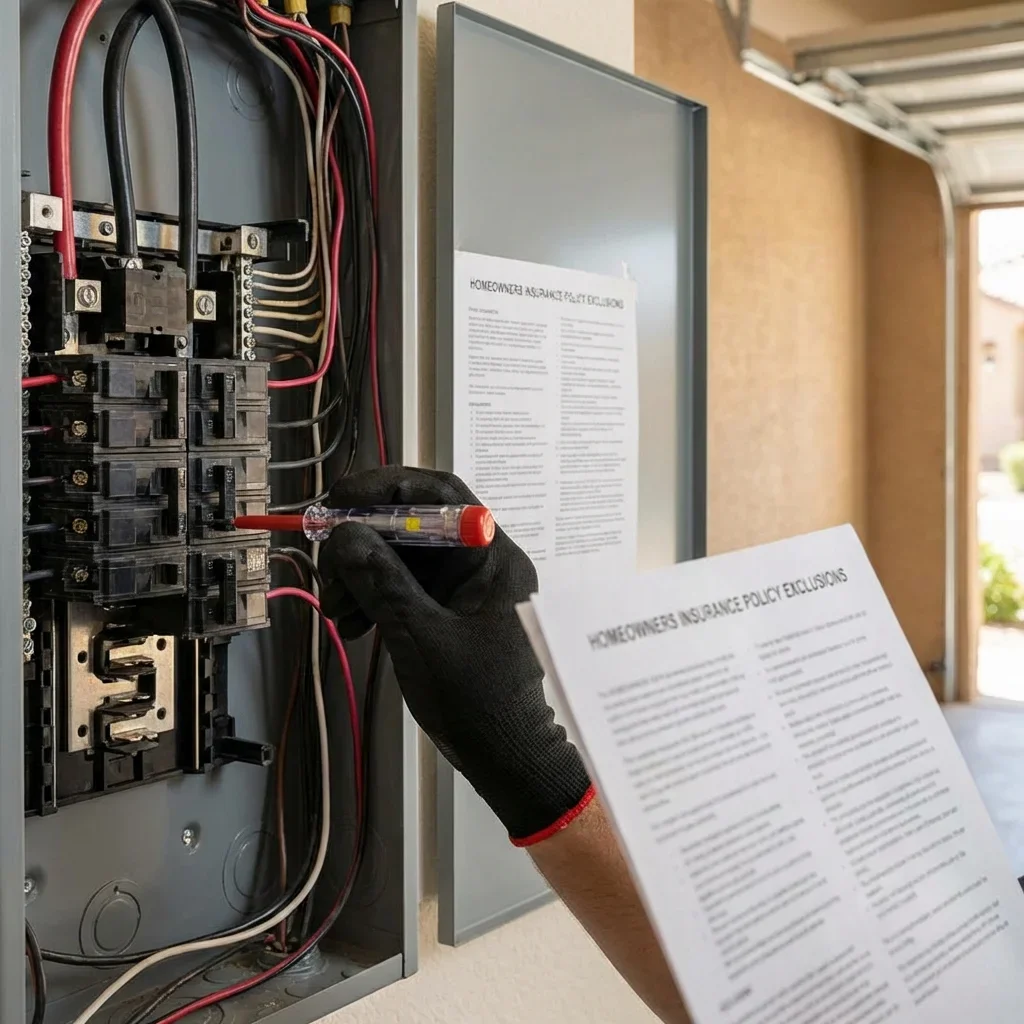
Unlicensed electrical work voids most homeowners insurance policies. If a fire starts from faulty wiring installed by an unlicensed worker, your insurer can deny the claim. You're also personally liable for any injuries that occur during the work or as a result of code violations.
Selling your home becomes complicated. Title companies and buyers' lenders often require documentation that all electrical work was permitted and performed by licensed contractors.
If you can't produce permits and sign-offs for major work like whole house rewiring or a panel upgrade, you may need to hire a licensed electrician to inspect, certify, or redo the work before closing.
You lose access to the ROC complaint process. If a licensed contractor does substandard work, you can file a complaint with the Arizona Registrar of Contractors, which has enforcement authority to suspend licenses, require corrections, and award damages. If your electrician isn't licensed, your only recourse is small claims court.
And good luck collecting from someone who operates outside the system.
When to Insist on a C-11 License (Not Just Any License)
For most residential work, a CR-11 dual license or an R-11 residential license will suffice. But certain projects benefit from hiring a contractor with commercial-grade experience.
Panel upgrades from 100A to 200A or 400A service often require coordination with the utility company and knowledge of commercial service entrance equipment, even when the building is residential. A C-11 contractor who regularly works on commercial projects will navigate utility requirements and code upgrades more smoothly than a residential-only electrician.
Large-scale lighting projects like whole-property landscape lighting or parking lot lighting for a home business fall into the C-11's overhead and underground wiring scope.[1]
If you're installing pathway lighting that runs across 5,000 square feet of property with multiple circuits and low-voltage transformers, a C-11 contractor brings experience with load planning and voltage drop calculations that smaller projects don't require.
Commercial property conversions are another area where the C-11 makes sense. Turning a detached garage into a home office or ADU, wiring a shop building with 240V circuits for equipment, installing three-phase power for a home-based business — these projects blur the residential/commercial line and benefit from a contractor who holds both classifications.
What the License Doesn't Guarantee (and What You Still Need to Verify)
A C-11 license proves the contractor passed exams, documented experience, and posted a bond. It doesn't prove they're good at customer service, punctual, or skilled at the specific type of work you need done.
You still need to ask for references, check online reviews, and verify that the contractor has recent experience with your project type.
If you're hiring for smart home wiring, EV charger installation, or surge protection systems, ask how many similar installations the contractor has completed in the past year. Licensing establishes a floor of competence, not a ceiling of expertise.
And remember: the ROC bond is a regulatory tool, not a consumer protection fund. If your contractor goes bankrupt or disappears mid-project, the bond may not cover your losses.
This is why payment terms matter. Never pay in full upfront, and tie progress payments to completed milestones, not calendar dates.
Verifying Credentials Is Your Responsibility, Not the Contractor's
Arizona law requires contractors to display their ROC license number on all advertising, business cards, estimates, and contracts. But enforcement is inconsistent, and unlicensed operators routinely ignore the rule. The ROC investigates complaints, but it's a small agency covering a state with over 60,000 active contractor licenses.
You can't assume everyone advertising electrical services in Phoenix or Scottsdale holds a valid license.
You can't trust that a contractor who worked legally five years ago is still licensed today. You need to verify credentials yourself using the ROC contractor search tool before you sign anything or hand over a deposit.
If you're comparing multiple bids for work like kitchen remodel electrical or dedicated circuit installation, verify each contractor's license during the bidding phase. Don't wait until you've chosen someone and scheduled a start date.
By then, you've wasted time on someone who may not be legally qualified to do the work.
- Arizona Registrar of Contractors. "License Classifications." https://roc.az.gov/license-class. Accessed April 07, 2026.
- Arizona Registrar of Contractors / PSI Services. "Electrical (Commercial) Candidate Information Bulletin." https://proctor2.psionline.com/programs/AZ%20CO/L-11.pdf. Accessed April 07, 2026.
- Arizona Registrar of Contractors. "Arizona License Classification Requirements." https://roc.az.gov/sites/default/files/license_class.pdf. Accessed April 07, 2026.
- Arizona Registrar of Contractors (referenced in City of Chandler document). "Acceptable License Classifications." https://roc.az.gov/license-class. Accessed April 07, 2026.
- Arizona Registrar of Contractors. "Contractor Search." https://roc.az.gov/contractor-search. Accessed April 07, 2026.